


President Tsai Ing-wen (蔡英文) yesterday called on like-minded nations to stand together and take action against anti-democratic forces that have put democracy at the risk of regression, while vowing that Taiwan would never move backward.
“Historical trends do not always favor the forward march of democracy, but in Taiwan, moving backward is not an option,” Tsai said at a Taipei forum titled “Global Solidarity of Democracy in Taiwan” hosted by the Taiwan Foundation for Democracy.
The forum, attended by guests from pro-democracy organizations in countries including Tunisia, India, Japan, South Korea and the US, was held to mark the 15th anniversary of the government-funded foundation.
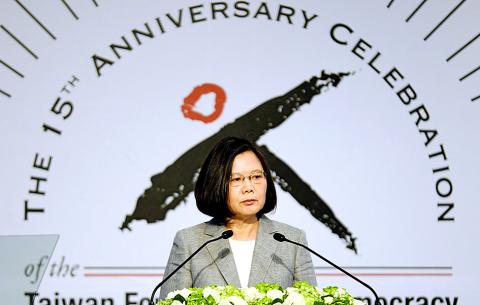
Photo: Liao Chen-huei, Taipei Times
Tsai said the gathering of so many long-time democracy advocates is not just a celebration, but also a timely opportunity to reflect on the past, present and future of democracy.
“In the 21st century, democracy is in retreat,” said Tsai, citing a report by Freedom that said this year marks the 12th consecutive year of decline in global freedom.
Tsai cited another report by the National Endowment for Democracy, funded largely by the US Congress, which examines how China and Russia use “sharp power” to project their influence.
The report says that “authoritarian regimes are exercising sharp power to take advantage of our free and open societies, promote alternative agendas, control and censor information, and undermine our democracies,” Tsai said.
Taiwan is on the frontline of a battle that is taking place here, in Australia, the US, Europe and in like-minded countries all over the world, she said.
“Over the past two years, we have faced increasing pressure from China as they threaten our democratic way of life and limit our international space,” she said.
These anti-democratic forces will proliferate if like-minded countries do not stand and act together, she said.
“It is only if like-minded countries work together — and stand together — that we can fight against unwanted economic, political or military coercion, and defend the values we hold dear,” she added.
Tsai made similar remarks in an interview with Agence France-Presse yesterday.
In the interview, she called on the international community to “constrain” China by standing up for freedoms, and urged other nations to unite with Taiwan in defending against Beijing’s expansionist aims and to protect shared liberal values.
“This is not just Taiwan’s challenge, it is a challenge for the region and the world as a whole, because today it’s Taiwan, but tomorrow it may be any other country that will have to face the expansion of China’s influence,” Tsai said. “Their democracy, freedom and freedom to do business will one day be affected by China.”
“We need to work together to reaffirm our values of democracy and freedom in order to constrain China and also minimize the expansion of their hegemonic influence,” she added.
She added that Taiwan had seen growing support from the US.
The warming relationship comes as Taiwan tries to boost its homegrown defense force.
“In the face of China’s threats we feel the need for us to improve self-defense capabilities,” she said.
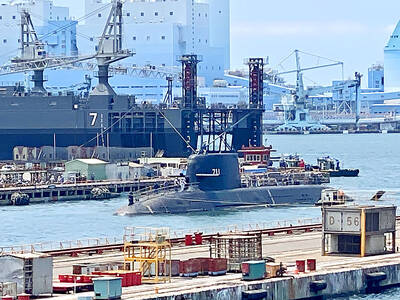
AGING: While Japan has 22 submarines, Taiwan only operates four, two of which were commissioned by the US in 1945 and 1946, and transferred to Taiwan in 1973 Taiwan would need at least 12 submarines to reach modern fleet capabilities, CSBC Corp, Taiwan chairman Chen Cheng-hung (陳政宏) said in an interview broadcast on Friday, citing a US assessment. CSBC is testing the nation’s first indigenous defense submarine, the Hai Kun (海鯤, Narwhal), which is scheduled to be delivered to the navy next month or in July. The Hai Kun has completed torpedo-firing tests and is scheduled to undergo overnight sea trials, Chen said on an SET TV military affairs program. Taiwan would require at least 12 submarines to establish a modern submarine force after assessing the nation’s operational environment and defense

A white king snake that frightened passengers and caused a stir on a Taipei MRT train on Friday evening has been claimed by its owner, who would be fined, Taipei Rapid Transit Corp (TRTC) said yesterday. A person on Threads posted that he thought he was lucky to find an empty row of seats on Friday after boarding a train on the Bannan (Blue) Line, only to spot a white snake with black stripes after sitting down. Startled, he jumped up, he wrote, describing the encounter as “terrifying.” “Taipei’s rat control plan: Release snakes on the metro,” one person wrote in reply, referring
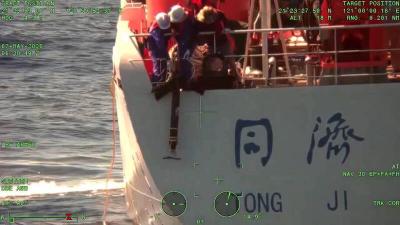
The coast guard today said that it had disrupted "illegal" operations by a Chinese research ship in waters close to the nation and driven it away, part of what Taipei sees a provocative pattern of China's stepped up maritime activities. The coast guard said that it on Thursday last week detected the Chinese ship Tongji (同濟號), which was commissioned only last year, 29 nautical miles (54km) southeast of the southern tip of Taiwan, although just outside restricted waters. The ship was observed lowering ropes into the water, suspected to be the deployment of scientific instruments for "illegal" survey operations, and the coast
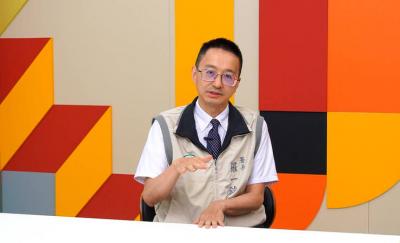
Taiwan’s two cases of hantavirus so far this year are on par with previous years’ case numbers, and the government is coordinating rat extermination work, so there should not be any outbreaks, Centers for Disease Control (CDC) Director-General Philip Lo (羅一鈞) said today in an interview with the Liberty Times (the Taipei Times’ sister newspaper). An increase in rat sightings in Taipei and New Taipei City has raised concerns about the spread of hantavirus, as rats can carry the disease. In January, a man in his 70s who lived in Taipei’s Daan District (大安) tested positive posthumously for hantavirus, Taiwan’s


 RSS
RSS