


The Philippines is positioning itself as Taiwan’s “gateway” to Southeast Asia and hopes to spur two-way economic and educational exchanges with Taiwan, Manila Economic and Cultural Office in Taipei (MECO) director for commercial affairs Michael Alfred Ignacio said.
Ignacio said he has seen “very strong interest” from the Taiwanese government in advancing its New Southbound Policy and Taiwan was the second-largest source of foreign direct investment (FDI) in the Philippines last year.
The southbound policy, adopted in May 2016, aims to forge links with ASEAN members, as well as South Asian nations, Australia and New Zealand.
Taiwanese FDI in the Philippines last year was 10.833 billion pesos (US$203.12 million at the current exchange rate), about a sevenfold increase from 1.608 billion pesos in 2016 and double the amount that Taiwan invested in 2015, Philippine Statistics Authority (PSA) data showed.
“We want to become Taiwan’s gateway to Southeast Asia and New Southbound countries,” Ignacio said.
The Philippines is Taiwan’s closest neighbor, its economy is growing at a strong pace, English is the main language of business and it has a market of 104 million people, making it a good country to partner with in the search for engagement with southbound countries, Ignacio said.
The Philippines has “been working very closely with Taiwan’s government to make [the policy] a reality,” said Ignacio, who started in the position 11 months ago.
Under the southbound policy and Manila’s strategy to engage Taiwan economically, partnerships are starting to materialize, he said.
In terms of industrial capacity building, for example, Taiwan has helped train Philippine engineers to develop the Philippines’ industrial capabilities and bolster its participation in the global electronics, manufacturing and Internet of Things supply chains, he said.
The countries also cooperate in industries where the Philippines has the best chance of success, such as shared service facilities aimed at improving the competitiveness of micro, small and medium-sized enterprises and IC design, Ignacio said.
He said the Philippines also wants to increase two-way trade and exchanges in education.
Taiwan ranked as the Philippines’ eighth-largest trading partner with bilateral trade of US$7.19 billion, PSA data showed.
It was also the country’s 10th largest export market and the eighth-largest exporter to the Philippines, the data showed.
A key initiative has been to intensify efforts to introduce Philippine products on Taiwan’s mainstream market, Ignacio said, a shift from what he called the “xenocentric” approach of importing products to Taiwan to sell in Philippine stores and to Philippine expatriates.
MECO is hosting an in-store promotion at City Super in Taipei for a second year running to showcase a variety of Philippine specialties, including snacks that go back to Spanish colonial days, such as chicharron, ethnic products, dried mangoes, pineapple juice, mango liquors and coconut oil, he said.
The office was involved in handpicking the items that have the most potential to succeed with Taiwanese consumers, he added.
The in-store promotion follows a visit in March by a delegation of Philippine food exporters to explore the Taiwanese market at the annual Sourcing Taiwan trade show and is to be followed by a large exhibition of Philippine products at the upcoming Taipei International Food Show from Wednesday to Saturday next week.
In terms of educational exchanges, the office has promoted the Philippines as a destination for Taiwanese students to study English, communications, literature, and the humanities and arts, Ignacio said.
“We want to promote our expertise, so we can help each other,” he said. “The Philippines offers excellent education and studying in the Philippines is very cheap.”
“We have a successful proof of concept with Japan and Korea,” Ignacio said. “Japanese and Koreans have been studying English in the Philippines for maybe 20 years. Why not Taiwanese?”

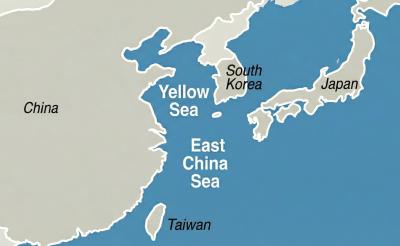
China has reserved offshore airspace in the Yellow Sea and East China Sea from March 27 to May 6, issuing alerts usually used to warn of military exercises, although no such exercises have been announced, the Wall Street Journal (WSJ) reported yesterday. Reserving such a large area for 40 days without explanation is an “unusual step,” as military exercises normally only last a few days, the paper said. These alerts, known as Notice to Air Missions (Notams), “are intended to inform pilots and aviation authorities of temporary airspace hazards or restrictions,” the article said. The airspace reserved in the alert is
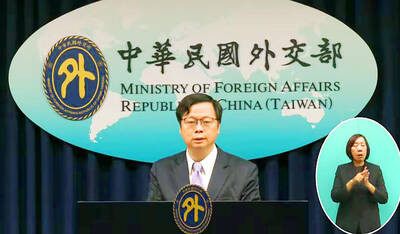
NAMING SPAT: The foreign ministry called on Denmark to propose an acceptable solution to the erroneous nationality used for Taiwanese on residence permits Taiwan has revoked some privileges for Danish diplomatic staff over a Danish permit that lists “Taiwan” as “China,” Eric Huang (黃鈞耀), head of the Ministry of Foreign Affairs’ Department of European Affairs, told a news conference in Taipei yesterday. Reporters asked Huang whether the Danish government had responded to the ministry’s request that it correct the nationality on Danish residence permits of Taiwanese, which has been listed as “China” since 2024. Taiwan’s representative office in Denmark continues to communicate with the Danish government, and the ministry has revoked some privileges previously granted to Danish representatives in Taiwan and would continue to review
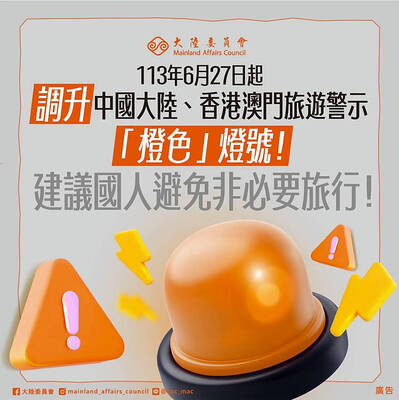
More than 6,000 Taiwanese students have participated in exchange programs in China over the past two years, despite the Mainland Affairs Council’s (MAC) “orange light” travel advisory, government records showed. The MAC’s publicly available registry showed that Taiwanese college and university students who went on exchange programs across the Strait numbered 3,592 and 2,966 people respectively. The National Immigration Agency data revealed that 2,296 and 2,551 Chinese students visited Taiwan for study in the same two years. A review of the Web sites of publicly-run universities and colleges showed that Taiwanese higher education institutions continued to recruit students for Chinese educational programs without
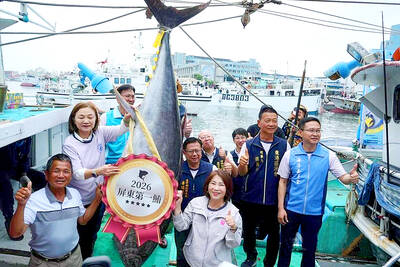
The first bluefin tuna of the season, brought to shore in Pingtung County and weighing 190kg, was yesterday auctioned for NT$10,600 (US$333.5) per kilogram, setting a record high for the local market. The auction was held at the fish market in Donggang Fishing Harbor, where the Siaoliouciou Island-registered fishing vessel Fu Yu Ching No. 2 delivered the “Pingtung First Tuna” it had caught for bidding. Bidding was intense, and the tuna was ultimately jointly purchased by a local restaurant and a local company for NT$10,600 per kilogram — NT$300 ,more than last year — for a total of NT$2.014 million. The 67-year-old skipper


 RSS
RSS