


The New Power Party (NPP) yesterday accused the Democratic Progressive Party (DPP) and the Chinese Nationalist Party (KMT) of attempting to control legislative agendas by making backroom deals, and called for more transparency in the legislative process.
Deputy Legislative Speaker Tsai Chi-chang (蔡其昌) on Monday afternoon announced that no legislative sessions would be convened for a week to allow for cross-caucus negotiations, after the legislature earlier passed a DPP proposal to prioritize a controversial bill that would cut veterans’ pensions.
Asked by reporters whether they were invited to join the meeting to discuss the postponement, NPP caucus convener Hsu Yung-ming (徐永明) said that the DPP and KMT have secretly decided a great part of the legislative agenda for the extraordinary session.
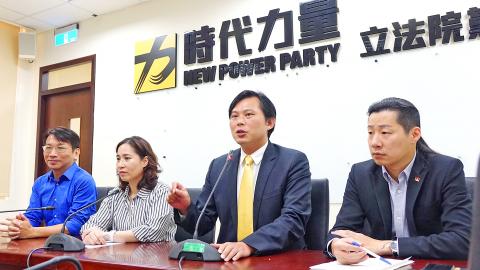
Photo: George Tsorng, Taipei Times
At 9am, when the meeting was scheduled to begin, Legislative Speaker Su Jia-chyuan (蘇嘉全) was not there and it was unclear what was going on, he said.
“We cannot stop the two major parties from making secret deals, but they do not own the legislature. If the meeting cannot begin at 9am, they should not inform people to show up at that time. That is ridiculous,” he said.
“Have they forgotten their pledge that they made in 2016 to reform the Legislative Yuan? Do they have no sense of shame?” NPP Executive Chairman Huang Kuo-chang (黃國昌) said, referring to a comment by a DPP legislator that the NPP is “just jealous” and could have joined the meeting if they wanted to.
As a relatively minor party, the NPP cannot decide the legislative agenda, but the legislature could be more friendly to minority parties by always including them in meetings about the agenda, NPP Legislator Kawlo Iyun Pacidal said.
Regarding the bill on pension reform for military personnel, the NPP believes that lower-ranking officers’ rights must be protected, while high-ranking officers’ should have more restrictions, NPP Legislator Freddy Lim (林昶佐) said.
While the Executive Yuan proposes a maximum income replacement ratio of 90 percent, the NPP believes it should be 80 percent, he said, adding that in its version, admirals would receive about double the amount that colonels receive and two-and-a-half times the amount that lieutenant colonels receive.
The NPP has also proposed lowering the preferential savings rate of 18 percent to zero within three years, which is the same rate that civil servants and public-school teachers would enjoy, he said.
When asked to comment on the NPP’s criticism of the legislature later yesterday, Su said that everything was carried out in accordance with the code of legislative procedures.
Additional reporting by CNA

Taiwan has received more than US$70 million in royalties as of the end of last year from developing the F-16V jet as countries worldwide purchase or upgrade to this popular model, government and military officials said on Saturday. Taiwan funded the development of the F-16V jet and ended up the sole investor as other countries withdrew from the program. Now the F-16V is increasingly popular and countries must pay Taiwan a percentage in royalties when they purchase new F-16V aircraft or upgrade older F-16 models. The next five years are expected to be the peak for these royalties, with Taiwan potentially earning
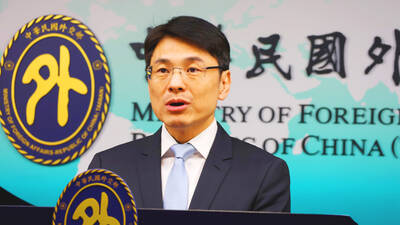
STAY IN YOUR LANE: As the US and Israel attack Iran, the ministry has warned China not to overstep by including Taiwanese citizens in its evacuation orders The Ministry of Foreign Affairs (MOFA) yesterday rebuked a statement by China’s embassy in Israel that it would evacuate Taiwanese holders of Chinese travel documents from Israel amid the latter’s escalating conflict with Iran. Tensions have risen across the Middle East in the wake of US and Israeli airstrikes on Iran beginning Saturday. China subsequently issued an evacuation notice for its citizens. In a news release, the Chinese embassy in Israel said holders of “Taiwan compatriot permits (台胞證)” issued to Taiwanese nationals by Chinese authorities for travel to China — could register for evacuation to Egypt. In Taipei, the ministry yesterday said Taiwan
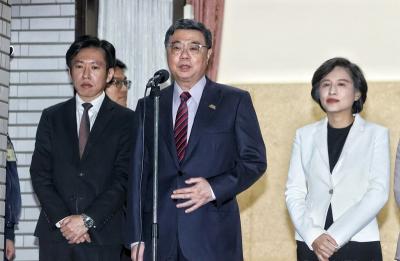
Taiwan is awaiting official notification from the US regarding the status of the Agreement on Reciprocal Trade (ART) after the US Supreme Court ruled US President Donald Trump's global tariffs unconstitutional. Speaking to reporters before a legislative hearing today, Premier Cho Jung-tai (卓榮泰) said that Taiwan's negotiation team remains focused on ensuring that the bilateral trade deal remains intact despite the legal challenge to Trump's tariff policy. "The US has pledged to notify its trade partners once the subsequent administrative and legal processes are finalized, and that certainly includes Taiwan," Cho said when asked about opposition parties’ doubts that the ART was
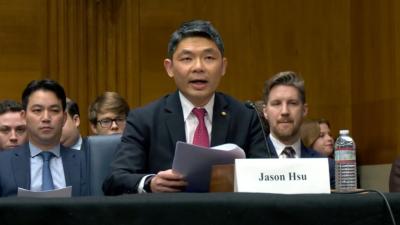
If China chose to invade Taiwan tomorrow, it would only have to sever three undersea fiber-optic cable clusters to cause a data blackout, Jason Hsu (許毓仁), a senior fellow at the Hudson Institute and former Chinese Nationalist Party (KMT) legislator, told a US security panel yesterday. In a Taiwan contingency, cable disruption would be one of the earliest preinvasion actions and the signal that escalation had begun, he said, adding that Taiwan’s current cable repair capabilities are insufficient. The US-China Economic and Security Review Commission (USCC) yesterday held a hearing on US-China Competition Under the Sea, with Hsu speaking on


 RSS
RSS