


Premier William Lai (賴清德) yesterday said he hopes that the nation’s annual water supply can be increased by 1.9 billion tonnes by 2031 with the government’s water management policies.
The Executive Yuan’s policy objectives related to water are to eliminate water shortages and protect against floods, supply people with clean water and build waterfront parks, while its water management plans center on developing water sources, redoubling water consumption efforts, facilitating water distribution and ensuring abundant backup supplies, Lai said at an awards ceremony in Taichung honoring individuals who have made outstanding contributions to the nation’s water infrastructure.
By working toward these objectives, the Executive Yuan hopes to add 1.9 billion tonnes, or about 520,000 tonnes per day, to the nation’s annual water supply, he said.
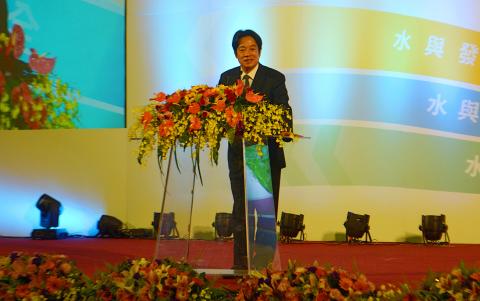
Photo: Chen Chien-chih, Taipei Times
With regard to developing water sources, the Water Resources Agency has completed the construction of a desilting tunnel at Zengwen Reservoir (曾文水庫), and work has begun on another desilting tunnel at Nanhua Reservoir (南化水庫), Lai said.
The government is also pushing water recycling policies and has launched several pilot projects with an aim to supply top-quality recycled water to Tainan’s industrial areas, he said.
To conserve water, state-owned Taiwan Water Corp (Taiwater) has set a goal of reducing water pipeline leaks to 10 percent by 2031, while the government aims to boost the recycling rate of industrial water to 80 percent, Lai said.
He also touted work by irrigation association officials to regulate and distribute water for agricultural use, which has played a crucial role in regulating water use, he said.
As an example of government efforts to facilitate water distribution, Lai said that as soon as the phase-two project to improve water supply to the Banciao-Sindian (板橋-新店) area is completed, Feitsui Reservoir (翡翠水庫) would be able to share the burden of supplying water to the area, which has been supplied by Shihmen Reservoir (石門水庫) until now.
The water that would be saved at Shihmen Reservoir could be then tapped by Hsinchu County, he added.
Lai suggested building a pipeline between Hsinchu and Miaoli counties, which would allow the two to pool water resources.
The government has launched a project that would cost NT$80 billion over eight years to combat flooding in areas totaling more than 500km2, Lai said.
The government would continue to build levees, water retention pools and floodways, and carry out dredging work to prevent floods, the premier said, adding that the Cabinet has allocated funds under the Forward-looking Infrastructure Development Program to tackle flooding.
On a related note, building more waterfront parks could also help prevent flooding, he said.
As for efforts to expand the coverage of clean potable water, Taiwater has teamed up with five-star hotels to encourage people to drink directly from faucets, as well as with schools to install drinking fountains, he said.
The government would continue to promote potable water for communities and at hotels to make international visitors feel “safe” about their drinking water, he added.

The military has spotted two Chinese warships operating in waters near Penghu County in the Taiwan Strait and sent its own naval and air forces to monitor the vessels, the Ministry of National Defense (MND) said. Beijing sends warships and warplanes into the waters and skies around Taiwan on an almost daily basis, drawing condemnation from Taipei. While the ministry offers daily updates on the locations of Chinese military aircraft, it only rarely gives details of where Chinese warships are operating, generally only when it detects aircraft carriers, as happened last week. A Chinese destroyer and a frigate entered waters to the southwest
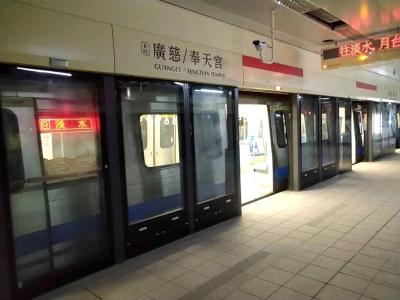
The eastern extension of the Taipei MRT Red Line could begin operations as early as late June, the Taipei Department of Rapid Transit Systems said yesterday. Taipei Rapid Transit Corp said it is considering offering one month of free rides on the new section to mark its opening. Construction progress on the 1.4km extension, which is to run from the current terminal Xiangshan Station to a new eastern terminal, Guangci/Fengtian Temple Station, was 90.6 percent complete by the end of last month, the department said in a report to the Taipei City Council's Transportation Committee. While construction began in October 2016 with an
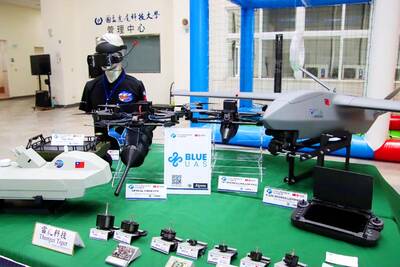
NON-RED SUPPLY: Boosting the nation’s drone industry is becoming increasingly urgent as China’s UAV dominance could become an issue in a crisis, an analyst said Taiwan’s drone exports to Europe grew 41.7-fold from 2024 to last year, with demand from Ukraine’s fight against Russian aggression the most likely driver of growth, a study showed. The Institute for Democracy, Society and Emerging Technology (DSET) in a statement on Wednesday said it found that many of Taiwan’s uncrewed aerial vehicle (UAV) sales were from Poland and the Czech Republic. These countries likely transferred the drones to Ukraine to aid it in its fight against the Russian invasion that started in 2022, it said. Despite the gains, Taiwan is not the dominant drone exporter to these markets, ranking second and fourth

Japanese Prime Minister Sanae Takaichi’s comment last year on Tokyo’s potential reaction to a Taiwan-China conflict has forced Beijing to rewrite its invasion plans, a retired Japanese general said. Takaichi told the Diet on Nov. 7 last year that a Chinese naval blockade or military attack on Taiwan could constitute a “survival-threatening situation” for Japan, potentially allowing Tokyo to exercise its right to collective self-defense. Former Japan Ground Self-Defense Force general Kiyofumi Ogawa said in a recent speech that the remark has been interpreted as meaning Japan could intervene in the early stages of a Taiwan Strait conflict, undermining China’s previous assumptions


 RSS
RSS