


Four of the nation’s top-ranking public universities use English as the language of instruction in an average of only 8 percent of their courses, despite large investments to “internationalize” them, the Ministry of Education said.
The ministry has collectively invested NT$4 billion (US$133.58 million at the current exchange rate) on programs and the hiring of foreign teachers at National Taiwan University, National Cheng Kung University, National Tsing Hua University and National Chiao Tung University, but students are not taking the English-language classes, the ministry said.
Students are reluctant to take courses conducted in English out of fear that they will be unable to follow the material, the ministry said, adding that the low number of courses available in English also means that the schools are unable to attract foreign students.
The ministry hopes to hire more foreign teachers to provide a greater number of courses in English, it said.
Of the 17,363 courses on offer at National Taiwan University last year, only 1,026, or 5.9 percent, were offered in English, excluding language courses.
At National Cheng Kung University 9.44 percent of classes were taught in English, at National Tsing Hua University it was 12.86 percent and at National Chiao Tung University the number was 13.17 percent.
The ministry originally planned to invest NT$50 billion over five years to introduce undergraduate study programs taught entirely in English and make the nation’s schools more international, Department of Higher Education Deputy Director-General Chu Hung-chang (朱俊彰) said.
However, as of last year, only 61 English-language programs were offered by the four schools, he said.
Concerned that the low number of programs would not be enough to make the schools stand out internationally, the ministry decided to merge its development plans with the Yushan Project, which is an educational incentive plan, and focus its efforts on hiring more foreign academics, he added.
Enrollment targets for English-language classes are hard to meet and teachers generally have a poor sense of achievement, National Taiwan University vice dean Chang Yao-wen (張耀文) said.
To more effectively promote English-language curricula, schools should evaluate professors teaching in English differently from those teaching in Chinese, and should incentivize English-language coursework instruction, he said.
National Chiao Tung University said it plans to make its campus more welcoming to international students, researchers and instructors, with upgrades that include a Muslim prayer room and eateries.
Yen Ta-jen (嚴大任), a professor of materials science and engineering at National Tsing Hua University, said that while his school is ready and able to conduct research entirely in English, he feels the issue of whether to offer undergraduate programs taught in English should be discussed more.
Schools with programs taught fully in English have had poorer results than those teaching in Chinese, said Huang Yueh-min (黃悅民), an applied computer science professor at National Cheng Kung University.
Programs might find more success if they incorporate elements of Taiwanese culture and inter-departmental collaboration, he said.
English-language programs are needed in law and politics, which are difficult for foreign students to take in Chinese, National Taiwan University student union president Lin Yan-ting (林彥廷) said, adding that the school should be cautious about the quality of the international students it accepts to maintain its standing in international rankings.
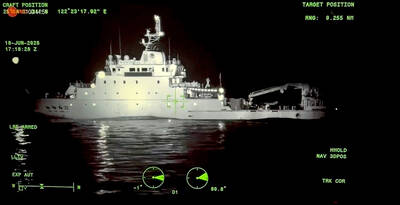
EXCUSES: Beijing is using government and research vessels as a pretext to harass the nation and enter its EEZ, and engage in ‘hegemonic expansion,’ the coast guard said The Coast Guard Administration yesterday said it drove away Chinese oceanographic research vessel Xiang Yang Hong 22 (向陽紅33) from restricted waters after warning it that it was in Taiwan’s exclusive economic zone (EEZ). The Chinese vessel entered restricted waters off the coast of Yilan County’s Suao (蘇澳) at 11:35pm on Thursday, the coast guard said, adding that it dispatched the Lanyu patrol vessel and the boat PP-10077 to shadow the Chinese ship and issue radio warnings ordering it to leave. China has no sovereignty over waters off Taiwan’s east coast, Lanyu’s crew told Xiang Yang Hong 22 over the radio, and demanded

BAIT AND SWITCH: Allowing KMT-run counties to sell to China while the threat of abrupt cancelations hangs overhead is another form of coercion, officials said Beijing is using agricultural purchase offers announced during the Straits Forum to deepen Taiwan’s dependence on the Chinese market, a Taiwanese official said yesterday as they criticized the Taitung County commissioner’s participation in the initiative. During the Straits Forum held in Xiamen on Saturday, Chinese officials announced a sales and purchase agreement for agricultural products from some counties led by the Chinese Nationalist Party (KMT). Taitung County Commissioner Yao Ching-ling (饒慶鈴), who was barred from attending the event in person by the Mainland Affairs Council, participated via video. Under the agreement, China would purchase atemoyas, pomeloes, tea and grouper harvested in Taitung,

SHIFTING FIRE: While the tempo of purely military exercises around Taiwan has gone down somewhat, Beijing is working to isolate Lai diplomatically from support abroad Chinese President Xi Jinping (習近平) is shifting tactics in his campaign to pressure Taiwan, ramping up diplomatic isolation of the nation while dialing down provocative displays of military aggression. Taiwan recorded a daily average of five Chinese military aircraft crossing the Taiwan Strait’s buffer line with China through May this year — half the number logged in the same period last year. In March, Beijing did not send a single fighter jet near Taiwan for seven days, the longest absence on record outside of typhoon season. In comparison, China sent 153 planes near Taiwan during one day at its peak in
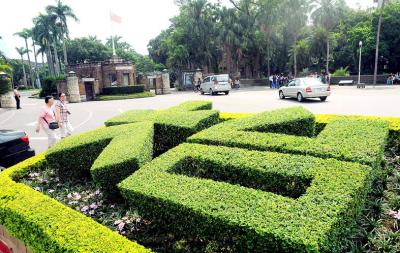
Four Taiwanese universities have been ranked among the world's top 200 institutions in the Quacquarelli Symonds (QS) World University Rankings for next year, the highest Taiwan has ever placed in the category, with National Taiwan University (NTU) achieving its best performance at 54th globally and 17th in Asia. The four Taiwanese institutions in the global top 200 are NTU (54th), National Tsing Hua University (142nd), National Yang Ming Chiao Tung University (177th) and National Cheng Kung University (191st), the rankings showed. All four universities achieved their highest-ever global rankings this year, QS data showed. National Cheng Kung University entered the top 200 for


 RSS
RSS