


Chinese Nationalist Party (KMT) Taipei mayoral candidate hopefuls yesterday called for closer exchanges with China and the “reinvigoration of Chinese culture” to boost the capital’s economy and tourism, and laid out plans for the Taipei International Airport (Songshan airport) and Taipei Dome projects.
The proposals were made at the first televised debate for the KMT’s four aspirants: Taipei City Councilor Chung Hsiao-ping (鍾小平), former Mainland Affairs Council deputy minister Chang Hsien-yao (張顯耀) and former KMT legislators Ting Shou-chung (丁守中) and Sun Ta-chien (孫大千).
The debate, organized and aired by CtiTV, came the week before the KMT headquarters is scheduled to conduct a telephone poll from Sunday next week to May 1 to decide its candidate.
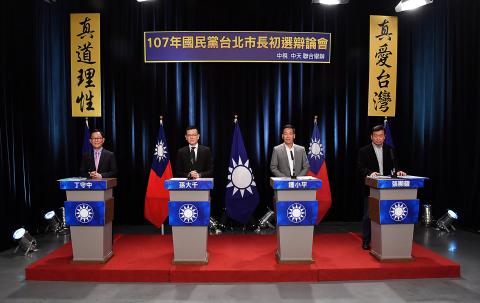
Photo: CNA
A focus of the debate was the annual twin-city forum, which has been held in Taipei and Shanghai on a rotating basis since 2010 to promote exchanges between the cities.
There have been allegations that Taipei Mayor Ko Wen-je (柯文哲), who is seeking re-election, has decided to postpone this year’s forum in Taipei until after the election due to political concerns.
“At a time when President Tsai Ing-wen’s (蔡英文) and Premier William Lai’s (賴清德) political stances have caused cross-strait relations to stall and have led to frequent Chinese military drills, the need to strengthen exchanges at the local level has grown even greater,” Ting said.
If elected, Ting said he would push for a similar twin-city forum with other major Chinese cities, such as Beijing and Shenzhen, as well as cities in other nations that provide Taiwan and Taipei with good business opportunities.
Chang agreed, but also proposed establishing city-level representative offices in Chinese cities with a large number of Taiwanese businesspeople, while Sun pledged to make sure that the annual forum yields achievements not only in politics, but also in culture and innovation.
Regarding tourism, Chung said that the city should make the best of the National Palace Museum and its rich collection of ancient Chinese artifacts and art, instead of pursuing a “desinicization” movement.
“Chinese fever is everywhere around the world — why would anyone still want to pursue desinicization? We must reinvigorate the 5,000-year-old Chinese culture here, because that is our most valuable appeal,” Chung said.
All four hopefuls vowed to put a swift end to the scandal surrounding the Taipei Dome, the construction of which has been suspended for more than two years due to safety concerns.
Ting said he would complete the project as soon as possible, while Chang said he would make a decision within three months of his election on whether to tear down, resume construction or redesign the dome.
While Chung said he plans to terminate the contract between the Taipei City Government and Farglory Group and start new negotiations, Sun said that the dome’s fate should be determined by the contract.
The four were divided on Songshan airport, with Chung and Chang advocating for its immediate relocation to allow further development of the neighboring areas, and Ting and Sun saying that such a move would not be possible until after a third terminal is built at Taiwan Taoyuan International Airport.
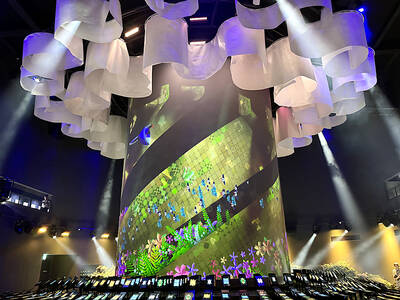
PRAISE: Japanese visitor Takashi Kubota said the Taiwanese temple architecture images showcased in the AI Art Gallery were the most impressive displays he saw Taiwan does not have an official pavilion at the World Expo in Osaka, Japan, because of its diplomatic predicament, but the government-backed Tech World pavilion is drawing interest with its unique recreations of works by Taiwanese artists. The pavilion features an artificial intelligence (AI)-based art gallery showcasing works of famous Taiwanese artists from the Japanese colonial period using innovative technologies. Among its main simulated displays are Eastern gouache paintings by Chen Chin (陳進), Lin Yu-shan (林玉山) and Kuo Hsueh-hu (郭雪湖), who were the three young Taiwanese painters selected for the East Asian Painting exhibition in 1927. Gouache is a water-based
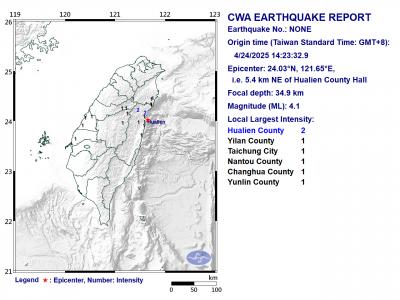
A magnitude 4.1 earthquake struck eastern Taiwan's Hualien County at 2:23pm today, according to the Central Weather Administration (CWA). The epicenter of the temblor was 5.4 kilometers northeast of Hualien County Hall, at a depth of 34.9 km, according to the CWA. The earthquake's intensity, which gauges the actual effect of a temblor, was the highest in Hualien County, where it measured 2 on Taiwan's 7-tier intensity scale. The quake also measured an intensity of 1 in Yilan county, Taichung, Nantou County, Changhua County and Yunlin County, the CWA said. There were no immediate reports of damage or injuries.
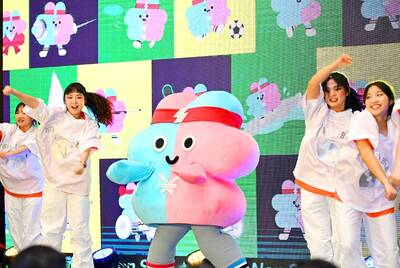
OFF-TARGET: More than 30,000 participants were expected to take part in the Games next month, but only 6,550 foreign and 19,400 Taiwanese athletes have registered Taipei city councilors yesterday blasted the organizers of next month’s World Masters Games over sudden timetable and venue changes, which they said have caused thousands of participants to back out of the international sporting event, among other organizational issues. They also cited visa delays and political interference by China as reasons many foreign athletes are requesting refunds for the event, to be held from May 17 to 30. Jointly organized by the Taipei and New Taipei City governments, the games have been rocked by numerous controversies since preparations began in 2020. Taipei City Councilor Lin Yen-feng (林延鳳) said yesterday that new measures by
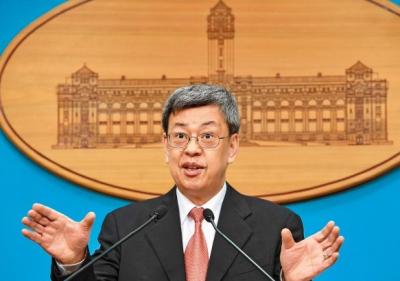
President William Lai (賴清德) has appointed former vice president Chen Chien-jen (陳建仁) to attend the late Pope Francis’ funeral at the Vatican City on Saturday on his behalf, the Ministry of Foreign Affairs said today. The Holy See announced Francis’ funeral would take place on Saturday at 10am in St Peter’s Square. The ministry expressed condolences over Francis’ passing and said that Chen would represent Taiwan at the funeral and offer condolences in person. Taiwan and the Vatican have a long-standing and close diplomatic relationship, the ministry said. Both sides agreed to have Chen represent Taiwan at the funeral, given his Catholic identity and


 RSS
RSS