


Reports of a potential sharp rise in the price of toilet paper might have been the result of deliberate price manipulation, the Cabinet said yesterday as it vowed to prevent price collusion and reassured the public that there is a sufficient supply of toilet paper at reasonable prices.
Media reports of a price hike and panic buying by the public might have been the consequence of a deliberate attempt to drive up prices, and is being investigated by the Fair Trade Commission and the Consumer Protection Committee, Vice Premier Shih Jun-ji (施俊吉) said at a Cabinet news conference attended by top finance officials.
Price competition between the nation’s three toilet paper manufacturers is fierce, Shih said, adding that the market presents strong motivation for price collusion because if only one manufacturer announced a price hike, it would likely lose out on sales.
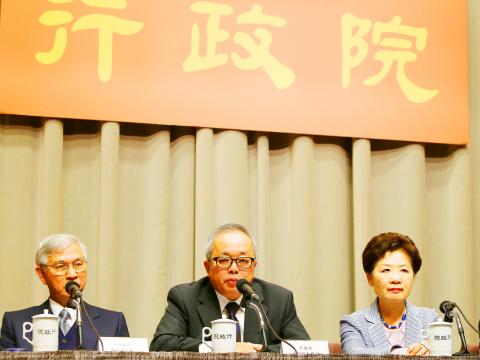
Photo: CNA
It is likely that the companies deliberately fanned the fears of consumers by spreading reports of a price hike, he said.
“The Fair Trade Commission will investigate whether the manufacturers spread reports through the media as part of a pending price hike and whether there was any collusion involved that enabled them to ‘bravely’ announce the price increase together,” commission Chairwoman Huang Mei-ying (黃美瑛) said.
The commission has launched an investigation, interviewing the manufacturers and five top chain retailers to uncover if there was any illegal activity, Huang said.
While the expected rise in toilet paper prices was reportedly the result of an increase in international pulp prices, the Council of Agriculture said that pulp prices over the past five years have been dropping.
The price of paper pulp decreased from NT$75.7 per kilogram in 2013 to NT$45.5 per kilogram in 2014 and to NT$43.1 last year, while the price of paper pulp in January this year was NT$43.2 per kilogram, showing a stable and gently downward trend in international pulp prices, council Deputy Minister Chen Chi-chung (陳吉仲) said.
A recent announcement of a 3 percent pay hike for public employees does not cause commodity prices to jump because the pay increase is paid with pre-allocated government funds and does not create extra governmental spending or inflation, Shih said.
A salary increase in the private sector has minimal impact on commodity prices because companies traded on local bourses increased revenue from NT$1.21 trillion in 2016 to NT$2.1 trillion last year (US$41.27 billion to US$71.63 billion at the current exchange rate), meaning that they have enough cash to afford the pay increase without affecting commodity prices, Shih said.
Inflation this year is expected to remain at a low level of between 0.88 percent and 1.3 percent, he added.
Executive Yuan spokesman Hsu Kuo-yung (徐國勇) said there is an ample supply of toilet paper and urged the public not to stockpile.
Toilet paper was yesterday available in large quantities at major retail outlets, according to the Cabinet’s field investigation, Hsu said.
The committee has asked manufacturers not to raise toilet paper prices before March 15, but that does not mean that prices are to go up afterward as the public fears, Hsu said.

The Centers for Disease Control (CDC) yesterday reported the first case of a new COVID-19 subvariant — BA.3.2 — in a 10-year-old Singaporean girl who had a fever upon arrival in Taiwan and tested positive for the disease. The girl left Taiwan on March 20 and the case did not have a direct impact on the local community, it said. The WHO added the BA.3.2 strain to its list of Variants Under Monitoring in December last year, but this was the first imported case of the COVID-19 variant in Taiwan, CDC Deputy Director-General Lin Ming-cheng (林明誠) said. The girl arrived in Taiwan on

South Korea is planning to revise its controversial electronic arrival card, a step Taiwanese officials said prompted them to hold off on planned retaliatory measures, a South Korean media report said yesterday. A Yonhap News Agency report said that the South Korean Ministry of Foreign Affairs is planning to remove the “previous departure place” and “next destination” fields from its e-arrival card system. The plan, reached after interagency consultations, is under review and aims to simplify entry procedures and align the electronic form with the paper version, a South Korean ministry official said. The fields — which appeared only on the electronic form
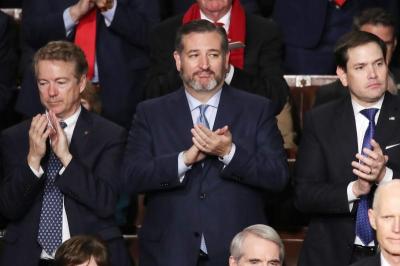
A bipartisan group of US senators has introduced a bill to enhance cooperation with Taiwan on drone development and to reduce reliance on supply chains linked to China. The proposed Blue Skies for Taiwan Act of 2026 was introduced by Republican US senators Ted Cruz and John Curtis, and Democratic US senators Jeff Merkley and Andy Kim. The legislation seeks to ease constraints on Taiwan-US cooperation in uncrewed aerial systems (UAS), including dependence on China-sourced components, limited access to capital and regulatory barriers under US export controls, a news release issued by Cruz on Wednesday said. The bill would establish a "Blue UAS

The Ministry of Foreign Affairs (MOFA) is suspending retaliation measures against South Korea that were set to take effect tomorrow, after Seoul said it is updating its e-arrival system, MOFA said today. The measures were to be a new round of retaliation after Taiwan on March 1 changed South Korea's designation on government-issued alien resident certificates held by South Korean nationals to "South Korea” from the "Republic of Korea," the country’s official name. The move came after months of protests to Seoul over its listing of Taiwan as "China (Taiwan)" in dropdown menus on its new online immigration entry system. MOFA last week


 RSS
RSS