


The scope of yesterday’s Cabinet reshuffle was too narrow, with the appointments likely reflecting President Tsai Ing-wen’s (蔡英文) hope to ameliorate cross-strait ties, Chinese Nationalist Party (KMT) lawmakers said.
The nation’s foreign and defense ministries and top agency for cross-strait policy all getting new leaders shows that Tsai is hoping to improve cross-strait relations, which have cooled considerably since she took office in May 2016, KMT caucus deputy secretary-general William Tseng (曾銘宗) said.
As Presidential Office Secretary-General Joseph Wu (吳釗燮) is perceived as having a pro-Taiwanese independence stance, his appointment as minister of foreign affairs is a mistake considering the diplomatic plight the nation faces, KMT caucus whip Lin Te-fu (林德福) said, adding that the administration should have appointed someone better suited to the position, as Wu would only further decrease the nation’s international space.
Lin also raised doubts that new Mainland Affairs Council (MAC) minister Chen Ming-tung (陳明通) — who in 2012 said the Democratic Progressive Party (DPP) was not attempting desinicization, but ridding the nation of the People’s Republic of China’s influence — could revive cross-strait ties, adding that the DPP’s reluctance to acknowledge the so-called “1992 consensus” has had a negative effect on the economy and encroached on the nation’s space in the international community.
The so-called “1992 consensus” — a term former MAC chairman Su Chi (蘇起) admitted to making up in 2000 — refers to a tacit understanding between the KMT and the Chinese Communist Party that both sides acknowledge there is “one China,” with each side having its own interpretation of what “China” means.
Tsai might hope to improve cross-strait relations with the reshuffle, but the task would ultimately depend on the president’s stance, KMT caucus secretary-general Lee Yen-hsiu (李彥秀) said.
Chen Ming-tung adopted a hardline stance on desinicization and the “1992 consensus” when serving as MAC minister under former president Chen Shui-bian (陳水扁), she said, adding that the DPP should stop resorting to doublespeak — implementing policies aimed at desinicization while claiming that it has extended goodwill toward China.
While data suggest sluggish economic growth, along with fewer cross-strait exchanges, are the areas in which Tsai has attracted the most criticism in opinion polls, Tseng said agencies in charge of the economy and people’s livelihood were excluded from the reshuffle, which could have been conducted on a much larger scale.
Echoing that view, KMT Culture and Communications Committee deputy director Hung Meng-kai (洪孟楷) said: “This reshuffle not only fails to meet the public’s expectation, it also runs counter to Tsai’s oft-stated goal of propping up the nation’s economy and the standard of living.”
Meanwhile, DPP Legislator Wang Ding-yu (王定宇) lauded the reshuffle, saying it signaled that the government is ready for a year filled with challenges and opportunities.
Appointing a new defense minister suggests that Tsai is prepared to meet the challenges facing the nation in light of increased instances of Beijing’s warships and fighter jets encroaching on Taiwan’s territoty, he said.
With Japanese Prime Minister Shinzo Abe continuing to extend his goodwill toward Taiwan, Tsai should explore the possibility of Taiwan gaining membership of the Japan-led Comprehensive and Progressive Agreement for Trans-Pacific Partnership and commencing military exchanges with Japan, he said, adding that recent developments in US politics have also presented opportunities for Taiwan and the US to leverage cooperation on defense and diplomacy.
The KMT would be able to see the big picture if it were not so fixated on scrutinizing officials’ political affiliations, but rather focus on their abilities and think about the best interests of Taiwanese instead of Chinese, Wang added.
Additional reporting by Stacy Hsu
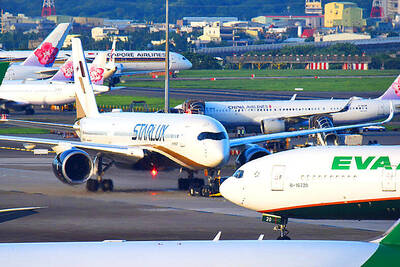
Trips for more than 100,000 international and domestic air travelers could be disrupted as China launches a military exercise around Taiwan today, Taiwan’s Civil Aviation Administration (CAA) said yesterday. The exercise could affect nearly 900 flights scheduled to enter the Taipei Flight Information Region (FIR) during the exercise window, it added. A notice issued by the Chinese Civil Aviation Administration showed there would be seven temporary zones around the Taiwan Strait which would be used for live-fire exercises, lasting from 8am to 6pm today. All aircraft are prohibited from entering during exercise, it says. Taipei FIR has 14 international air routes and
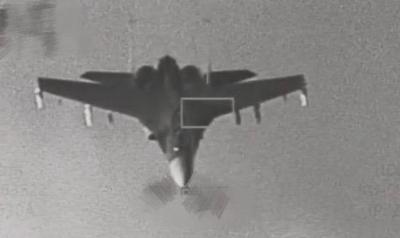
The Ministry of National Defense (MND) today released images of the military tracking China’s People's Liberation Army (PLA) movements during the latest round of Chinese drills around Taiwan. The PLA began "Justice Mission 2025" drills today, carrying out live-fire drills, simulated strikes on land and maritime targets, and exercises to blockade the nation's main ports. The exercises are to continue tomorrow, with the PLA announcing sea and air space restrictions for five zones around Taiwan for 10 hours starting from 8:30am. The ministry today released images showing a Chinese J-16 fighter jet tracked by a F-16V Block 20 jet and the

Snow fell on Yushan (Jade Mountain, 玉山) yesterday morning as a continental cold air mass sent temperatures below freezing on Taiwan’s tallest peak, the Central Weather Administration (CWA) said. Snowflakes were seen on Yushan’s north peak from 6:28am to 6:38am, but they did not fully cover the ground and no accumulation was recorded, the CWA said. As of 7:42am, the lowest temperature recorded across Taiwan was minus-5.5°C at Yushan’s Fengkou observatory and minus-4.7°C at the Yushan observatory, CWA data showed. On Hehuanshan (合歡山) in Nantou County, a low of 1.3°C was recorded at 6:39pm, when ice pellets fell at Songsyue Lodge (松雪樓), a
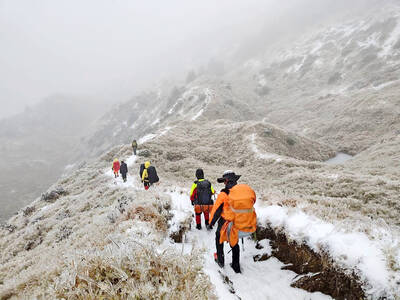
NO SHAME IN RETREAT: Hikers should consider turning back if the weather turns bad or if they do not have sufficient equipment, the Taroko park headquarters said Two people died of hypothermia over the weekend while hiking on Hsuehshan (雪山), prompting park authorities to remind hikers to bring proper equipment and consider their physical condition before setting out in the cold weather. Temperatures dropped over the weekend, bringing snow to high altitudes in Shei-pa National Park. One hiker, surnamed Lin (林), who on Friday was traveling with a group of six along the Hsuehshan west ridge trail, lost consciousness due to hypothermia and died, the Shei-pa National Park Headquarters said. On Saturday, another hiker, surnamed Tien (田), in a group of five on the southeast of the west


 RSS
RSS