


The Taipei City Hospital and the Ministry of Health and Welfare have given several tips for staying healthy during the Lunar New Year’s holiday.
Taipei City Hospital pharmacist Li Chia-hsin (黎嘉欣) said many people like to travel to Japan and bring back various over-the-counter (OTC) drugs, but they should remember that “drugs are not general merchandise and should not be purchased as souvenirs, or given to friends and family as presents.”
Some drugs sold in other nations have not been approved in Taiwan and the lack of labels in Chinese can increase the risk of misuse, so people should not purchase them if they are uncertain, and carefully read the package insert before taking them, she said.
However, people should be aware that they cannot apply for drug injury relief if they suffer negative health effects from misuse or overdose of unapproved drugs bought in other nations, Li added.
The maximum amount of OTC drugs — including cold medicine, vitamins, abdominal pain medicine or ointment — that people can bring back from other nations is no more than 12 bottles (or boxes) of each type and no more than 36 bottles in total, while the maximum amount for prescription drugs is no more than six months on prescription and no more than two months without prescription, Li said.
In addition, a doctor’s prescription is required for injection medicine and controlled drugs; no more than 1kg of each type of Chinese herbal medicine and no more than 12 types in all; and no more than 12 bottles (or boxes) of any type of herbal medicine preparation or food as tablets or capsules and no more than 36 bottles in all, she said.
Meanwhile, the Health Promotion Administration (HPA) encouraged people to remember to exercise regularly over the holiday period.
A HPA survey in 2016 found that 46 percent of respondents said they do about the same amount of exercise during the Lunar New Year holidays, and 6 percent said they did more exercise than usual.
Regular exercise not only enhances physical and mental health, but can also make people feel happier as the body produces a number of hormones that trigger a positive feeling, the agency said.
It cited three WHO principles for keeping the body active and healthy during the holidays.
Adults aged 18 to 64 should do at least 150 minutes of moderate-intensity aerobic physical activity throughout the week, and children and young people between the ages of five and 17 should do at least 420 minutes of moderate to vigorous-physical activity per week or an average of an hour per day, the HPA said.
Fitness walking is a good entry-level exercise that most people can engage in, as they only have to wear casual clothing, athletic shoes and walk at a pace faster than normal and begin to feel sweating, the HPA said, adding that studies have suggested that walking for at least 10,000 steps per day can provide health benefits.
Always warm up properly before exercising and take protective measures to prevent injuries or ill health, such as wearing cold-weather outfits outdoors and not drinking alcohol while exercising, it said, while people with chronic diseases should consult their doctors about suitable exercises and exercise indoors when the air quality is bad.
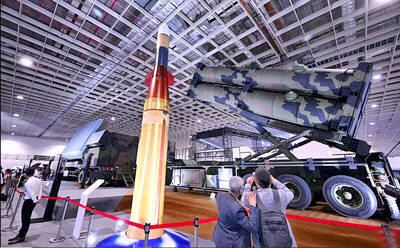
Taiwan is to commence mass production of the Tien Kung (天弓, “Sky Bow”) III, IV and V missiles by the second quarter of this year if the legislature approves the government’s NT$1.25 trillion (US$39.78 billion) special defense budget, an official said yesterday. Commenting on condition of anonymity, a defense official with knowledge of the matter said that the advanced systems are expected to provide crucial capabilities against ballistic and cruise missiles for the proposed “T-Dome,” an advanced, multi-layered air defense network. The Tien Kung III is an air defense missile with a maximum interception altitude of 35km. The Tien Kung IV and V
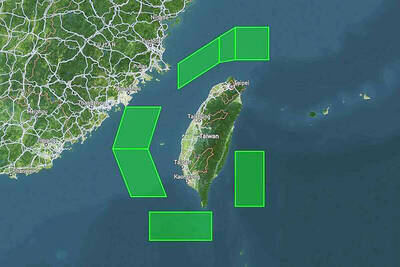
The disruption of 941 flights in and out of Taiwan due to China’s large-scale military exercises was no accident, but rather the result of a “quasi-blockade” used to simulate creating the air and sea routes needed for an amphibious landing, a military expert said. The disruptions occurred on Tuesday and lasted about 10 hours as China conducted live-fire drills in the Taiwan Strait. The Civil Aviation Administration (CAA) said the exercises affected 857 international flights and 84 domestic flights, affecting more than 100,000 travelers. Su Tzu-yun (蘇紫雲), a research fellow at the government-sponsored Institute for National Defense and Security Research, said the air
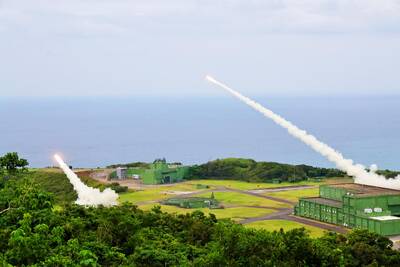
Taiwan lacks effective and cost-efficient armaments to intercept rockets, making the planned “T-Dome” interception system necessary, two experts said on Tuesday. The concerns were raised after China’s military fired two waves of rockets during live-fire drills around Taiwan on Tuesday, part of two-day exercises code-named “Justice Mission 2025.” The first wave involved 17 rockets launched at 9am from Pingtan in China’s Fujian Province, according to Lieutenant General Hsieh Jih-sheng (謝日升) of the Office of the Deputy Chief of the General Staff for Intelligence at the Ministry of National Defense. Those rockets landed 70 nautical miles (129.6km) northeast of Keelung without flying over Taiwan,
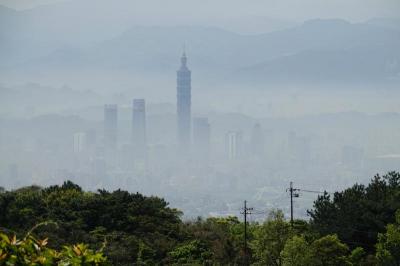
A strong continental cold air mass is to bring pollutants to Taiwan from tomorrow, the Ministry of Environment said today, as it issued an “orange” air quality alert for most of the country. All of Taiwan except for Hualien and Taitung counties is to be under an “orange” air quality alert tomorrow, indicating air quality that is unhealthy for sensitive groups. In China, areas from Shandong to Shanghai have been enveloped in haze since Saturday, the ministry said in a news release. Yesterday, hourly concentrations of PM2.5 in these areas ranged from 65 to 160 micrograms per cubic meter (mg/m³), and pollutants were


 RSS
RSS