


Kaohsiung’s Shoushan Zoo has said that long-time elephant caretaker Chang Yung-hsing (張永興) is to retire next year and part with an African elephant named A-li (阿里) that he has cared for over the past 39 years.
Chang was 23 when first started caring for the then-five-year-old female elephant, zoo director Chuang Hsuan-chih (莊絢智) said.
“The man and the elephant share a profound rapport,” Chuang said.
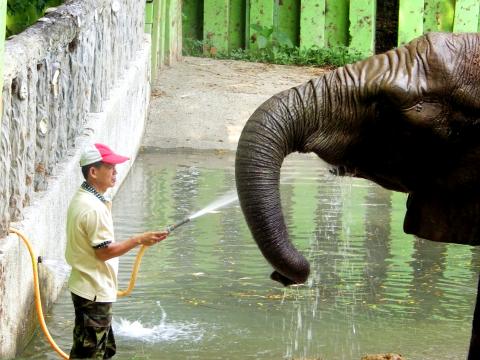
Photo courtesy of Shoushan Zoo
Now 44, A-li is one of three African elephants in Taiwan and the only one in Shoushan Zoo. The other two are in Taipei Zoo.
Shoushan Zoo officials are concerned that Chang’s retirement could depress A-li and they have been familiarizing the elephant with her new caretaker over the past three years, Chuang said.
Captive elephants can become attached to their human caretakers and losing familiar caretakers can cause elephants to become depressed and refuse to eat until they starve to death, Chuang said.
“We hope to gradually reduce A-li’s emotional dependence on Chang,” she added.
A-li’s caretaker-in-waiting, Pai Po-yuan (白博元), said that although he has been Chang’s assistant for three years, the elephant has not entirely warmed up to him.
Although A-li understands that he is Chang’s occasional substitute, the staff still have to keep the elephant behind safety barriers when he cleans the enclosure or brings her food, Pai said.
“If I make a wrong move, my life could be in danger,” he said, adding that the situation is still an improvement over when A-li was throwing stones and dung at him.
National Dong Hwa University environmental science professor Kurtis Pei (裴家騏) has urged Shoushan Zoo to let A-li live with the elephants in Taipei Zoo as a humane alternative to solitude.
All three of the nation’s African elephants are females, which are naturally social, and it is inhumane to make A-li live without companionship, the Chinese-language Apple Daily quoted Pei as saying.
Taipei and Kaohsiung city officials said they agree that it would be preferable to let the elephants live together, but the elephants might not get along, as they are territorial and might resist being moved, the newspaper said.
Kaohsiung Tourism Bureau Director Tseng Tzu-wen (曾姿雯) said the bureau is interested in protecting the welfare of zoo animals and is willing to discuss the issue with Taipei Zoo, the newspaper said.
Taipei Zoo spokesman Chin Shih-chien (金士謙) said that the elephants at the zoo have lived together for decades and might not accept A-li, but the proposal has a lot of merit and deserves serious consideration, it said.
“No matter how difficult, this is an issue that is worth our colleagues at Shoushan and us expending some effort and trying to find a solution,” he was quoted as saying.

NATIONAL SECURITY: Authorities are working to confirm the identities of the military personnel involved and investigating possible illegal conduct and regulatory violations Authorities are probing possible national security implications after Kinmen police and immigration officers on Sunday found a Chinese woman allegedly posing as a tourist while engaging in prostitution involving more than 10 military personnel. The woman, surnamed Chen (陳), has since been deported, authorities said, adding that investigators are still working to confirm the identities of those implicated, as the records only listed code names and aliases. The case stemmed from a report received by the Kinmen District Prosecutors’ Office on Friday last week from the Jinhu Precinct of the Kinmen County Police Bureau. On Sunday, police, along with the National Immigration

GLOBALGIVING: ‘ Caving to external pressure is not acceptable for an organization that has cultivated justice reform and human rights for 30 years,’ one NGO said A slew of non-government organizations (NGOs) have withdrawn from the GlobalGiving fundraising platform after it announced it would use “Chinese Taipei” instead of “Taiwan” from next month. The Taiwan Good Rice Association wrote on Facebook on Friday that it was informed on April 28 via a teleconference call of the change, which was made because the platform wanted to operate in China. Taiwan Good Rice is to terminate all cooperative relationships with GlobalGiving in response to the platform’s “unilateral and non-negotiable” decision to remove references to Taiwan, the NGO said. “Taiwan is in the official name of Taiwan Good Rice Association and the

HEAVY WEATHER: Typhoon Jangmi is due to crash straight into the Ryukyus as airlines look to shift flights to larger aircraft or cancel flights to Okinawa entirely Taiwan’s international air carriers announced flight adjustments over the weekend as Typhoon Jangmi is forecast to hit the Ryukyu Islands today and tomorrow. The Central Weather Administration (CWA) upgraded Jangmi from a tropical storm to a typhoon at 8am yesterday, with the eye located 580km south of Naha city. It was moving north at 19kph. Today, China Airlines’ CI-120, CI-121, CI-122 and CI-123 flights between Taoyuan and Naha, Okinawa, have been canceled as well as CI-132 and CI-133 between Kaohsiung and Naha. EVA Air’s BR-112, BR-113, BR-186 and BR-185 flights between Taoyuan and Naha are also canceled. Low-cost carrier Tigerair Taiwan canceled IT-230,

Chinese Nationalist Party (KMT) Chairwoman Cheng Li-wun (鄭麗文) yesterday briefed her party’s Central Standing Committee regarding her scheduled visit to the US between Monday next week and June 16, saying that her purpose would be to persuade the US that the Republic of China (ROC) Constitution was a “one China” constitution that would foster stable and peaceful cross-strait relations. The ROC Constitution is the most important defense for all Taiwanese citizens, as it upholds our democracy and has contributed to our robust economy, which aligns with international and US interests, she said. “We would not be troublemakers and drag the US under,”


 RSS
RSS