


The majority of Control Yuan nominees yesterday made public their conditional support for abolishing the agency during a review at the Legislative Yuan.
The legislature had requested that the six Control Yuan nominees — former Democratic Progressive Party (DPP) legislator Tien Chiu-chin (田秋堇), former Judicial Reform Foundation chief executive officer Kao Yung-cheng (高涌誠), Taiwan Association for Disability Rights secretary-general Wang Yu-ling (王幼玲), former minister without portfolio Lin Sheng-feng (林盛豐), National Yang Ming University public health professor Peter Chang (張武修) and former DPP legislator Walis Perin — be present for the review, which was carried out in the form of a question-and-answer session.
Asked by Chinese Nationalist Party (KMT) Legislator Lee Yen-hsiu (李彥秀) whether they agreed that the Control Yuan should be abolished, Tien started her response by mentioning former Control Yuan members Huang Huang-hsiung (黃煌雄) and Chang Teh-ming (張德銘).
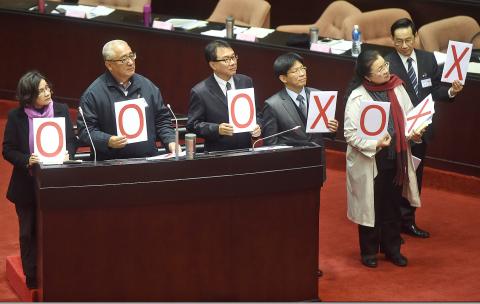
Photo: Chien Jung-fong, Taipei Times
“If all Control Yuan members can live up to the standards set by Huang and Chang Teh-ming when investigating,” Tien said, before she was interrupted by Lee, who demanded a straight answer.
Tien said she conditionally agreed.
Until the Constitution is amended, it is necessary to retain the Control Yuan, which could be repurposed in the meantime, Wang said.
Perin said he would agree to abolish it if a constitutional amendment was passed by lawmakers and approved via a referendum.
Kao said the Control Yuan has no place in his ideal constitutional system, but that does not mean he endorses annulling the right of audit, which should be returned to the legislature after the Constitution is amended.
Lin said he conditionally agreed.
Peter Chang was the only nominee who unconditionally agreed to the idea.
Lee then asked Tien whether she would stand her ground on US pork containing ractopamine and file a correction against the Council of Agriculture if it allowed US pork to be imported.
After Tien said she would, Lee challenged her response.
“Of course I would,” Tien said.
The KMT lawmaker then asked Kao whether he would open a case to investigate police who allegedly obstructed lawyers offering legal assistance to labor rights campaigners lying down on the tracks at Taipei Railway Station on Monday in a protest over amendments to the Labor Standards Act (勞動基準法).
Kao declined to comment on an “isolated” case, saying that it would hamper his investigative neutrality if his nomination is approved by lawmakers on Tuesday next week.
However, after Lee pressed him, Kao said that authorities should treat lawyers performing their duties with a certain level of respect, adding that he would investigate what he deems worthy issues if confirmed.
KMT Legislator Chen Yi-min (陳宜民) asked the six nominees whether they were members of a political party, and found that, except for Kao and Peter Chang, all are members of the DPP.
Tien protested after being asked by Chen if she believed that Control Yuan members should look past their political affiliations, saying that she is “clearly” politically affiliated, but that does not mean she would perform her duties as Control Yuan member in a biased manner.

FUKUOKA SITUATION: Japanese media reported that the pathogen is expected to be identified by the summer, while the CDC downplayed the idea that it was hMPV A “mysterious cold-like illness” reported in Japan’s Fukuoka Prefecture does not seem to be a new disease, but Japanese authorities have been asked about the situation, the Centers for Disease Control (CDC) said yesterday. The Fukuoka Prefectural Medical Association on Wednesday told a news conference that a “mystery cold” that has become a hot topic on social media is “highly likely to be caused by some kind of viral infection,” Japan’s KBC News reported. “Many people are experiencing symptoms starting with a sore throat, followed by a runny nose, phlegm and a severe cough,” KBC News reported, citing association officials. Health authorities are

Nvidia Corp CEO Jensen Huang (黃仁勳) arrived in Taiwan yesterday ahead of upcoming AI and technology events, saying he plans to meet with clients and Taiwan Semiconductor Manufacturing Co Chairman C.C. Wei (魏哲家) during his visit. After landing at Taipei Songshan Airport, Huang posed for photos with fans and handed out Yakult drinks to reporters and supporters waiting at the scene, saying he has “a lot to do” during the trip. Asked about reports that Nvidia’s planned headquarters site in Taipei’s Beitou Shilin Technology Park could break ground on May 27, Huang said that if the company holds an event, he would

The Ministry of Finance this afternoon announced the winning numbers for the March-April uniform invoice lottery. The winning number for the NT$10 million (US$318,060) special prize is 19531471, and the winning number for the NT$2 million grand prize is 85941329. Three numbers were drawn for the NT$200,000 first prize: 07225810, 20231230 and 83518781. Those with receipts matching the last seven digits of any of the first-prize numbers will win the NT$40,000 second prize, while those matching the last six digits will win the NT$10,000 third prize. Those whose receipts match the last five digits of the first-prize numbers can claim the NT$4,000 fourth prize,
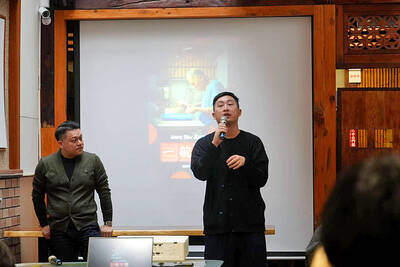
Taiwan Travelogue (臺灣漫遊錄), which earlier this week became the first Taiwanese novel to win the International Booker Prize, is to be adapted into a television series through a Taiwan-Japan coproduction, producer Chang Chen-yu (張辰漁) said yesterday. Chang, a producer at World Softest Production Film Co, wrote on Facebook that the company had been searching for projects with international appeal that retain a strong Taiwanese identity after colleagues and Japanese partners strongly recommended the novel. After reading the book, Chang said he immediately decided to pursue the screen rights. “A great story has the power to transcend time and borders, and connect countless people,”


 RSS
RSS