

The examination of past authoritarian rule as part of the transitional justice program should be carried out without commemorating the achievements of former presidents Chiang Kai-shek (蔣介石) and Chiang Ching-kuo (蔣經國), because the examination is aimed at revealing state violence during their authoritarian rule, Minister of Culture Cheng Li-chiun (鄭麗君) said at a meeting of the legislature’s Education and Culture Committee yesterday.
Cheng was debating the legacy of the two former presidents with Chinese Nationalist Party (KMT) lawmakers, who asked the Ministry of Culture (MOC) to give due credit to the former presidents while examining their human rights violations.
KMT Legislator Apollo Chen (陳學聖) asked Cheng and Minister of Education Pan Wen-chung (潘文忠) to name three achievements of the two presidents, but both refused to do so, saying that enough of their achievements have been taught through state education.
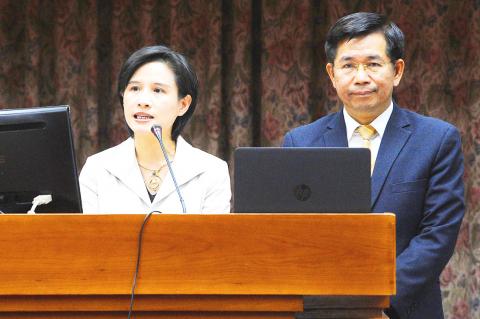
Photo: Chen Chih-chu, Taipei Times
“Examining the truth is not about comparing their achievements with wrongdoings, but to discover the truth about persecution,” Cheng said.
Chen criticized what he described as the ministry’s and the Democratic Progressive Party’s (DPP) “one-sided historical perspective,” as the Act on Promoting Transitional Justice (促進轉型正義條例), which was passed on Tuesday last week, does not address the injustices done to Aborigines and those committed during the Japanese colonial era.
The DPP has also failed to appreciate the KMT’s efforts in defending the nation and preserving National Palace Museum artifacts, Chen added.
Non-Partisan Solidarity Union Legislator May Chin (高金素梅) also questioned the act’s failure to address Aboriginal issues.
Citing DPP Legislator Rosalia Wu’s (吳思瑤) comments on Saturday that the act is part of “third wave democratization” and therefore does not include the more remote issue of Aboriginal transitional justice, Chin said the DPP is deceiving and alienating Aboriginal people.
“Screw your third wave democratization,” Chin said.
Cheng said to review the history of authoritarian rule should not involve the commemoration of the achievements of former presidents, but should instead seek to reconstruct history from the perspective of the victims of past persecutions.
“Do Europeans commemorate Hitler’s achievements when dealing with the Holocaust?” Cheng asked.
Considering the proposals to repurpose and rename the Chiang Kai-shek Memorial Hall, the MOC will not unilaterally decide its future functions, but will instead conduct a five-day forum next year to invite discussions about the proposals.
The MOC will then propose a draft bill to reinvent the memorial hall based on opinions collected from the forum, Cheng said.
“The bottom-up consensus-forming process should not be the same with the top-down authoritarian decisionmaking process that authorized the construction of the memorial hall. The rights to interpretation and decisionmaking should be returned to the public,” she said.
The MOC will also preserve 45 historic sites where political persecution took place and launch an educational program centered on those historic sites, the minister said.
Transitional justice cannot be reduced to renaming roads and schools or misinterpreted as political confrontation — it is to compensate victims and achieve reconciliation, she said.
While there are 29 schools in the nation named after Chiang Kai-shek and another five named to laud his longevity, Pan said that whether they should be renamed depends on democratic discussions among school faculties, students and alumni.
The democratic consensus-forming process will be the most meaningful achievement during the course of campus transitional justice, Pan added.
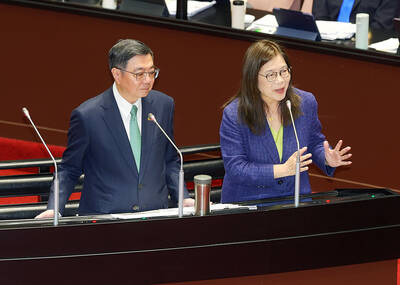
The donation of offshore patrol vessel Kinmen to the Philippines includes provisions that protect Taiwanese fishers and facilitate security cooperation across the First Island Chain, officials said yesterday. The comment was made during the Cabinet’s comprehensive administrative report at the legislature after Chinese Nationalist Party (KMT) Legislator Hsu Yu-chen (許宇甄) expressed concerns about the decision to give a ship to a country whose coast guard had in 2013 fired on a Taiwanese trawler and killed its captain without provocation. The Cabinet should lay out the safeguards that have been established to prevent the Philippine government from using the Kinmen to harass, expel
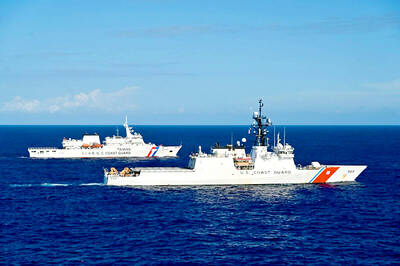
GROWING TIES: The CGA is planning a goodwill mission to the Philippines, in what would be the first time since 1975 a Taiwanese paramilitary vessel has visited the country The Coast Guard Administration (CGA) plans to significantly expand its participation in international security cooperative frameworks and its operational capabilities, a budget proposal for next year showed. The budget indicates a transformation of the CGA from a maritime law enforcement arm into a national defense and intelligence gathering entity capable of tackling larger regional security matters. The proposal showed that personnel from the coast guard’s Intelligence Division and Special Action Support Center are to participate in high-level national security talks with the US. As the CGA has dealt with China’s rising “gray zone” threats around Taiwan, it has become a valuable asset to
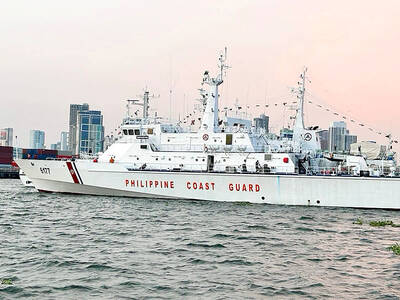
A patrol vessel donated by the Coast Guard Administration (CGA) to the Philippines was commissioned into the Philippine Coast Guard (PCG) on Friday, a Philippine non-governmental organization said. The CGA on Sept. 16 confirmed media reports that Taiwan had donated a retired 500-tonne patrol vessel to the Philippines. The Manila-based We Protect Our Seas (WPS) foundation, which served as an intermediary in the transfer, said that the vessel was formerly the CGA’s 500-tonne petrol vessel Kinmen (CG123). The WPS, in a statement issued on Friday, said the vessel, renamed as the BRP Sarangani, had been commissioned into the PCG the
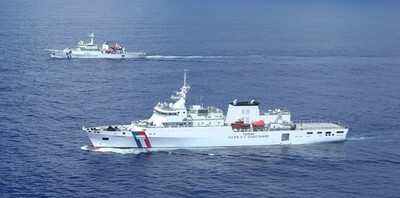
The Coast Guard Administration (CGA) today said that two of its patrol vessels have docked at Palau's Malakal Harbor as part of an expedition exercise and diplomatic visit, during which a senior official is expected to meet with the Palauan president. The two vessels, the 4,000-tonne-class Chiayi (嘉義) and the 1,000-tonne-class Penghu (澎湖), set sail for Palau from Taiwan last week and arrived at Malakal Harbor yesterday, the CGA's Fleet Branch said in a statement. The journey marked the second time the CGA has dispatched a "Friendship Fleet" to another country, after it sent its first-ever goodwill fleet, comprising the Hualien (花蓮)


 RSS
RSS