


The nation should consider phasing out cars powered by fossil fuels to reduce air pollution, following the model of some European countries, Premier William Lai (賴清德) has said.
Some European nations have announced that they would place a ban on the sale of gasoline and diesel-powered cars by 2040, while more than 100 Chinese cities are to replace gasoline-powered scooters with electric ones by 2030, Lai said in an interview published yesterday by the Chinese-language Mirror Media magazine.
The government should evaluate when those goals can be achieved in Taiwan, Lai said.
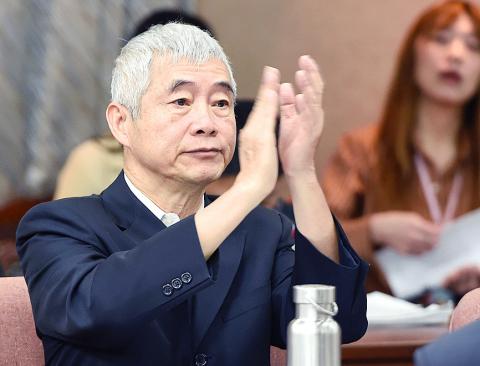
Photo: Liao Chen-huei, Taipei Times
One-third of the air pollutants in Taiwan are from traffic emissions, while factory and power-plant emissions make up another third and the rest originates from other nations, mainly China, Lai said.
The government needs to implement measures to reduce traffic emissions and develop public transportation, he said, adding that at the least, subsidies should be provided for all cities and counties to develop an express bus service.
The six-route express bus service in Tainan — fashioned after the routes of Taipei’s Mass Rapid Transit System — helped boost the number of bus travelers from 7.24 million in 2009 to 20 million last year, Lai said.
To reduce emissions from coal-fired power plants, they are to be refitted with ultra-supercritical power generators, while advanced pollution prevention equipment are to operate on low capacity during peak pollution periods, he added.
Meanwhile, Minister of Transportation and Communications Hochen Tan (賀陳旦) said his ministry would ban vehicles that run on fossil fuels no later than 2040.
During a question-and-answer session at a meeting of the legislature’s Transportation Committee, Hochen said the ministry has been discussing with the Ministry of Economic Affairs and the Environmental Protection Administration about across-the-board adoption of electric vehicles, which should happen no later than 2040, when most developed nations are set to ban such vehicles.
Asked if Taiwan could catch up with China in phasing out fossil-fuel-powered motorcycles by 2030, Hochen said the goal is hardly attainable with the number of scooters in Taiwan.
Compulsory emission tests are ineffective, as trucks, buses and heavy vehicles are producing more pollutants than they are allowed, Democratic Progressive Party Legislator Cheng Pao-ching (鄭寶清) said, calling for improved efforts to promote electric vehicles.
Electric cars could not reduce pollution, because they only trade traffic emissions for power-plant emissions, and full electrification means high facility costs and technical challenges, independent Legislator Chao Cheng-yu (趙正宇) said, adding that promoting hybrid vehicles would be a practical solution.
Meanwhile, Taiwan External Trade Development Council chairman James Huang (黃志芳) lauded Lai’s announcement as a correct policy direction that can stimulate the development of the local electric vehicle industry.
Government policy is a catalyst for industrial development, Huang said, citing the exemption of Chinese electric car owners from registration fees and a highway toll-free scheme extended to electric car owners in some European nations.
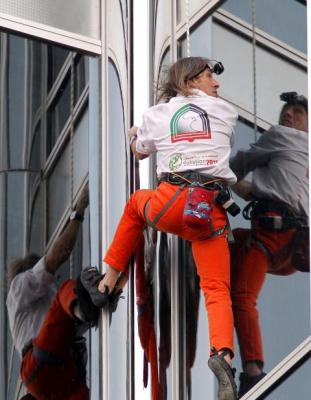
Alain Robert, known as the "French Spider-Man," praised Alex Honnold as exceptionally well-prepared after the US climber completed a free solo ascent of Taipei 101 yesterday. Robert said Honnold's ascent of the 508m-tall skyscraper in just more than one-and-a-half hours without using safety ropes or equipment was a remarkable achievement. "This is my life," he said in an interview conducted in French, adding that he liked the feeling of being "on the edge of danger." The 63-year-old Frenchman climbed Taipei 101 using ropes in December 2004, taking about four hours to reach the top. On a one-to-10 scale of difficulty, Robert said Taipei 101

Nipah virus infection is to be officially listed as a category 5 notifiable infectious disease in Taiwan in March, while clinical treatment guidelines are being formulated, the Centers for Disease Control (CDC) said yesterday. With Nipah infections being reported in other countries and considering its relatively high fatality rate, the centers on Jan. 16 announced that it would be listed as a notifiable infectious disease to bolster the nation’s systematic early warning system and increase public awareness, the CDC said. Bangladesh reported four fatal cases last year in separate districts, with three linked to raw date palm sap consumption, CDC Epidemic Intelligence

US climber Alex Honnold left Taiwan this morning a day after completing a free-solo ascent of Taipei 101, a feat that drew cheers from onlookers and gained widespread international attention. Honnold yesterday scaled the 101-story skyscraper without a rope or safety harness. The climb — the highest urban free-solo ascent ever attempted — took just more than 90 minutes and was streamed live on Netflix. It was covered by major international news outlets including CNN, the New York Times, the Guardian and the Wall Street Journal. As Honnold prepared to leave Taiwan today, he attracted a crowd when he and his wife, Sanni,

Taiwanese and US defense groups are collaborating to introduce deployable, semi-autonomous manufacturing systems for drones and components in a boost to the nation’s supply chain resilience. Taiwan’s G-Tech Optroelectronics Corp subsidiary GTOC and the US’ Aerkomm Inc on Friday announced an agreement with fellow US-based Firestorm Lab to adopt the latter’s xCell, a technology featuring 3D printers fitted in 6.1m container units. The systems enable aerial platforms and parts to be produced in high volumes from dispersed nodes capable of rapid redeployment, to minimize the risk of enemy strikes and to meet field requirements, they said. Firestorm chief technology officer Ian Muceus said


 RSS
RSS