


The Ministry of Transportation and Communications has pledged to complete and promulgate regulations regarding the management of driverless cars, as well as an amendment to the definition of “car,” by the end of the year.
The ministry’s comments came in light of legal obstacles blocking tests of driverless buses in Taipei and Kaohsiung, primarily due to the applications for tests being denied based on the legal definition of “car.”
Under the Regulations for Road and Traffic Safety (道路交通安全規則), a car is defined as having a steering wheel and requiring a number of emergency exits.
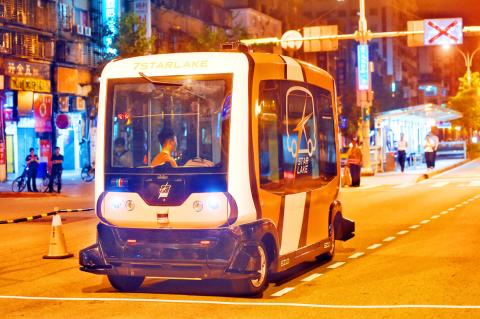
Photo: Fang Pin-chao, Taipei Times
According to the draft regulations on submitting an application to test driverless vehicles, vehicles are considered to have met the criteria of Society of Automotive Engineers Level 3 autonomous driving if the system installed on driverless buses can automatically control the steering, control the vehicle’s speed and monitor its environment.
The ministry’s Technological Consultation Office Director Wang Mu-heng (王穆衡) said that the draft drew from the experience of Google’s driverless vehicle tests and demands that at least one staff member must be present on a driverless bus during trial operations to provide manual driving services should there be a system failure.
All driverless buses must have equipment onboard that records its driving paths and all buses must be insured in the case of an accident, the ministry said.
There are still no insurance packages offered for driverless vehicles and while the ministry has considered placing the cost of insurance packages at NT$150 million (US$4.98 million), it might prove too steep a price for vehicle testers, Wang said.
The ministry is to hold another meeting next week to determine the amount of insurance packages and to consider alternative ways — such as offering secured assets, or initiating trials at times and locations with less traffic — to lower insurance costs, Wang said.
The timing and locations could be designated by those wishing to test the vehicles, the ministry said, but added that testing must first be conducted in closed areas and on restricted roads before trial would be allowed on unrestricted roads.

Yangmingshan National Park authorities yesterday urged visitors to respect public spaces and obey the law after a couple was caught on a camera livestream having sex at the park’s Qingtiangang (擎天崗) earlier in the day. The Shilin Police Precinct in Taipei said it has identified a suspect and his vehicle registration number, and would summon him for questioning. The case would be handled in accordance with public indecency charges, it added. The couple entered the park at about 11pm on Thursday and began fooling around by 1am yesterday, the police said, adding that the two were unaware of the park’s all-day live

Fast food chain McDonald's is to raise prices by up to NT$5 on some products at its restaurants across Taiwan, starting on Wednesday next week, the company announced today. The prices of all extra value meals and sharing boxes are to increase by NT$5, while breakfast combos and creamy corn soup would go up by NT$3, the company said in a statement. The price of the main items of those meals, if ordered individually, would remain the same. Meanwhile, the price of a medium-sized lemon iced tea and hot cappuccino would rise by NT$3, extra dipping sauces for chicken nuggets would go up

Yangmingshan National Park’s Qingtiangang (擎天崗) nature area has gone viral after a park livestream camera observed a couple in the throes of intimate congress, which was broadcast live on YouTube, drawing large late-night crowds and sparking a backlash over noise, bright lights and disruption to wildlife habitat. The area’s livestream footage appeared to show a couple engaging in sexual activity on a picnic table in the park on Friday last week, with the uncensored footage streamed publicly online. The footage quickly spread across social media, prompting a tide of visitors to travel to the site to “check in” and recreate the

Minister of Digital Affairs Lin Yi-ching (林宜敬) yesterday cited regulatory issues and national security concerns as an expert said that Taiwan is among the few Asian regions without Starlink. Lin made the remarks on Facebook after funP Innovation Group chief executive officer Nathan Chiu (邱繼弘) on Friday said Taiwan and four other countries in Asia — China, North Korea, Afghanistan and Syria — have no access to Starlink. Starlink has become available in 166 countries worldwide, including Ukraine, Malaysia, the Philippines and Vietnam, in the six years since it became commercial, he said. While China and North Korea block Starlink, Syria is not


 RSS
RSS