


Beijing is to exert more pressure on Taiwan by stepping up its dual strategy of draining the nation of its workforce while coercing Taiwan by diplomatic means, Mainland Affairs Council (MAC) Minister Katharine Chang (張小月) said yesterday during a forum discussing cross-strait relations following the Chinese Communist Party’s 19th National Congress.
While Beijing has not changed its policy toward Taiwan, despite incorporating Chinese President Xi Jinping’s (習近平) cross-strait “family” motif during the congress, it will continue its “dual strategy of courting and coercing,” Chang told the forum organized by Democratic Progressive Party (DPP) lawmakers at the Legislative Yuan in Taipei.
“Beijing will be softer on its soft strategy and tougher on its hardline strategy,” she said.
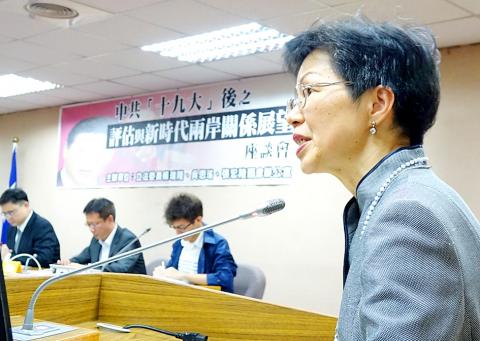
Photo: Chu Pei-hsiung, Taipei Times
It would continue the “one generation and one stratum” policy to attract Taiwan’s younger generation and the grassroots stratum with occupational, educational and other preferential treatment in a bid to assimilate Taiwanese, Chang said.
On the diplomatic front, Beijing will redouble its efforts to impose the “one China” principle on the international community and curb Taiwan’s international presence, she said.
The cross-strait relations have moved to a new phase after the DPP administration took office in May last year, and both sides have to form a new mindset and put aside disputes to develop a peaceful and prosperous relationship, she said.
President Tsai Ing-wen (蔡英文) has reiterated that her administration would not change its goodwill or promises toward Beijing and would not return to confrontation or succumb to pressure, Chang said, calling on Beijing to start a friendly dialogue with Taipei.
Council Deputy Minister Chiu Chui-cheng (邱垂正) said Xi has not proposed any essential Taiwan policy, which might be put forward during his second term, adding that the council would be closely watching Beijing’s moves.
National Taiwan University politics professor Chen Ming-tung (陳明通) said there would not be dramatic changes to cross-strait relations in the next 30 years if Taiwan can maintain the strategic balance between Taiwan, China and the US.
Over a multilateral interaction spanning six decades, a strategic balance has been achieved between Taiwan, the US and China, with Taiwan achieving a peaceful autonomy, China preventing Taiwan from seeking de jure independence and the US preventing Taiwan from becoming a Chinese military base, Chen said.
Taiwan has to keep that balance while seeking to develop a new mode of cross-strait interaction, Chen said.
Tamkang University politics professor Chang Wu-Ueh (張五岳) said China is reshuffling its Central Leading Group for Taiwan Affairs, which is expected to be led by experts of China-US relations including Chinese Vice Premier Wang Yang (汪洋) and Chinese Ambassador to the UN Liu Jieyi (劉結一).
China-US relationship is the most critical bilateral relations to cross-strait and international relations, and Beijing’s new leadership group is the one that is most familiar with the US in history, and Taiwan needs to prepare for possible effects on cross-strait relations, Chang said.
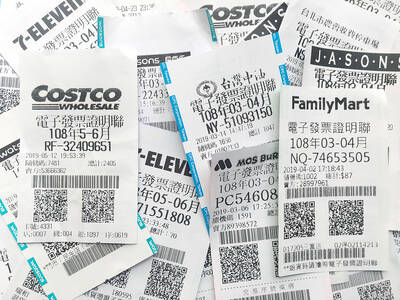
A NT$39 receipt for two bottles of tea at a FamilyMart was among the NT$10 million (US $312,969) special prize winners in the January-February uniform invoice lottery. FamilyMart said that two NT$10 million-winning receipts were issued at its stores, as well as two NT$2 million grand prizes and three NT$200,000 first prizes. The two NT$10 million receipts were issued at stores in Pingtung County and Yilan County’s Dongshan Township (冬山). One winner spent just NT$39 on two bottles of tea, while another spent NT$80 on water, tea and coffee, the company said. Meanwhile, 7-Eleven reported three NT$10 million winners — in New Taipei

Considering that most countries issue more than five denominations of banknotes, the central bank has decided to redesign all five denominations, the bank said as it prepares for the first major overhaul of the banknotes in more than 24 years. Central bank Governor Yang Chin-lung (楊金龍) is expected to report to the Legislative Yuan today on the bank’s operations and the redesign’s progress. The bank in a report sent to the legislature ahead of today’s meeting said it had commissioned a survey on the public’s preferences. Survey results showed that NT$100 and NT$1,000 banknotes are the most commonly used, while NT$200 and NT$2,000

The Centers for Disease Control (CDC) yesterday reported the first case of a new COVID-19 subvariant — BA.3.2 — in a 10-year-old Singaporean girl who had a fever upon arrival in Taiwan and tested positive for the disease. The girl left Taiwan on March 20 and the case did not have a direct impact on the local community, it said. The WHO added the BA.3.2 strain to its list of Variants Under Monitoring in December last year, but this was the first imported case of the COVID-19 variant in Taiwan, CDC Deputy Director-General Lin Ming-cheng (林明誠) said. The girl arrived in Taiwan on

ANNUAL EVENT: Two massive Pokemon balloons are to be set up in Daan Park, with an event zone operating from 10am to 6pm This year’s Taipei Floral Picnic is to be held at Daan Park today and tomorrow, featuring an exclusive Pokemon Go event, a themed food market, a coffee rave picnic area and stage performances, the Taipei Department of Information and Tourism said yesterday. Two massive Pokemon balloons are to be set up in the park as attractions, with an exclusive event zone operating from 10am to 6pm, it said. Participants who complete designated tasks on-site would have a chance to receive limited-edition souvenirs, it added. People could also try the newly launched game Pokemon Pokopia in the trial area, the department said. Three PokeStops are


 RSS
RSS