


Former president Ma Ying-jeou (馬英九) yesterday issued a four-point suggestion for President Tsai Ing-wen (蔡英文) to improve the deteriorating cross-strait ties, as several Chinese Nationalist Party (KMT) heavyweights commemorated the anniversary of Taiwan’s lifting of the ban on veterans visiting China in 1987, which paved the way for decades of warmer ties across the Taiwan Strait.
Ma made the comments at a KMT-sponsored commemoration of the 30th anniversary of the historical event, which was also attended by KMT Chairman Wu Den-yih (吳敦義), KMT vice chairmen Tseng Yung-chuan (曾永權) and Hau Lung-bin (郝龍斌), and former KMT chairman Wu Poh-hsiung (吳伯雄).
Ma said cross-strait relations had worsened over the past year-and-a-half to the point that they are now a source of great apprehension.
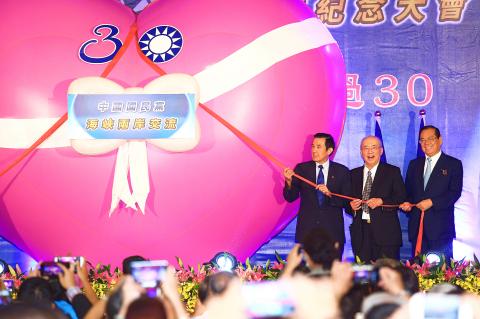
Photo: CNA
He called on the Tsai administration to “return to the Constitution, return to the ‘1992 consensus,’ oppose Taiwanese independence and peacefully develop [cross-strait relations].”
The so-called “1992 consensus” refers to a tacit understanding between the KMT and Beijing that both sides of the Taiwan Strait acknowledge there is “one China,” with each side having its own interpretation of what “China” means. Former Mainland Affairs Council chairman Su Chi (蘇起) said in 2006 that he had made up the term in 2000.
According to the constitution, cross-strait relations are relations between two areas of the Republic of China, Ma said.
On the basis of this understanding, the “1992 consensus” that allowed both sides to have different interpretations of “one China” emerged, he said, adding that those ideas allowed cross-strait relations to develop smoothly and unhindered.
Ma also stressed the gravity of Tsai’s failure to mention the constitution or the Act Governing Relations Between the People of the Taiwan Area and the Mainland Area (台灣地區與大陸地區人民關係條例) in her Double Ten National Day speech, as she had done during a US trip two years ago and during her inauguration last year.
“I hope it was just an oversight. If it was intentional, then it is very serious,” he said.
Both sides of the Strait must go back to the “1992 consensus” if the relationship is to be saved, he said.
“The ‘1992 consensus’ is very important to Taiwan. It gives Taiwan space to develop, but the Democratic Progressive Party does not accept it,” he said.
Ma said that Tsai used to abide by the “1992 consensus” when she was minister of the Mainland Affairs Council in 2000, but she has not acknowledged the formula since taking office.
The former president also called on the Tsai administration to oppose Taiwanese independence.
“Individuals can advocate independence as part of free speech, but for the head of the highest executive body to advocate independence in the Legislative Yuan is a very serious matter,” Ma said in reference to comments by Premier William Lai (賴清德).
“For the premier to advocate independence and the president to omit mention of the Constitution or cross-strait relations in her National Day speech will bring about misunderstanding,” he said, adding: “Cross-strait relations are already in a slump. Restoring warm relations in the future is going to be harder and harder.”
Ma said that completely breaking away from China is impossible, adding that not every nation that declares independence will be recognized by the world.
He said he does not believe that the nation’s 20 diplomatic allies would continue to recognize the nation if it changed its name.
Several independence-leaning legislators had hoped to lower the referendum threshold for making changes to the nation’s claimed territory, but quickly abandoned the idea out of fear of serious consequences, Ma said.
“The premier has said he will not promote independence again, so what need is there to talk about it again? It will only cause suspicion among the public and will not gain international support,” he said.
Ma said reports from the Ministry of National Defense that it could defend the nation for two weeks in the event of an attack by China were hard for him to read.
“There is no need to defend from an attack if we can get along peacefully. [We should] use peaceful cross-strait relations to prevent war in the first place,” Ma said.

Taiwanese can file complaints with the Tourism Administration to report travel agencies if their activities caused termination of a person’s citizenship, Mainland Affairs Council Minister Chiu Chui-cheng (邱垂正) said yesterday, after a podcaster highlighted a case in which a person’s citizenship was canceled for receiving a single-use Chinese passport to enter Russia. The council is aware of incidents in which people who signed up through Chinese travel agencies for tours of Russia were told they could obtain Russian visas and fast-track border clearance, Chiu told reporters on the sidelines of an event in Taipei. However, the travel agencies actually applied
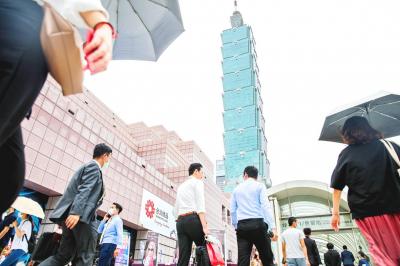
Japanese footwear brand Onitsuka Tiger today issued a public apology and said it has suspended an employee amid allegations that the staff member discriminated against a Vietnamese customer at its Taipei 101 store. Posting on the social media platform Threads yesterday, a user said that an employee at the store said that “those shoes are very expensive” when her friend, who is a migrant worker from Vietnam, asked for assistance. The employee then ignored her until she asked again, to which she replied: "We don't have a size 37." The post had amassed nearly 26,000 likes and 916 comments as of this

New measures aimed at making Taiwan more attractive to foreign professionals came into effect this month, the National Development Council said yesterday. Among the changes, international students at Taiwanese universities would be able to work in Taiwan without a work permit in the two years after they graduate, explainer materials provided by the council said. In addition, foreign nationals who graduated from one of the world’s top 200 universities within the past five years can also apply for a two-year open work permit. Previously, those graduates would have needed to apply for a work permit using point-based criteria or have a Taiwanese company
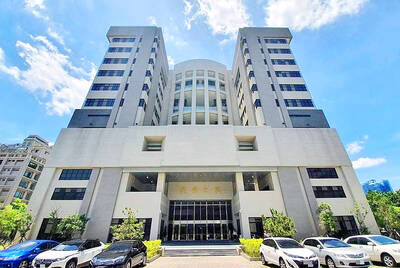
The Shilin District Prosecutors’ Office yesterday indicted two Taiwanese and issued a wanted notice for Pete Liu (劉作虎), founder of Shenzhen-based smartphone manufacturer OnePlus Technology Co (萬普拉斯科技), for allegedly contravening the Act Governing Relations Between the People of the Taiwan Area and the Mainland Area (臺灣地區與大陸地區人民關係條例) by poaching 70 engineers in Taiwan. Liu allegedly traveled to Taiwan at the end of 2014 and met with a Taiwanese man surnamed Lin (林) to discuss establishing a mobile software research and development (R&D) team in Taiwan, prosecutors said. Without approval from the government, Lin, following Liu’s instructions, recruited more than 70 software


 RSS
RSS