


New Taipei City police on Sunday arrested 14 people suspected of involvement in a fraud ring that allegedly stole money through unauthorized payment channels on the online shopping site Shopee.
Police said they suspect the leader of the ring to be a 39-year-old man surnamed Su (蘇), who purloined a total of NT$1.5 million (US$49,381) from 36 buyers over the past seven months.
Su and others were apprehended during raids that were carried out over the past several days, Sinjhuang Precinct investigation brigade chief Chang Chun-ming (張俊明) said, adding that they will continue to investigate the case as prosecutors pursue fraud charges against the 14 suspects.
“Su headed up the group that put items up for sale on Shopee. They attracted buyers with lower-than-market prices for mobile phones, personal electronics and household appliances,” Chang said.
The group circumvented the authorized payment channels by calling potential buyers and offering even lower prices for purchases made outside the official Shopee platform, Chang said.
“The buyers wired the money to accounts set up by Su, who then dispatched group members to collect the money, but the buyers never received the purchased items,” he said.
A buyer tipped off the authorities earlier this year, but it took more than six months of monitoring the transactions and investigating before police could track down Su and the others, Chang said.
Shopee, a subsidiary of Singapore-based computer gaming company Garena, was launched in Taiwan in October 2015.
Garena, which in May changed its name to Sea Ltd, was founded in 2009 by Singaporean entrepreneur Forrest Li (李小冬) and has since branched out to e-commerce and other businesses. It is now one of Southeast Asia’s leading mobile shopping and payment services.
Chinese tech giant Tencent Holdings had been a major shareholder in the firm since 2013, raising concerns that personal information and financial records from transactions would be passed to the Chinese government, breaching personal privacy and undermining Taiwan’s national security.
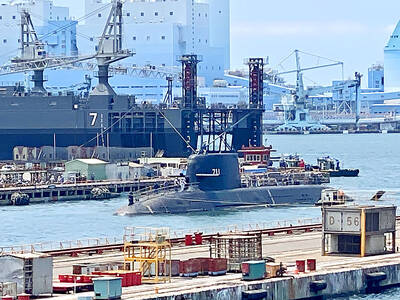
AGING: While Japan has 22 submarines, Taiwan only operates four, two of which were commissioned by the US in 1945 and 1946, and transferred to Taiwan in 1973 Taiwan would need at least 12 submarines to reach modern fleet capabilities, CSBC Corp, Taiwan chairman Chen Cheng-hung (陳政宏) said in an interview broadcast on Friday, citing a US assessment. CSBC is testing the nation’s first indigenous defense submarine, the Hai Kun (海鯤, Narwhal), which is scheduled to be delivered to the navy next month or in July. The Hai Kun has completed torpedo-firing tests and is scheduled to undergo overnight sea trials, Chen said on an SET TV military affairs program. Taiwan would require at least 12 submarines to establish a modern submarine force after assessing the nation’s operational environment and defense

A white king snake that frightened passengers and caused a stir on a Taipei MRT train on Friday evening has been claimed by its owner, who would be fined, Taipei Rapid Transit Corp (TRTC) said yesterday. A person on Threads posted that he thought he was lucky to find an empty row of seats on Friday after boarding a train on the Bannan (Blue) Line, only to spot a white snake with black stripes after sitting down. Startled, he jumped up, he wrote, describing the encounter as “terrifying.” “Taipei’s rat control plan: Release snakes on the metro,” one person wrote in reply, referring
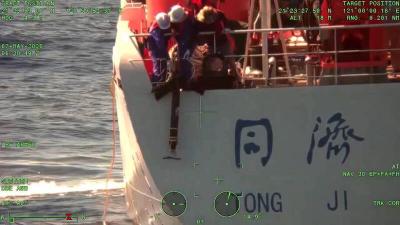
The coast guard today said that it had disrupted "illegal" operations by a Chinese research ship in waters close to the nation and driven it away, part of what Taipei sees a provocative pattern of China's stepped up maritime activities. The coast guard said that it on Thursday last week detected the Chinese ship Tongji (同濟號), which was commissioned only last year, 29 nautical miles (54km) southeast of the southern tip of Taiwan, although just outside restricted waters. The ship was observed lowering ropes into the water, suspected to be the deployment of scientific instruments for "illegal" survey operations, and the coast
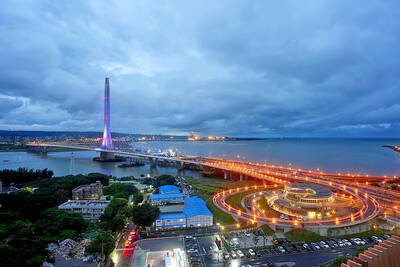
An inauguration ceremony was held yesterday for the Danjiang Bridge, the world’s longest single-mast asymmetric cable-stayed bridge, ahead of its official opening to traffic on Tuesday, marking a major milestone after nearly three decades of planning and construction. At the ceremony in New Taipei City attended by President William Lai (賴清德), Premier Cho Jung-tai (卓榮泰), Minister of Transportation and Communications Chen Shih-kai (陳世凱) and New Taipei City Mayor Hou Yu-ih (侯友宜), the bridge was hailed as both an engineering landmark and a long-awaited regional transport link connecting Tamsui (淡水) and Bali (八里)


 RSS
RSS