


The government will spend NT$380 million (US$12.5 million) on the establishment of a new car assessment program, Minister of Transportation and Communications Hochen Tan (賀陳旦) said this week, adding that the program would be ready in two years.
Hochen and Premier William Lai (賴清德) talked about the plan at a legislative plenary session on Tuesday when questioned by Democratic Progressive Party Legislator Lin Shu-feng (林淑芬).
Lin asked if the Ministry of Transportation and Communications (MOTC) plans to allocate NT$100 million each year to buy cars and conduct collision tests based on the standards.
Test results would affect how people choose the cars they want to buy, which in turn forces automakers to upgrade their safety features, she said.
Hochen said that the program’s timeline was finalized at a discussion on Tuesday.
The government would spend about NT$380 million in the initial phase, he said, adding that an annual operational fund of NT$92 million to NT$100 million would also be allocated to ensure the program’s continuation.
“We want the operational fund to come not only from the government’s budget, but also from drivers’ car insurance fees,” he said.
Lai promised that funding for the program would not be an issue.
Hochen on Monday said in a meeting of the legislature’s Transportation Committee that the ministry would reveal more details before the end of this year as to when and how the program would be enforced.
Earlier this year, some people proposed that the government require automakers to publish the results of collision tests on an online public policy forum established by the National Development Council before the cars enter the market.
The ministry and the Vehicle Safety Certification Center in June held a forum to discuss the proposal.
The ministry began drafting regulations after the proposal secured enough online backing following a second deliberation on June 18.
Tsai Yu-ting (蔡育庭) on auto blog www.7car.tw said that new car assessment programs in other nations are enforced by third-party institutions supported either by the private sector or the government.
Tests are conducted on cars that are available for purchase, Tsai said, adding that they are different from collision tests stipulated by government regulations.
“The purpose of the program is to use higher standards to evaluate cars, and the test results would be presented using a star-rating system,” Tsai said, adding that the program is viewed as a way to encourage automakers to improve car safety features.
However, Tsai said that test items should be carried out in accordance with the standards set in the program if the nation is considering using the same or a similar program.
These would include testing grounds, equipment and the qualifications of test administrators, Tsai added.
“Whether Taiwan would follow an existing car assessment program or create a similar program would affect the credibility of the tests,” Tsai said, adding that people should also pay attention to whether Taiwan’s program is stricter than other assessment programs, which could lead to trade barriers.

LOUD AND PROUD Taiwan might have taken a drubbing against Australia and Japan, but you might not know it from the enthusiasm and numbers of the fans Taiwan might not be expected to win the World Baseball Classic (WBC) but their fans are making their presence felt in Tokyo, with tens of thousands decked out in the team’s blue, blowing horns and singing songs. Taiwanese fans have packed out the Tokyo Dome for all three of their games so far and even threatened to drown out home team supporters when their team played Japan on Friday. They blew trumpets, chanted for their favorite players and had their own cheerleading squad who dance on a stage during the game. The team struggled to match that exuberance on the field, with
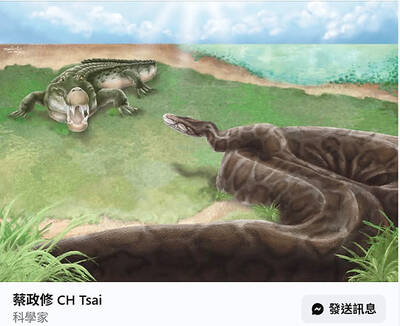
Taiwanese paleontologists have discovered fossil evidence that pythons up to 4m long inhabited Taiwan during the Pleistocene epoch, reporting their findings in the international scientific journal Historical Biology. National Taiwan University (NTU) Institute of Ecology and Evolutionary Biology associate professor Tsai Cheng-hsiu (蔡政修) led the team that discovered the largest snake fossil ever found in Taiwan. The single trunk vertebra was discovered in Tainan at the Chiting Formation, dated to between 400,000 and 800,000 years ago in the Middle Pleistocene, the paper said. The area also produced Taiwan’s first avian fossil, as well as crocodile, mammoth, saber-toothed cat and rhinoceros fossils, it said. Discoveries

Taiwanese paleontologists have discovered fossil evidence that pythons up to 4m long inhabited Taiwan during the Pleistocene epoch, reporting their findings in the international scientific journal Historical Biology. National Taiwan University (NTU) Institute of Ecology and Evolutionary Biology associate professor Tsai Cheng-hsiu (蔡政修) led the team that discovered the largest snake fossil ever found in Taiwan. A single trunk vertebra was discovered in Tainan at the Chiting Formation, dated to between 800,000 to 400,000 years ago in the Middle Pleistocene, the paper said. The area also produced Taiwan’s first avian fossil, as well as crocodile, mammoth, sabre-toothed cat and rhinoceros fossils, it said. Discoveries
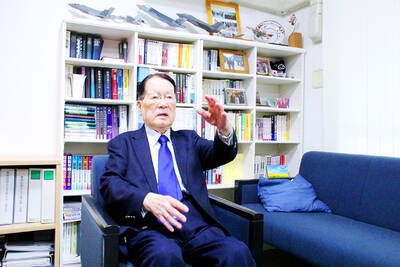
Whether Japan would help defend Taiwan in case of a cross-strait conflict would depend on the US and the extent to which Japan would be allowed to act under the US-Japan Security Treaty, former Japanese minister of defense Satoshi Morimoto said. As China has not given up on the idea of invading Taiwan by force, to what extent Japan could support US military action would hinge on Washington’s intention and its negotiation with Tokyo, Morimoto said in an interview with the Liberty Times (sister paper of the Taipei Times) yesterday. There has to be sufficient mutual recognition of how Japan could provide


 RSS
RSS