

The nation’s military is hopeful that Taiwan-US military cooperation will proceed apace if the US Congress passes the National Defense Authorization Act (NDAA) for Fiscal Year 2018, sources at the Ministry of National Defense said.
The US House of Representatives and the Senate have each passed a version of the bill and the two chambers still have to iron out their differences before the final bill can be forwarded for ratification by US President Donald Trump.
According to the bill, the US secretary of defense is to report to US congressional committees no later than Sept. 1 next year on the “feasibility and advisability” of the US Navy making port calls in Taiwan and of the Taiwanese navy the same in US territories.
The proposed bill would place certain obligations on the US to support Taiwan’s undersea warfare capabilities and invite its military to observe maneuvers.
The NDAA for this fiscal year has already established perimeters for exchanges or visits by the two nations’ military officers, ministry sources said on condition of anonymity.
Taiwan will continue to ask the US to allow high-ranking, active-service officers from both sides to visit and observe military maneuvers, the sources said.
The government is seeking to expand the categories of military cooperation between the two nations and is lobbying to send more groups of observers, they said.
The ministry’s plans to procure arms from the US would be guided by the military’s need to develop its capabilities and build on its current cooperative framework, they said.
The government has asked the US about procuring Lockheed-Martin F-35B Lightnings for the air force, the sources said.
However, Washington has expressed reservations about the proposal, citing Taiwan’s logistical capabilities to sustain stealth tactical aircraft and concern over reaction in the region to their presence, they said.
The military is re-evaluating other types of fighter jets that offer the same stealth capability and short takeoff and landing features, while it prepares the groundwork for its domestic jet program, they said.
In addition, the military is considering acquiring technical assistance outside of the US for its domestic submarine program, they said.
The NDAA may also authorize US assistance in Taiwan’s development of submarine vessels, which might refer to the upgrading of existing Chienlung-class boats rather than acquisition of new ones, they said.
It is too early at this point to speculate what the NDAA would portend for the nation’s navy, they said.
As the US Navy has no active surface diesel-electrical submarines, it is an open question what help, if any, the US may render, they said.
However, the US’ shipbuilding capabilities suggest that there are areas where interaction may be of benefit, they said.
The domestic submarine program’s requirements for resources, design and foreign assistance will be clarified in the first half of next year, they said.
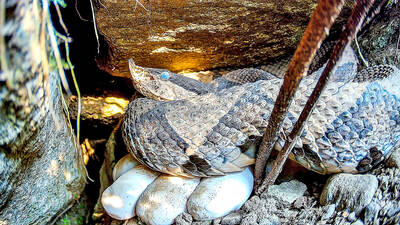
NATURE TAKES ITS COURSE: The agency’s head said he felt a sense of loss watching red-banded snakes eat the babies, as they had decided on non-intervention The Forestry and Nature Conservation Agency yesterday released a documentary on a hundred-pace viper that had incubated 16 eggs, all of which hatched, but only a baby viper escaped after they were attacked by red-banded snakes. The agency’s Taichung branch last year launched the viper reproduction monitoring project soon after forest rangers Lin Chun-yu (林俊佑) and Chou Chia-cheng (周家成) spotted a pregnant hundred-pace viper in a grass-covered burrow near a parking lot in Tbulan Village (松鶴部落). The Atayal village, in Taichung’s Heping District (和平), is headed by Ecyang Yapu, who was positive about the project and assisted in access control and power
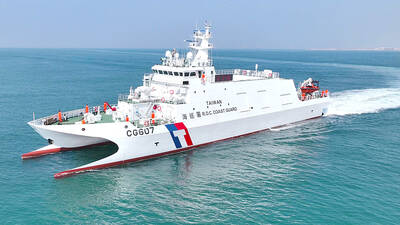
The Coast Guard Administration (CGA) yesterday said that it had deployed vessels to “monitor” Chinese ships operating in waters off the east coast. The CGA said it dispatched vessels in response to a China Coast Guard announcement that it had carried out another “routine law-enforcement patrol” in waters off the east coast. “The CGA firmly rejects China’s cognitive warfare campaign of ‘law enforcement in name, jurisdictional expansion in practice,’” it said on X. As of 11am yesterday, two China Coast Guard ships were “loitering and drifting” about 105 nautical miles (195km) and 74 nautical miles east of Green Island (綠島) respectively, it said. It

A Straits Exchange Foundation official today warned that yielding to political pressure in exchange for access to China’s entertainment industry rarely ends well, amid rumors that China is seeking to lure Taiwanese K-pop star Chou Tzu-yu (周子瑜). Chou, more commonly known as Tzuyu, is the only Taiwanese member of the girl group Twice. Her contract with JYP Entertainment is set to expire at the end of this year, and there have been widespread reports that she would not renew it. She is reportedly planning to pursue solo activities under her parents’ agency, Yu Hai Entertainment (瑜海娛樂), although China has also reportedly offered
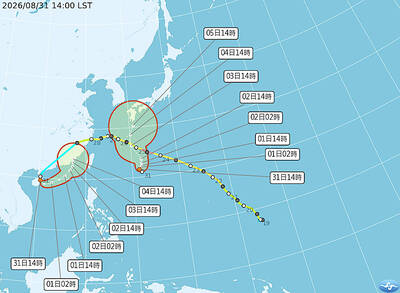
A tropical depression near Hainan that was once Typhoon Saudel may once again strengthen into a tropical storm, the Central Weather Administration (CWA) said yesterday, but a sea warning for waters around Taiwan is unlikely. CWA forecaster Huang En-hung (黃恩鴻) said that Saudel would return to being a weak tropical storm by late yesterday or early this morning. However, as the storm is to gradually weaken again and would head toward China’s Guangdong Province away from Taiwan, the chances that it would affect Taiwan enough for the CWA to issue a sea warning are relatively low,


 RSS
RSS