


Following the passage of a major pension reform bill, Democratic Progressive Party (DPP) Legislator Tuan Yi-kang (段宜康) yesterday announced that he would no longer run or hold any public office after the end of his term, as his mission of rolling out reforms would be completed by then.
“After the end of this term, I will not run anymore. I will not hold any position in the government, state-run businesses and legal entities or the DPP,” Tuan wrote on Facebook. “People who want to get back at me have to do it now. I will probably not be reachable in the future.”
The legislator-at-large has proposed and endorsed progressive bills on pension reform and same-sex marriage, making him a major target of criticism by reform opponents and conservatives.

Photo: Liao Chen-huei, Taipei Times
Chinese Nationalist Party (KMT) Taipei City Councilor Chung Hsiao-ping (鍾小平) on Monday threatened to “go after” Tuan “with thousands of knives” until the end of Tuan’s political career, after Tuan’s proposal to minimize the phaseout period of an 18 percent preferential savings rate for public employees was adopted.
A draft bill on pension reform proposed by Tuan included clauses that would accelerate the pace of pension cuts — including a two-year phaseout of the preferential savings rate, which was passed into law on Tuesday — and would lower the income replacement ratio for public employees to 60 percent in five years, which influenced the DPP caucus into accelerating the ratio cut from a proposed 15 years to 10 years.
Tuan has also endorsed a draft bill to legalize same-sex marriage by amending the Civil Code and has voiced objections to proposals to legislate a special same-sex marriage law, which advocates and opponents consider a middle ground.
“Those who criticize and threaten to chase and kill me do not understand me. As a legislator-at-large, I have chosen the most unpopular Judiciary and Organic Laws and Statutes Committee [of the Legislative Yuan] because there are missions to complete, including marriage equality, pension reform, transitional justice and legislative reform,” Tuan wrote.
The committee last year completed reviews of transitional justice and marriage equality bills, followed by pension reform this year, and is to begin reviewing legislation to reform the legislature next year, Tuan added.
The DPP did not comment on the announcement, which nearly amounts to a withdrawal from politics.
Tuan is a figurehead of the DPP’s New Tide faction, arguably the most influential group in the party.

The military has spotted two Chinese warships operating in waters near Penghu County in the Taiwan Strait and sent its own naval and air forces to monitor the vessels, the Ministry of National Defense (MND) said. Beijing sends warships and warplanes into the waters and skies around Taiwan on an almost daily basis, drawing condemnation from Taipei. While the ministry offers daily updates on the locations of Chinese military aircraft, it only rarely gives details of where Chinese warships are operating, generally only when it detects aircraft carriers, as happened last week. A Chinese destroyer and a frigate entered waters to the southwest

A magnitude 6.1 earthquake struck off the coast of Yilan County at 8:39pm tonight, the Central Weather Administration (CWA) said, with no immediate reports of damage or injuries. The epicenter was 38.7km east-northeast of Yilan County Hall at a focal depth of 98.3km, the CWA’s Seismological Center said. The quake’s maximum intensity, which gauges the actual physical effect of a seismic event, was a level 4 on Taiwan’s 7-tier intensity scale, the center said. That intensity level was recorded in Yilan County’s Nanao Township (南澳), Hsinchu County’s Guansi Township (關西), Nantou County’s Hehuanshan (合歡山) and Hualien County’s Yanliao (鹽寮). An intensity of 3 was

Instead of focusing solely on the threat of a full-scale military invasion, the US and its allies must prepare for a potential Chinese “quarantine” of Taiwan enforced through customs inspections, Stanford University Hoover fellow Eyck Freymann said in a Foreign Affairs article published on Wednesday. China could use various “gray zone” tactics in “reconfiguring the regional and ultimately the global economic order without a war,” said Freymann, who is also a nonresident research fellow at the US Naval War College. China might seize control of Taiwan’s links to the outside world by requiring all flights and ships entering or leaving Taiwan
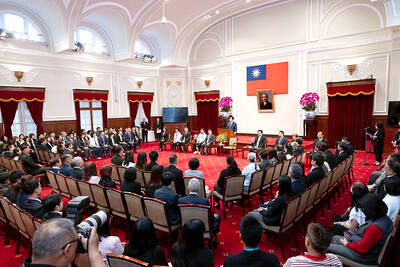
The next minimum wage hike is expected to exceed NT$30,000, President William Lai (賴清德) said yesterday during an award ceremony honoring “model workers,” including migrant workers, at the Presidential Office ahead of Workers’ Day today. Lai said he wished to thank the awardees on behalf of the nation and extend his most sincere respect for their hard work, on which Taiwan’s prosperity has been built. Lai specifically thanked 10 migrant workers selected for the award, saying that although they left their home countries to further their own goals, their efforts have benefited Taiwan as well. The nation’s industrial sector and small businesses lay


 RSS
RSS