


Former vice president Annette Lu (呂秀蓮) yesterday presented more evidence which she said showed that former president Ma Ying-jeou (馬英九) was involved in the formation of Taipei Fubon Commercial Bank (台北富邦銀行) , as she demanded that prosecutors conduct a thorough investigation of the case.
Lu accused Ma of influence-peddling and illegal conduct in Fubon Bank’s (富邦銀行) takeover of Taipei Bank (台北銀行) — resulting in the formation of Taipei Fubon Commercial Bank — in 2002 when Ma was Taipei mayor.
Others have also long suspected wrongdoing, alleging that Ma directed the takeover deal when state-owned Taipei Bank was under the city government’s control to generate more than NT$30 billion (US$992.5 million at the current exchange rate) in unlawful profits that benefited the bank’s owners and himself.
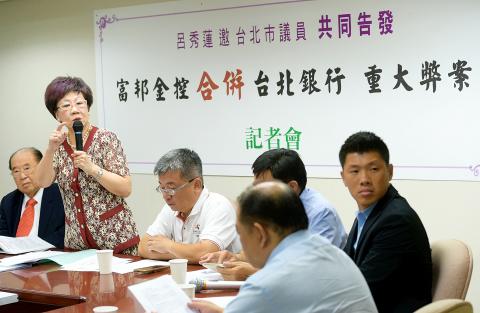
Photo: Chang Chia-ming, Taipei Times
The takeover deal was signed by then-Taipei Department of Finance director Lee Sush-ter (李述德), but the legal representative of the bank was Ma and Lee had no authorization to represent the city government, Lu said.
She said that according to the Company Act (公司法) and the Business Mergers and Acquisitions Act (企業併購法), when a company is being sold or taken over, the deal requires the approval of a majority of shareholders, while at least two-thirds have to attend a shareholders’ meeting.
“However, there was no shareholders’ meeting or a vote, and therefore the deal was illegal,” Lu said. “The Taipei City Government sold Taipei Bank’s 3,545 ping [11,719m2] of land and 27,000 ping [89,256m2] of commercial building floor space at lower than market valuation. So the bank’s owners acquired those assets at far below market prices.”
Lu also displayed a letter she said she received from then-Fubon Group chairman Tsai Wan-tsai (蔡萬才).
“During that period, I questioned the legality of the takeover during a media interview and called for the judiciary to conduct an investigation. Tsai was angered by my words, even though I had no particular reason to pick a fight with Fubon Group,” Lu said. “So Tsai sent me this letter, in which he questioned my understanding of the deal and said that my words were misguided. In the letter he wrote that [then-]president Chen Shui-bian (陳水扁) choosing me as vice president was a mistake and demanded that I withdraw from the 2004 presidential election.”
Lu said she was outraged at what Tsai had done.
“This is a very serious issue, that a business conglomerate can openly interfere in the nation’s political affairs,” she said.
Lu and some Democratic Progressive Party (DPP) Taipei city councilors said they has retained attorney George Wang (王可富) to pursue the case against Ma.
Based on his calculations, Wang said the Taipei City Government enabled the bank’s owners to reap financial benefits of about NT$37.3 million.
“We urge prosecutors to dig through the details of this case and conduct a thorough investigation, so these questionable profits can be returned to the city government,” Wang said.
“We wanted Taipei Mayor Ko Wen-je (柯文哲) to join us to help prosecute this case and retrieve the illegal profits for the city’s residents, but he did not see fit to meet with us and that is why we sought help from Lu,” he said.

EXCUSES: Beijing is using government and research vessels as a pretext to harass the nation and enter its EEZ, and engage in ‘hegemonic expansion,’ the coast guard said The Coast Guard Administration yesterday said it drove away Chinese oceanographic research vessel Xiang Yang Hong 22 (向陽紅33) from restricted waters after warning it that it was in Taiwan’s exclusive economic zone (EEZ). The Chinese vessel entered restricted waters off the coast of Yilan County’s Suao (蘇澳) at 11:35pm on Thursday, the coast guard said, adding that it dispatched the Lanyu patrol vessel and the boat PP-10077 to shadow the Chinese ship and issue radio warnings ordering it to leave. China has no sovereignty over waters off Taiwan’s east coast, Lanyu’s crew told Xiang Yang Hong 22 over the radio, and demanded

BAIT AND SWITCH: Allowing KMT-run counties to sell to China while the threat of abrupt cancelations hangs overhead is another form of coercion, officials said Beijing is using agricultural purchase offers announced during the Straits Forum to deepen Taiwan’s dependence on the Chinese market, a Taiwanese official said yesterday as they criticized the Taitung County commissioner’s participation in the initiative. During the Straits Forum held in Xiamen on Saturday, Chinese officials announced a sales and purchase agreement for agricultural products from some counties led by the Chinese Nationalist Party (KMT). Taitung County Commissioner Yao Ching-ling (饒慶鈴), who was barred from attending the event in person by the Mainland Affairs Council, participated via video. Under the agreement, China would purchase atemoyas, pomeloes, tea and grouper harvested in Taitung,
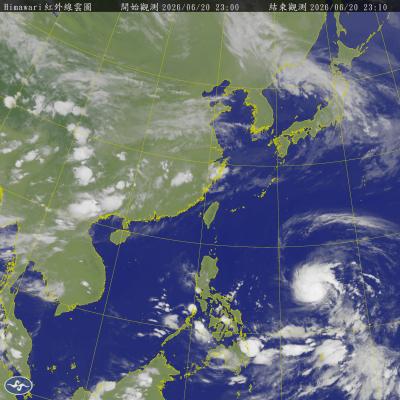
Tropical Storm Mekkhala is forecast to strengthen into a typhoon tomorrow and could come close enough to Taiwan later in the week to prompt a sea warning, the Central Weather Administration (CWA) said yesterday. As of 2 pm, the storm was located 1,870 kilometers southeast of Taiwan's southern tip and moving west- northwest at 23 km per hour. CWA forecaster Cheng Chieh-jen (鄭傑仁) said Mekkhala is expected to continue moving west-northwest through Tuesday under the influence of the Pacific high- pressure system before gradually turning north toward waters east of Taiwan or south of the Ryukyu Islands. The timing and angle of the
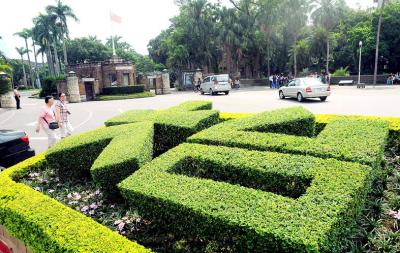
Four Taiwanese universities have been ranked among the world's top 200 institutions in the Quacquarelli Symonds (QS) World University Rankings for next year, the highest Taiwan has ever placed in the category, with National Taiwan University (NTU) achieving its best performance at 54th globally and 17th in Asia. The four Taiwanese institutions in the global top 200 are NTU (54th), National Tsing Hua University (142nd), National Yang Ming Chiao Tung University (177th) and National Cheng Kung University (191st), the rankings showed. All four universities achieved their highest-ever global rankings this year, QS data showed. National Cheng Kung University entered the top 200 for


 RSS
RSS