


A well-known artist has been teaching visual art at Keelung Prison for five years.
Yan Shang-wen (嚴尚文) has painted in the traditional Japanese style known as gyotaku for 36 years.
Gyotaku, or fish printing, involves applying ink, paint or pigment to the relief side of a fish, which is then pressed onto paper or canvas.
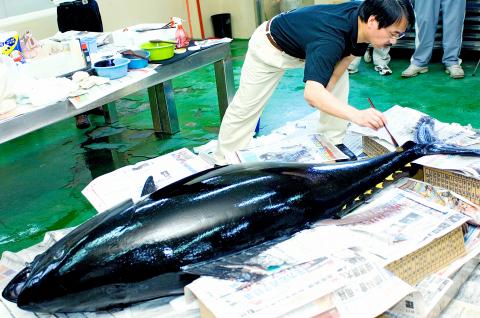
Photo: Wu Cheng-feng, Taipei Times
Yan’s works have sold for millions of dollars at auction and have been displayed at the Louvre Museum in Paris.
Five years ago Yan accepted a teaching position at the prison, which hopes to use art to help rehabilitate inmates.
“I am 62 years old. I wanted to act while I still have the ability to help people who nobody else has concern for,” Yan said.
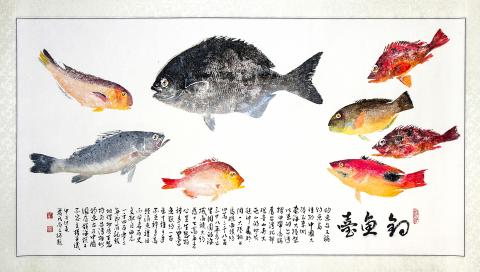
Photo: Wu Cheng-feng, Taipei Times
The Ministry of Justice in 2012 launched a program to promote special characteristics for each prison. Keelung Prison chose to feature the city’s fishing industry through gyotaku printing.
The ministry offered to pay Yan NT$1,600 per lesson.
“I felt that I had the opportunity to serve society, and at my age it was providence as well as my responsibility. I gladly accepted,” Yan said.
Yan has taught more than 100 inmates, only five of whom have been reincarcerated after their release.
Yan said classes demonstrate that marginalized people can develop self-confidence and a sense of achievement through art, adding that it can help with rehabilitation.
“For me, everything started with fishing,” Yan said.
Yan said he first made prints of his catches to record their size, the bait used and the time and place.
He later became interested in fish printing as an art form and started making prints with different numbers, colors and types of fish.
His art eventually gained Yan recognition nationwide.
In 2007 he was invited to make a 2m print of an Atlantic bluefin tuna for the annual Pingtung Bluefin Tuna Cultural Festival with then-president Chen Shui-bian (陳水扁), who drew the tuna’s eyes.
In 2014 Yan’s work was displayed at the Louvre Museum and the museum’s staff wore copies of his prints on their uniforms. The gyotaku print exhibit was the first of its size.
The value of gyotaku art is determined by how rare the fish is, as well as the quality of the print, Yan said.
Preparation takes a long time, but the printing takes five to 10 minutes, Yan said, adding that patience is very important to the process.
“Learning to enter that composed, meditative state of mind is exactly what many inmates need most,” Yan said.
Yan said he would help any of his former inmate students if they found it difficult to find work, adding that he has done so in the past.
People who have visited inmates in the prison have been moved to tears by seeing Yan work with them, the prison said.
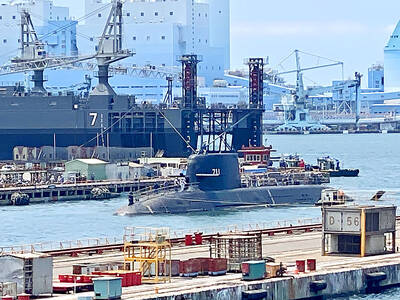
AGING: While Japan has 22 submarines, Taiwan only operates four, two of which were commissioned by the US in 1945 and 1946, and transferred to Taiwan in 1973 Taiwan would need at least 12 submarines to reach modern fleet capabilities, CSBC Corp, Taiwan chairman Chen Cheng-hung (陳政宏) said in an interview broadcast on Friday, citing a US assessment. CSBC is testing the nation’s first indigenous defense submarine, the Hai Kun (海鯤, Narwhal), which is scheduled to be delivered to the navy next month or in July. The Hai Kun has completed torpedo-firing tests and is scheduled to undergo overnight sea trials, Chen said on an SET TV military affairs program. Taiwan would require at least 12 submarines to establish a modern submarine force after assessing the nation’s operational environment and defense

A white king snake that frightened passengers and caused a stir on a Taipei MRT train on Friday evening has been claimed by its owner, who would be fined, Taipei Rapid Transit Corp (TRTC) said yesterday. A person on Threads posted that he thought he was lucky to find an empty row of seats on Friday after boarding a train on the Bannan (Blue) Line, only to spot a white snake with black stripes after sitting down. Startled, he jumped up, he wrote, describing the encounter as “terrifying.” “Taipei’s rat control plan: Release snakes on the metro,” one person wrote in reply, referring
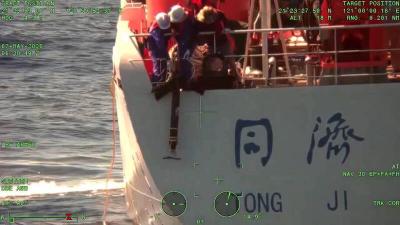
The coast guard today said that it had disrupted "illegal" operations by a Chinese research ship in waters close to the nation and driven it away, part of what Taipei sees a provocative pattern of China's stepped up maritime activities. The coast guard said that it on Thursday last week detected the Chinese ship Tongji (同濟號), which was commissioned only last year, 29 nautical miles (54km) southeast of the southern tip of Taiwan, although just outside restricted waters. The ship was observed lowering ropes into the water, suspected to be the deployment of scientific instruments for "illegal" survey operations, and the coast
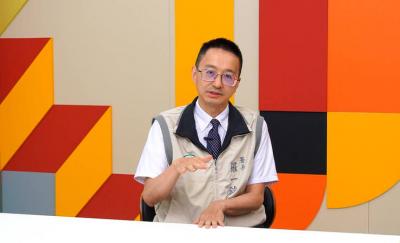
Taiwan’s two cases of hantavirus so far this year are on par with previous years’ case numbers, and the government is coordinating rat extermination work, so there should not be any outbreaks, Centers for Disease Control (CDC) Director-General Philip Lo (羅一鈞) said today in an interview with the Liberty Times (the Taipei Times’ sister newspaper). An increase in rat sightings in Taipei and New Taipei City has raised concerns about the spread of hantavirus, as rats can carry the disease. In January, a man in his 70s who lived in Taipei’s Daan District (大安) tested positive posthumously for hantavirus, Taiwan’s


 RSS
RSS