


The Executive Yuan yesterday said 98 government-made applications render their users highly vulnerable to hacking, adding that it would pull the apps from circulation if improvements are not made by the middle of the month.
Only 20 apps out of a total of 144 made by the Executive Yuan’s subordinate agencies passed all tests conducted by its evaluators, an Executive Yuan inventory report to the Legislative Yuan Internal Administration Committee said.
Of the remaining apps, 23 were found to have four to six vulnerabilities and 101 have one to three vulnerabilities, the report said.
The 98 apps that failed the tests pose a “high informational security risk” and the National Development Council last month instructed agencies to improve them before the middle of this month.
Those that fail to meet the deadline are to be pulled, Executive Yuan sources said.
The apps that posed a low risk should be improved before the end of July, sources added.
Apps with six vulnerabilities include the following: Tienkena’s Attack (進擊的鐵克納) by the National Science and Technology Museum, Mobile Water Manager (行動水管家) by Taiwan Water Corp (台灣自來水), Taiwan Railways eTicket (台鐵e訂通) by the Taiwan Railways Administration, Foreign Workers’ Little Assistant (外籍勞工小幫手) by the Workforce Development Agency and Accounting Mobile Go (統計隨身GO) by the Directorate-General of Budget, Accounting and Statistics.
During the budget review for this fiscal year, lawmakers on the Internal Administration Committee passed a resolution that said the Executive Yuan must review its apps for potential vulnerabilities that could compromise state secrets or users’ privacy or financial information.
According to the executive’s report, information security evaluations were conducted on the 144 apps that are available for download by 73 of its agencies.
The evaluations were performed according to the Industrial Bureau’s “guidelines for evaluating basic informational security of mobile applications,” it said, adding that the apps were tested on 10 to 16 protocols, including on their management of sensitive data, connection security and the validity of digital certificates.
The most common security issues were related to storage of sensitive data, vulnerabilities in software, invalid certificates for servers and others, the report said.
The National Development Council is to draft new standards for information security, which all future government-made apps must meet before distribution, the Executive Yuan said.
In addition, the Industrial Bureau is to incorporate informational security evaluation services into contracting guidelines for all agencies, it said.

Taiwan has received more than US$70 million in royalties as of the end of last year from developing the F-16V jet as countries worldwide purchase or upgrade to this popular model, government and military officials said on Saturday. Taiwan funded the development of the F-16V jet and ended up the sole investor as other countries withdrew from the program. Now the F-16V is increasingly popular and countries must pay Taiwan a percentage in royalties when they purchase new F-16V aircraft or upgrade older F-16 models. The next five years are expected to be the peak for these royalties, with Taiwan potentially earning
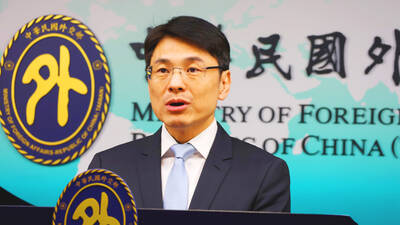
STAY IN YOUR LANE: As the US and Israel attack Iran, the ministry has warned China not to overstep by including Taiwanese citizens in its evacuation orders The Ministry of Foreign Affairs (MOFA) yesterday rebuked a statement by China’s embassy in Israel that it would evacuate Taiwanese holders of Chinese travel documents from Israel amid the latter’s escalating conflict with Iran. Tensions have risen across the Middle East in the wake of US and Israeli airstrikes on Iran beginning Saturday. China subsequently issued an evacuation notice for its citizens. In a news release, the Chinese embassy in Israel said holders of “Taiwan compatriot permits (台胞證)” issued to Taiwanese nationals by Chinese authorities for travel to China — could register for evacuation to Egypt. In Taipei, the ministry yesterday said Taiwan
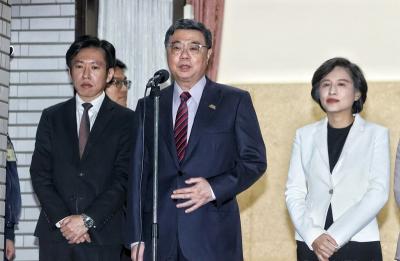
Taiwan is awaiting official notification from the US regarding the status of the Agreement on Reciprocal Trade (ART) after the US Supreme Court ruled US President Donald Trump's global tariffs unconstitutional. Speaking to reporters before a legislative hearing today, Premier Cho Jung-tai (卓榮泰) said that Taiwan's negotiation team remains focused on ensuring that the bilateral trade deal remains intact despite the legal challenge to Trump's tariff policy. "The US has pledged to notify its trade partners once the subsequent administrative and legal processes are finalized, and that certainly includes Taiwan," Cho said when asked about opposition parties’ doubts that the ART was
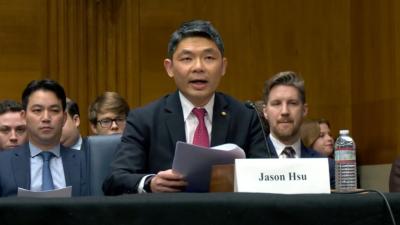
If China chose to invade Taiwan tomorrow, it would only have to sever three undersea fiber-optic cable clusters to cause a data blackout, Jason Hsu (許毓仁), a senior fellow at the Hudson Institute and former Chinese Nationalist Party (KMT) legislator, told a US security panel yesterday. In a Taiwan contingency, cable disruption would be one of the earliest preinvasion actions and the signal that escalation had begun, he said, adding that Taiwan’s current cable repair capabilities are insufficient. The US-China Economic and Security Review Commission (USCC) yesterday held a hearing on US-China Competition Under the Sea, with Hsu speaking on


 RSS
RSS