


The nature of the ongoing pension reform protests and the 2014 Sunflower movement protests are different and incomparable, former Sunflower movement leader Chen Wei-ting (陳為廷) said on Facebook yesterday.
Chen made the comments after people protesting against pension reform outside the legislature in Taipei yesterday held banners with the slogan: “If the Sunflower [movement] can, why can’t we?”
The slogans referred to Sunflower movement members occupying the main chamber of the Legislative Yuan from March 19 to April 10, 2014, to protest Chinese Nationalist Party (KMT) legislators attempt to force through the passage of the cross-strait service trade agreement.
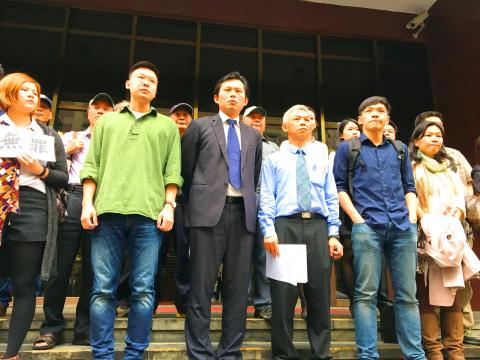
Photo: CNA
The Taipei District Court declared on March 31 that the actions of the 22 Sunflower movement members were in line with the concept of “civil disobedience” and found them not guilty of inciting others to commit a crime, obstruction of police officers in the discharge of their duties and other crimes. The verdict can be appealed.
“The Sunflower movement really was different from you [pension reform protesters],” Chen wrote.
Chen drew a comparison between the violence faced by New Power Party (NPP) Legislator Hsu Yung-ming (徐永明), and Democratic Progressive Party (DPP) legislators Tsai Yi-yu (蔡易餘) and Wang Ding-yu (王定宇) when they passed through the crowds to enter the legislature yesterday and the ease with which then-premier Jiang Yi-huah (江宜樺) communicated with the Sunflower movement protesters.
Hsu had water poured on him and was involved in a scuffle, while Wang and Tsai were chased by angry protesters before they managed to escape into the building.
Chen said that even during the students’ occupation of the legislature, both DPP and KMT legislators were able to come and go as they pleased, and that they held a total of six or seven cross-caucus negotiations.
It is understandable that many still question the need for pension reform, but the legislative review of the draft bills has only just begun, Chen said, adding that there is still time for debate or protest in the coming months.
If protesters truly feel that “we’re just doing what the Sunflower movement did” and continue to let such violence represent them, it would hasten society’s aversion to the protests, Chen said, adding that it is impossible to win popular support through such actions.
Chen, who threw a shoe at then-Miaoli County commissioner Liu Cheng-hung (劉政鴻) in September 2013, said that was a special circumstance aimed at preventing Liu from forcing his way into the home of Chang Sen-wen (張森文) to pay tribute to him.
Chang committed suicide after the forced demolition of his pharmacy on a contested plot of land in Miaoli’s Dapu Township (大埔) when the family went to Taipei to protest the county government’s seizure of farmland to expand the Hsinchu Science Park.

Taiwan has received more than US$70 million in royalties as of the end of last year from developing the F-16V jet as countries worldwide purchase or upgrade to this popular model, government and military officials said on Saturday. Taiwan funded the development of the F-16V jet and ended up the sole investor as other countries withdrew from the program. Now the F-16V is increasingly popular and countries must pay Taiwan a percentage in royalties when they purchase new F-16V aircraft or upgrade older F-16 models. The next five years are expected to be the peak for these royalties, with Taiwan potentially earning
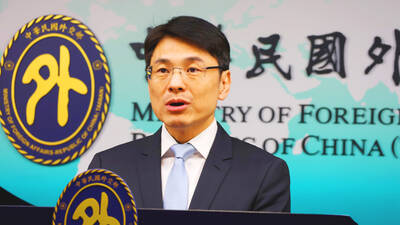
STAY IN YOUR LANE: As the US and Israel attack Iran, the ministry has warned China not to overstep by including Taiwanese citizens in its evacuation orders The Ministry of Foreign Affairs (MOFA) yesterday rebuked a statement by China’s embassy in Israel that it would evacuate Taiwanese holders of Chinese travel documents from Israel amid the latter’s escalating conflict with Iran. Tensions have risen across the Middle East in the wake of US and Israeli airstrikes on Iran beginning Saturday. China subsequently issued an evacuation notice for its citizens. In a news release, the Chinese embassy in Israel said holders of “Taiwan compatriot permits (台胞證)” issued to Taiwanese nationals by Chinese authorities for travel to China — could register for evacuation to Egypt. In Taipei, the ministry yesterday said Taiwan
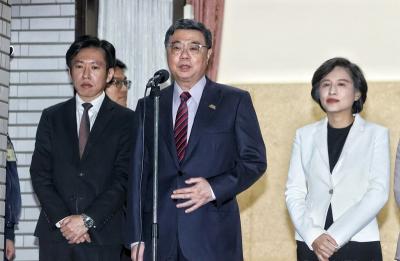
Taiwan is awaiting official notification from the US regarding the status of the Agreement on Reciprocal Trade (ART) after the US Supreme Court ruled US President Donald Trump's global tariffs unconstitutional. Speaking to reporters before a legislative hearing today, Premier Cho Jung-tai (卓榮泰) said that Taiwan's negotiation team remains focused on ensuring that the bilateral trade deal remains intact despite the legal challenge to Trump's tariff policy. "The US has pledged to notify its trade partners once the subsequent administrative and legal processes are finalized, and that certainly includes Taiwan," Cho said when asked about opposition parties’ doubts that the ART was
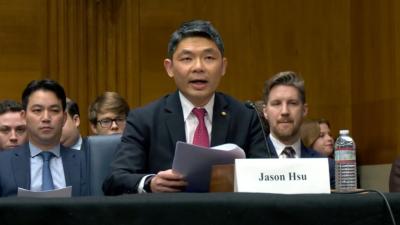
If China chose to invade Taiwan tomorrow, it would only have to sever three undersea fiber-optic cable clusters to cause a data blackout, Jason Hsu (許毓仁), a senior fellow at the Hudson Institute and former Chinese Nationalist Party (KMT) legislator, told a US security panel yesterday. In a Taiwan contingency, cable disruption would be one of the earliest preinvasion actions and the signal that escalation had begun, he said, adding that Taiwan’s current cable repair capabilities are insufficient. The US-China Economic and Security Review Commission (USCC) yesterday held a hearing on US-China Competition Under the Sea, with Hsu speaking on


 RSS
RSS