


Taipei Mayor Ko Wen-je (柯文哲) yesterday said he is unlikely to meet Chinese President Xi Jinping (習近平) when he visits China in June for the Taipei-Shanghai Forum, but will forward an invitation for Xi to attend the opening ceremony of the Taipei Summer Universiade in August.
When asked by Chinese Nationalist Party (KMT) Taipei City Councilor Chin Huei-chu (秦慧珠) to comment on news reports indicating a possible Ko-Xi meeting in June, the mayor said: “I am not that great.”
Ko said the Taipei City Government is in the process of organizing dates for the forum with Shanghai officials, who are considering holding it from June 25 to 27.
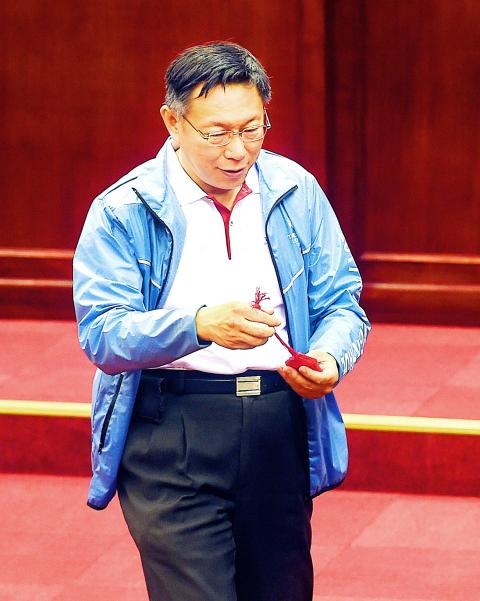
Photo: Fang Pin-chao, Taipei Times
He said his delegation is considering visiting Beijing to deliver an invitation to officials overseeing China’s preparations for the Universiade.
Chin asked Ko whether he would invite other high-ranking Beijing officials should Xi turn down his invitation, to which Ko replied: “[The plan] is not that grand.”
Ko said the purpose of his visit is to increase cross-strait exchanges and goodwill.
Taipei City Government Secretary-General Su Li-chung (蘇麗瓊), who heads the Taipei Universiade Organizing Committee, said that she had delivered an invitation to Beijing officials last year during a visit to promote the Universiade, with Beijing agreeing to send a delegation to compete in the sporting event.
When Chin asked how many heads of state the committee plans to invite, Su said that the committee would assess the offices held by foreign officials and consult with the International University Sports Federation before sending out invitations.
Democratic Progressive Party (DPP) Taipei City Councilor Lin Shih-tsung (林世宗) said that the Universiade is one of Ko’s nemeses standing in the way of his re-election next year.
The Universiade is to run from Aug. 19 to 30, during the typhoon season, and some matches might be interrupted or delayed, Lin said.
Committee spokesman Yang Ching-tang (楊景棠) said that the committee would allot “leeway days” during the games, on which matches delayed due to the elements can be resumed.
If there is not enough time for all matches in a sports category to be completed, all finalists will be awarded gold medals, he said, citing the baseball in the 2015 Universiade in South Korea as an example.
DPP Taipei City Councilor Hsieh Wei-chou (謝維洲) asked Ko what he would do if Chinese athletes protested against Taiwanese spectators bringing the national flag to cheer for the national team.
Ko said that to avoid interrupting the games, he would not take any action.
Su said that according to International Olympic Committee rules, spectators can bring their national flag provided they are not attached to masts.
Yang said that to avoid blocking the audience’s view, the size of national flags, along with other props, carried by spectators would be subject to limitations, which are to be announced in June.

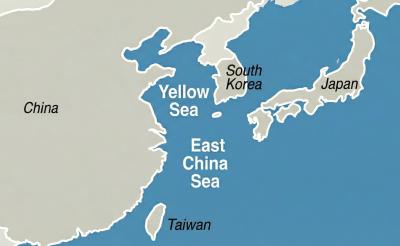
China has reserved offshore airspace in the Yellow Sea and East China Sea from March 27 to May 6, issuing alerts usually used to warn of military exercises, although no such exercises have been announced, the Wall Street Journal (WSJ) reported yesterday. Reserving such a large area for 40 days without explanation is an “unusual step,” as military exercises normally only last a few days, the paper said. These alerts, known as Notice to Air Missions (Notams), “are intended to inform pilots and aviation authorities of temporary airspace hazards or restrictions,” the article said. The airspace reserved in the alert is
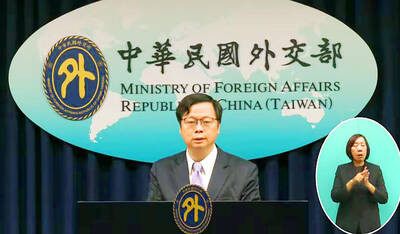
NAMING SPAT: The foreign ministry called on Denmark to propose an acceptable solution to the erroneous nationality used for Taiwanese on residence permits Taiwan has revoked some privileges for Danish diplomatic staff over a Danish permit that lists “Taiwan” as “China,” Eric Huang (黃鈞耀), head of the Ministry of Foreign Affairs’ Department of European Affairs, told a news conference in Taipei yesterday. Reporters asked Huang whether the Danish government had responded to the ministry’s request that it correct the nationality on Danish residence permits of Taiwanese, which has been listed as “China” since 2024. Taiwan’s representative office in Denmark continues to communicate with the Danish government, and the ministry has revoked some privileges previously granted to Danish representatives in Taiwan and would continue to review
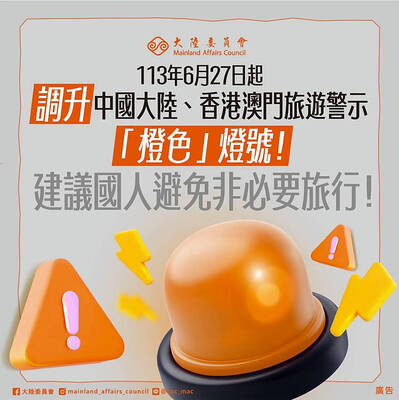
More than 6,000 Taiwanese students have participated in exchange programs in China over the past two years, despite the Mainland Affairs Council’s (MAC) “orange light” travel advisory, government records showed. The MAC’s publicly available registry showed that Taiwanese college and university students who went on exchange programs across the Strait numbered 3,592 and 2,966 people respectively. The National Immigration Agency data revealed that 2,296 and 2,551 Chinese students visited Taiwan for study in the same two years. A review of the Web sites of publicly-run universities and colleges showed that Taiwanese higher education institutions continued to recruit students for Chinese educational programs without

A bipartisan group of US senators has introduced a bill to enhance cooperation with Taiwan on drone development and to reduce reliance on supply chains linked to China. The proposed Blue Skies for Taiwan Act of 2026 was introduced by Republican US senators Ted Cruz and John Curtis, and Democratic US senators Jeff Merkley and Andy Kim. The legislation seeks to ease constraints on Taiwan-US cooperation in uncrewed aerial systems (UAS), including dependence on China-sourced components, limited access to capital and regulatory barriers under US export controls, a news release issued by Cruz on Wednesday said. The bill would establish a "Blue UAS


 RSS
RSS