


The Taiwan Solidarity Union (TSU) yesterday demanded that the government use “Taiwan” instead of “Chinese Taipei” during the 2020 Summer Olympics in Tokyo, and called on recently installed Sports Administration Director-General Lin Te-fu (林德福) to resign over his refusal to make the change.
TSU officials and members of the party’s youth department staged a demonstration in front of the Sports Administration’s office in Taipei, holding placards that said: “Taiwan is Taiwan,” “We are not Chinese Taipei,” “Down with ‘Olympic model,” “Rectify the name to Taiwan now” and “Down with Sports Administration, stop belittling Taiwan.”
Former TSU legislator Chou Ni-an (周倪安) said the so-called “Olympic model” that says Taiwan must compete under the name “Chinese Taipei” was agreed to by the then-Chinese Nationalist Party (KMT) government, but the political and social climate has since changed.
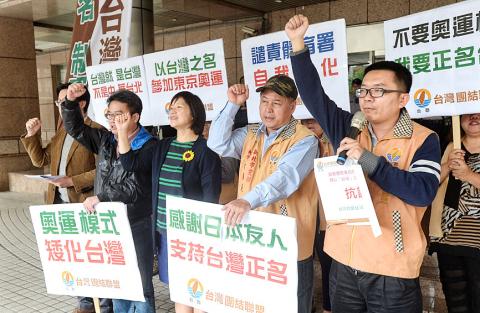
Photo: Lin Cheng-kun, Taipei Times
“For transitional justice, this must also apply to our participation in international sporting events,” Chou said.
Chou said Taiwanese athletes should use the name that is a true representation of their nation.
“It is especially important. Even President Tsai Ing-wen (蔡英文) always calls herself the president of Taiwan on the international stage,” Chou said.
The protest was directed at Lin, who in several media interviews and statements in recent weeks has said that the agency will continue to use the name “Chinese Taipei” for Taiwanese teams and athletes at the Olympic Games.
“We know people are not happy about using ‘Chinese Taipei,’ but we have to accept it. If we try to make a name change, maybe our right to take part in Olympics will be taken away, so that is another problem. At these international sports tournaments, we have to continue use the old moniker. It cannot be changed simply because we want to,” Lin said.
The “Olympic model” refers to the 1989 agreement reached between Taiwan and the International Olympic Committee that only the name “Chinese Taipei” — not “Taiwan” or “Republic of China (ROC)” — can be used at Olympic venues and that only the Chinese Taipei Olympic Committee flag can be used at Olympic events.
“Why was Lin appointed head of the sports agency? We can see his attitude is typical of a ponderous, stuck-up bureaucrat. He is not worthy of the post. If he encounters any problems is he always going to say: ‘Well, it is difficult to change, so we have to abide by the old rules’?” Chou said.
Democratic Progressive Party (DPP) Legislator Wang Ting-yu (王定宇) asked government officials to fight for a name change at a legislative committee session.
“We should promote and support the campaign seeking to change the name from ‘Chinese Taipei’ to ‘Taiwan.’ There is a vigorous movement in Japan, which was initiated by Japanese and joined by Taiwanese living there. It has gathered more than 60,000 signatures and is to be presented to the International Olympic Committee,” Wang said.
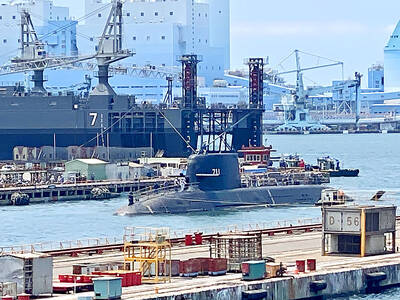
AGING: While Japan has 22 submarines, Taiwan only operates four, two of which were commissioned by the US in 1945 and 1946, and transferred to Taiwan in 1973 Taiwan would need at least 12 submarines to reach modern fleet capabilities, CSBC Corp, Taiwan chairman Chen Cheng-hung (陳政宏) said in an interview broadcast on Friday, citing a US assessment. CSBC is testing the nation’s first indigenous defense submarine, the Hai Kun (海鯤, Narwhal), which is scheduled to be delivered to the navy next month or in July. The Hai Kun has completed torpedo-firing tests and is scheduled to undergo overnight sea trials, Chen said on an SET TV military affairs program. Taiwan would require at least 12 submarines to establish a modern submarine force after assessing the nation’s operational environment and defense

A white king snake that frightened passengers and caused a stir on a Taipei MRT train on Friday evening has been claimed by its owner, who would be fined, Taipei Rapid Transit Corp (TRTC) said yesterday. A person on Threads posted that he thought he was lucky to find an empty row of seats on Friday after boarding a train on the Bannan (Blue) Line, only to spot a white snake with black stripes after sitting down. Startled, he jumped up, he wrote, describing the encounter as “terrifying.” “Taipei’s rat control plan: Release snakes on the metro,” one person wrote in reply, referring
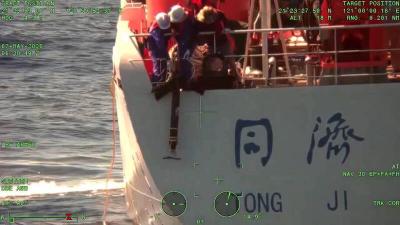
The coast guard today said that it had disrupted "illegal" operations by a Chinese research ship in waters close to the nation and driven it away, part of what Taipei sees a provocative pattern of China's stepped up maritime activities. The coast guard said that it on Thursday last week detected the Chinese ship Tongji (同濟號), which was commissioned only last year, 29 nautical miles (54km) southeast of the southern tip of Taiwan, although just outside restricted waters. The ship was observed lowering ropes into the water, suspected to be the deployment of scientific instruments for "illegal" survey operations, and the coast
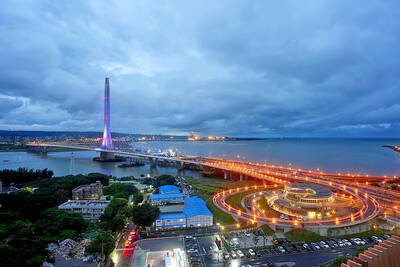
An inauguration ceremony was held yesterday for the Danjiang Bridge, the world’s longest single-mast asymmetric cable-stayed bridge, ahead of its official opening to traffic on Tuesday, marking a major milestone after nearly three decades of planning and construction. At the ceremony in New Taipei City attended by President William Lai (賴清德), Premier Cho Jung-tai (卓榮泰), Minister of Transportation and Communications Chen Shih-kai (陳世凱) and New Taipei City Mayor Hou Yu-ih (侯友宜), the bridge was hailed as both an engineering landmark and a long-awaited regional transport link connecting Tamsui (淡水) and Bali (八里)


 RSS
RSS