


Democratic Progressive Party (DPP) legislators yesterday criticized the National Police Agency for what they called its failure to enforce protest regulations, which has given rise to organized crime and conflict between the public and police.
Hong Kong democracy campaigner Joshua Wong’s (黃之鋒) visit to Taiwan in January was marked by violent protests allegedly organized by criminal groups, while a peaceful demonstration last week commemorating the 228 Incident in Taipei was disrupted by alleged gang members, DPP Legislator Lo Chih-cheng (羅致政) said.
“The agency’s failure to prevent violence could threaten freedom of speech and freedom of association, the most important values of a democracy,” Lo said.
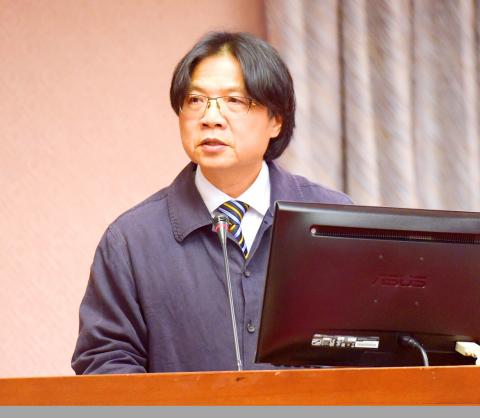
Photo: Huang Yao-cheng, Taipei Times
“Tolerance of different opinions is valuable in Taiwan, but peace is the underlying principle. It is unacceptable that violence was used on those with differing opinions. We demand that the agency take a tougher stance on protest regulations and criminal activities camouflaged as protests,” Lo said.
The “fake” protests staged by suspected criminal groups — possibly dictated to and financed by Beijing — should be taken seriously and not be allow to happen again, DPP Legislator Chiang Yung-chang (江永昌) said.
“The recurrence of such ‘protests’ cause public aversion to protests that are otherwise a peaceful expression of opinion,” Chiang said.
The agency has been unable to prevent protests from escalating into violence since the DPP administration was sworn in last year, with a number of protests marked by physical violence and conflicts, DPP Legislator Shih Yi-fang (施義芳) said.
The agency has failed to enforce President Tsai Ing-wen’s (蔡英文) drug policies over the past year, and to crack down on telecom fraud rings that hurt Taiwan’s international reputation, Shih said.
“The underperformance of the agency suggests that agency Director-General Chen Kuo-en (陳國恩) has a mindset inherited from the former government, and the new government has to take the blame,” Shih said. “The director-general must be tried. It is recommended he take some rest and not to hold the Cabinet back any longer.”
It was the latest in a series of criticism against the agency, notably from DPP legislators closely affiliated with Tsai.
DPP Legislator Wang Ding-yu (王定宇) called a news conference in January condemning the agency for the violence against visiting Hong Kong councilors and activists by suspected gang members, with Chen being the prime target of criticism and asked to resign.
Minister of the Interior Yeh Jiunn-rong (葉俊榮), Chen’s supervisor and overseer of the agency, said that the agency was on top of protest situations and Chen has always been in charge of protest management.
“Chen has endeavored to ensure peace during protests and he is often seen personally directing officers at protests,” Yeh said. “The police deserve more encouragement.”
Police have achieved much in terms of drug prevention, with the number of people arrested for illegal drug activities this year higher than the same period last year, Yeh said.

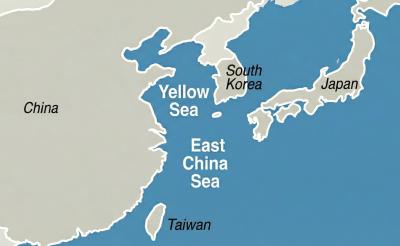
China has reserved offshore airspace in the Yellow Sea and East China Sea from March 27 to May 6, issuing alerts usually used to warn of military exercises, although no such exercises have been announced, the Wall Street Journal (WSJ) reported yesterday. Reserving such a large area for 40 days without explanation is an “unusual step,” as military exercises normally only last a few days, the paper said. These alerts, known as Notice to Air Missions (Notams), “are intended to inform pilots and aviation authorities of temporary airspace hazards or restrictions,” the article said. The airspace reserved in the alert is

South Korea is planning to revise its controversial electronic arrival card, a step Taiwanese officials said prompted them to hold off on planned retaliatory measures, a South Korean media report said yesterday. A Yonhap News Agency report said that the South Korean Ministry of Foreign Affairs is planning to remove the “previous departure place” and “next destination” fields from its e-arrival card system. The plan, reached after interagency consultations, is under review and aims to simplify entry procedures and align the electronic form with the paper version, a South Korean ministry official said. The fields — which appeared only on the electronic form

A bipartisan group of US senators has introduced a bill to enhance cooperation with Taiwan on drone development and to reduce reliance on supply chains linked to China. The proposed Blue Skies for Taiwan Act of 2026 was introduced by Republican US senators Ted Cruz and John Curtis, and Democratic US senators Jeff Merkley and Andy Kim. The legislation seeks to ease constraints on Taiwan-US cooperation in uncrewed aerial systems (UAS), including dependence on China-sourced components, limited access to capital and regulatory barriers under US export controls, a news release issued by Cruz on Wednesday said. The bill would establish a "Blue UAS
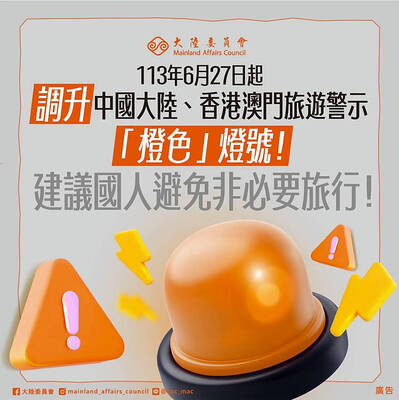
More than 6,000 Taiwanese students have participated in exchange programs in China over the past two years, despite the Mainland Affairs Council’s (MAC) “orange light” travel advisory, government records showed. The MAC’s publicly available registry showed that Taiwanese college and university students who went on exchange programs across the Strait numbered 3,592 and 2,966 people respectively. The National Immigration Agency data revealed that 2,296 and 2,551 Chinese students visited Taiwan for study in the same two years. A review of the Web sites of publicly-run universities and colleges showed that Taiwanese higher education institutions continued to recruit students for Chinese educational programs without


 RSS
RSS