


Chinese Nationalist Party (KMT) Chairwoman Hung Hsiu-chu’s (洪秀柱) office on Friday said its own poll had a different result from one published by a Chinese-language weekly magazine, which showed Hung trailing former vice president Wu Den-yih (吳敦義) and KMT Vice Chairman Hau Lung-bin (郝龍斌) in the party’s chairperson race.
A poll, commissioned by the China Times Weekly magazine and published on Friday showed Wu leading with 20.1 percent support, followed by Hau on 17.4 percent and Hung on 16.8 percent.
In another poll, also by the magazine, that excluded pan-green supporters, Hau bested Wu with 24.7 percent to Wu’s 23.1 percent, and Hung came in third with 21.3 percent.

Photo: CNA
Hung’s office said that the magazine’s poll numbers “had apparent gaps with the general consensus and our office’s poll results.”
“The magazine’s survey only had about 400 respondents; we would refrain from commenting on its validity,” it said, adding that a poll commissioned by the office and conducted between Feb. 2 and 6 with more than 1,200 samples from pan-blue supporters showed Hung had 65 percent support as party chairwoman.
“Hung’s cross-strait peace policy platform was shown to have 78 percent support and she was also leading in the chairperson race, though without obtaining a majority,” office spokesman Yu Hao (游顥) said, without providing precise numbers.
Hau and Wu yesterday said they would not place too much importance on the poll numbers, with Hau adding that what matters is being the first in the final vote.
Asked whether Hung’s office conducted the poll using the party headquarters’ resources, Hau said Hung should make public the poll if the party paid for it, adding that Hung has vowed to distribute party resources fairly and complete a list of party members, according to party regulations.
“What matters most now is for the party headquarters to quickly help set up an election committee with representatives recommended by all the chairperson candidates,” he said.
Additional Reporting by Shih Hsiao-kuang and Wang Jung-hsiang

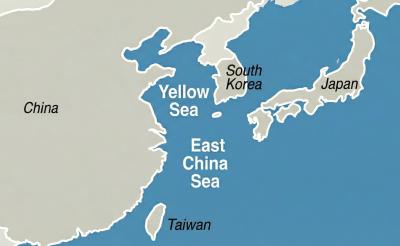
China has reserved offshore airspace in the Yellow Sea and East China Sea from March 27 to May 6, issuing alerts usually used to warn of military exercises, although no such exercises have been announced, the Wall Street Journal (WSJ) reported yesterday. Reserving such a large area for 40 days without explanation is an “unusual step,” as military exercises normally only last a few days, the paper said. These alerts, known as Notice to Air Missions (Notams), “are intended to inform pilots and aviation authorities of temporary airspace hazards or restrictions,” the article said. The airspace reserved in the alert is

NAMING SPAT: The foreign ministry called on Denmark to propose an acceptable solution to the erroneous nationality used for Taiwanese on residence permits Taiwan has revoked some privileges for Danish diplomatic staff over a Danish permit that lists “Taiwan” as “China,” Eric Huang (黃鈞耀), head of the Ministry of Foreign Affairs’ Department of European Affairs, told a news conference in Taipei yesterday. Reporters asked Huang whether the Danish government had responded to the ministry’s request that it correct the nationality on Danish residence permits of Taiwanese, which has been listed as “China” since 2024. Taiwan’s representative office in Denmark continues to communicate with the Danish government, and the ministry has revoked some privileges previously granted to Danish representatives in Taiwan and would continue to review

The first bluefin tuna of the season, brought to shore in Pingtung County and weighing 190kg, was yesterday auctioned for NT$10,600 (US$333.5) per kilogram, setting a record high for the local market. The auction was held at the fish market in Donggang Fishing Harbor, where the Siaoliouciou Island-registered fishing vessel Fu Yu Ching No. 2 delivered the “Pingtung First Tuna” it had caught for bidding. Bidding was intense, and the tuna was ultimately jointly purchased by a local restaurant and a local company for NT$10,600 per kilogram — NT$300 ,more than last year — for a total of NT$2.014 million. The 67-year-old skipper

China has reserved offshore airspace over the Yellow Sea and East China Sea from March 27 to May 6, issuing alerts that are usually used to warn of military exercises, although no such exercises have been announced, the Wall Street Journal (WSJ) reported on Sunday. Reserving such a large area for 40 days without explanation is an “unusual step,” as military exercises normally only last a few days, the paper said. The alerts, known as notice to air missions (NOTAMs), “are intended to inform pilots and aviation authorities of temporary airspace hazards or restrictions,” the article said. The airspace reserved in the alert


 RSS
RSS