


The nation participates in 12 governmental or non-governmental international organizations using the name “Taiwan” or the “Republic of China (ROC),” or about one-third of a total of 37 organizations, Ministry of Foreign Affairs’ records show.
In an effort to limit Taiwan’s international space, the Chinese government routinely pressures these organizations to refer to the nation using names other than the “ROC” or “Taiwan,” such as “Chinese Taipei” or the “Separate Customs Territory of Taiwan, Penghu, Kinmen and Matsu,” the records show.
In 2000, the Asian Development Bank, on Beijing’s entreaty, switched from using the “ROC” to “Taipei, China” — a move that Taipei continues to protest at the annual meeting.
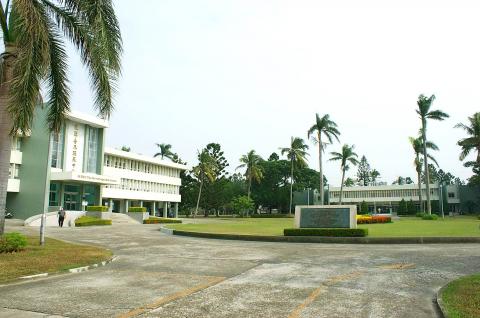
Photo: Wu Chun-feng, Taipei Times
However, the nation is recognized as a member named “Taiwan” by seven international organizations: the World Vegetable Center, the Association of World Election Bodies, the Commission for the Conservation of Southern Bluefin Tuna’s Extended Commission, the Egmont Group, the International Council for Information Technology in Government Administration, the International Cotton Advisory Committee and the International Competition Network.
Furthermore, Taiwan is recognized as the “ROC” by five international organizations: the Association of Asian Election Authorities, the African-Asian Rural Development Organization, the Asian Productivity Organization, the Central American Bank for Economic Integration, and the Food and Fertilizer Technology Center for the Asian and Pacific Region (FFTC/ASPAC).
Taiwan has representative offices in 57 countries that are not diplomatic allies: 50 of these offices use the name Taipei; six (Fiji, Papua New Guinea, Jordan, United Arab Emirates, Nigeria and Ecuador) are called the ROC; and one (Bahrain) is named Taiwan.
On the other hand, of the non-allied countries that have representative offices in Taiwan, 29 include the name “Taiwan” in their nomenclature, with 21 calling it “Taipei, Taiwan” and five (Finland, Japan, Oman, Papua New Guinea and the US) just “Taiwan.”
Taiwan’s order of preference in names used in international organizations are the ROC, Taiwan (ROC) and Taiwan, with Chinese Taipei or the Separate Customs Territory of Taiwan, Penghu, Kinmen and Matsu being the least preferred name, a high-ranking official in the foreign relations establishment said on condition of anonymity.
“The challenges we confront today are immense due to China’s aggressive efforts to exclude or downgrade Taiwan,” the official said.
In most cases, Taiwan’s inclusion in older global organizations can be attributed to the fact that their founding members were either states that recognized Taiwan’s sovereign status at the time, or those that recognize Taiwan’s significant contributions, Democratic Progressive Party (DPP) Legislator Lo Chih-cheng (羅致政) said.
For example, nearly every country in Central and South America historically recognized Taiwan, which afforded the nation a greater degree of prominence in organizations based in the region, while organizations such as the FFTC/ASPAC and the World Vegetable Center were founded by the Taiwanese government and its then-partners, Lo said.
However, since Taiwan joined APEC as “Chinese Taipei,” organizations founded after APEC generally used that model when considering Taiwan’s participation as a member, Lo said.
Whether the nation can maintain its name as Taiwan or the ROC in the 12 organizations is an issue that will be determined by the competing influences of Taiwan and China, Lo said, adding that the nature of those organizations might influence the outcome, as the Chinese are not keen on participating in certain organizations in the first place.
Taiwan’s conduct of foreign relations during former president Chiang Ching-kuo’s (蔣經國) administration was epitomized by the so-called “flexible diplomacy,” and the government was content to post overseas offices without giving much importance to what names they used.
As a result, the government established for diplomatic purposes a variety of organizations, such as the Far Eastern Trade Services Inc, the Institute of Chinese Culture Studies and the Sun Yat-sen Center Foundation, without any apparent unifying rule or order to their nomenclature, he said.
Former president Lee Teng-hui’s (李登輝) “pragmatic diplomacy” attempted to bring some unity to the names of these representative offices, but at the time, “Taipei” was used in lieu of “Taiwan,” he said, calling the choice “regrettable.”
“Many countries are willing to use the word ‘Taiwan,’ which proves that there is a real opportunity for Taiwan to use the name in the international community. We do not need to limit ourselves on our own initiative,” Lo said.

US climber Alex Honnold is to attempt to scale Taipei 101 without a rope and harness in a live Netflix special on Jan. 24, the streaming platform announced on Wednesday. Accounting for the time difference, the two-hour broadcast of Honnold’s climb, called Skyscraper Live, is to air on Jan. 23 in the US, Netflix said in a statement. Honnold, 40, was the first person ever to free solo climb the 900m El Capitan rock formation in Yosemite National Park — a feat that was recorded and later made into the 2018 documentary film Free Solo. Netflix previewed Skyscraper Live in October, after videos

NUMBERS IMBALANCE: More than 4 million Taiwanese have visited China this year, while only about half a million Chinese have visited here Beijing has yet to respond to Taiwan’s requests for negotiation over matters related to the recovery of cross-strait tourism, the Tourism Administration said yesterday. Taiwan’s tourism authority issued the statement after Chinese-language daily the China Times reported yesterday that the government’s policy of banning group tours to China does not stop Taiwanese from visiting the country. As of October, more than 4.2 million had traveled to China this year, exceeding last year. Beijing estimated the number of Taiwanese tourists in China could reach 4.5 million this year. By contrast, only 500,000 Chinese tourists are expected in Taiwan, the report said. The report

Temperatures are forecast to drop steadily as a continental cold air mass moves across Taiwan, with some areas also likely to see heavy rainfall, the Central Weather Administration (CWA) said. From today through early tomorrow, a cold air mass would keep temperatures low across central and northern Taiwan, and the eastern half of Taiwan proper, with isolated brief showers forecast along Keelung’s north coast, Taipei and New Taipei City’s mountainous areas and eastern Taiwan, it said. Lows of 11°C to 15°C are forecast in central and northern Taiwan, Yilan County, and the outlying Kinmen and Lienchiang (Matsu) counties, and 14°C to 17°C
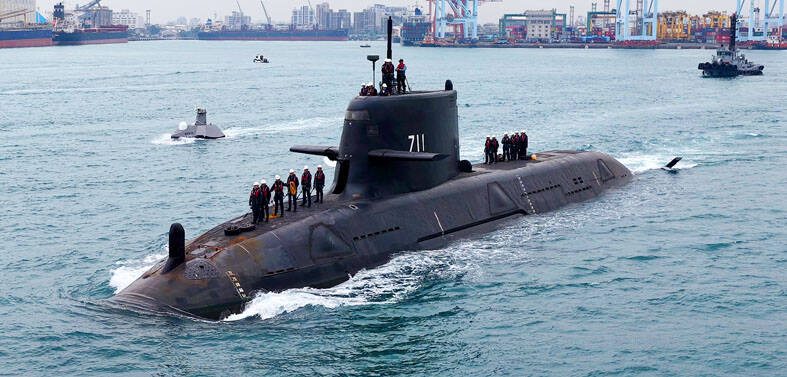
STEERING FAILURE: The first boat of its class is experiencing teething issues as it readies for acceptance by the navy, according to a recent story about rudder failure The Hai Kun (海鯤), the nation’s first locally built submarine, allegedly suffered a total failure of stern hydraulic systems during the second round of sea acceptance trials on June 26, and sailors were forced to manually operate the X-rudder to turn the submarine and return to port, news Web site Mirror Daily reported yesterday. The report said that tugboats following the Hai Kun assisted the submarine in avoiding collisions with other ships due to the X-rudder malfunctioning. At the time of the report, the submarine had completed its trials and was scheduled to begin diving and surfacing tests in shallow areas. The X-rudder,


 RSS
RSS