


Tainan Mayor William Lai (賴清德) yesterday said he would not run for president in 2020 as he reaffirmed President Tsai Ing-wen’s (蔡英文) performance and ability to re-elected.
In a radio interview, Lai, a member of the Democratic Progressive Party, said he would not join the next presidential election, denying Taipei Mayor Ko Wen-je’s (柯文哲) description of him as a likely candidate.
Ko’s comments were straightforward, but unfounded and there has been no discussion between us about the next presidential election, Lai said.
Lai said he would not join the Cabinet without seeing two major construction projects in his city finished: The reconstruction of the Weiguan Jinlong Complex, which collapsed in February last year during a major earthquake, and an underground railway project.
Although the first seven months of Tsai’s presidency have been “stumbling,” Lai said the public should be reassured over her performance.
He said that public faith in Tsai could be restored if the government could carry out pension reform successfully.
In terms of domestic policy, the controversies associated with labor law amendments and the government’s handling of a China Airlines staff strike suggested that the Cabinet was still in a “fine-tuning process,” but it is expected to be “a different one” after the Lunar New Year holiday, he said.
Lai said that he would call China by that name, not “the mainland” if he were president.
Lai said the term “mainland” represents a misconception about cross-strait relations and “it is absolutely wrong that people in China have adopted the Chinese Nationalist Party [KMT] terminology in their understanding of Taiwan.”
Taiwanese understand that the so-called “1992 consensus” is a deception and there is no “one China, different interpretations,” because what China espouses is “one China, no interpretation,” he said.
“The ‘different interpretations’ of ‘one China, different interpretations’ framework advocated by former president Ma Ying-jeou (馬英九) and former vice president Wu Den-yih (吳敦義) is a lie to Taiwanese,” he said.
“Taiwan is 100 percent a nation,” Lai said.
The “1992 consensus” — a term former Mainland Affairs Council chairman Su Chi (蘇起) admitted to making up in 2000 — refers to a tacit understanding between the KMT and the Chinese Communist Party that both sides of the Taiwan Strait acknowledge there is “one China,” with each side having its own interpretation of what that means.
Asked if he supports Tsai’s cross-strait policy on maintaining the “status quo,” Lai said the nation has to keep it without compromising.
Taiwan cannot expect any friendly feedback from China by making concessions, as former president Chen Shui-bian (陳水扁) made a U-turn in his attitude toward China without seeing any softening in Beijing’s stance, while Ma was unable to keep his campaign promises to revitalize the economy, also because of China’s uncompromising attitude.
It is not up to Chinese President Xi Jinping (習近平) to change Beijing’s attitude, because Chinese society has not reached a point where its leadership is allowed to compromise, Lai said.
It is imperative to let Chinese understand that it is Taiwan that has contributed most to China’s economic growth over the past 20 years and an advanced Taiwan can still play an important role in China’s development, he said.
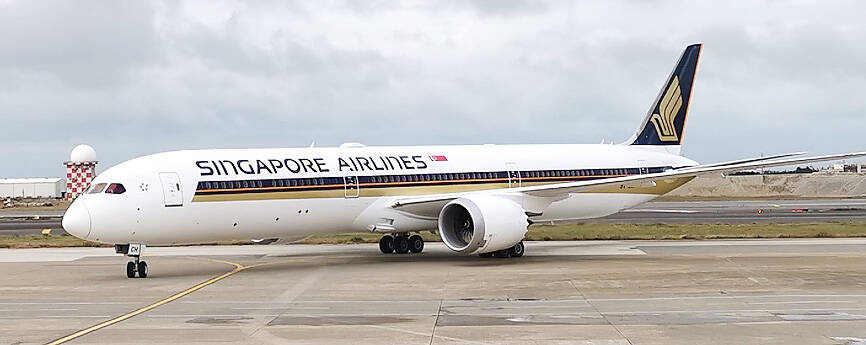
INCREASED CAPACITY: The flights on Mondays, Wednesdays, Fridays and Sundays would leave Singapore in the morning and Taipei in the afternoon Singapore Airlines is adding four supplementary flights to Taipei per week until May to meet increased tourist and business travel demand, the carrier said on Friday. The addition would raise the number of weekly flights it operates to Taipei to 18, Singapore Airlines Taiwan general manager Timothy Ouyang (歐陽漢源) said. The airline has recorded a steady rise in tourist and business travel to and from Taipei, and aims to provide more flexible travel arrangements for passengers, said Ouyang, who assumed the post in July last year. From now until Saturday next week, four additional flights would depart from Singapore on Monday, Wednesday, Friday

Taiwan’s three major international carriers are increasing booking fees, with EVA Airways having already increased the charge to US$28 per flight segment from US$25, while China Airlines (CAL) and Starlux Airlines are set to follow suit. Booking fees are charged by airlines through a global distribution system (GDS) and passed on to passengers. Carriers that apply the fees include CAL, EVA, Starlux and Tigerair Taiwan. A GDS is a computerized network operated by a company that connects airlines with travel agents and ticketing platforms, allowing reservations to be made and processed in real time. Major players include Amadeus, Sabre and Travelport. EVA Air began

WATCH FOR HITCHHIKERS: The CDC warned those returning home from Japan to be alert for any contagious diseases that might have come back with them People who have returned from Japan following the World Baseball Classic (WBC) games during the weekend are recommended to watch for symptoms of infectious gastroenteritis, flu and measles for two weeks, the Centers for Disease Control (CDC) said. Flu viruses remain the most common respiratory pathogen in Taiwan in the past four weeks and the influenza B virus accounted for 55.7 percent of the tested cases, exceeding the percentage of influenza A (H3N2) infections and becoming the local dominant strain, CDC Epidemic Intelligence Center Deputy Director Lee Chia-lin (李佳琳) said at a news conference on Tuesday. There were 82,187 hospital visits for

Alumni from Japan’s Kyoto Tachibana Senior High School marching band, widely known as the “Orange Devils,” staged a flash mob performance at the Grand Hotel in Taipei yesterday to thank Taiwan for its support after the Great East Japan Earthquake. The show, performed on the earthquake’s 15th anniversary, drew more than 100 spectators, some of whom arrived two hours before the show to secure a good viewing spot. The 26-member group played selections from “High School Musical,” “Beauty and the Beast,” and their signature piece “Sing Sing Sing” and shouted “I love


 RSS
RSS