

The American Institute in Taiwan’s (AIT) Washington Office managing director John Norris on Saturday said that he expects Taiwan-US relations to advance during US President Donald Trump’s tenure as stability across the Taiwan Strait remains a core interest to the US.
Speaking at an annual meeting with overseas Taiwanese in Washington, Norris said the US will continue to commit to the Taiwan Relations Act (TRA), the US legislation governing relations with Taiwan.
The Asia-Pacific region is of interest to the US and peaceful development across the Taiwan Strait benefits the US, he said.
Although there could be different approaches to maintaining US interests in the area under different administrations, the TRA will remain the top principle when handling related affairs, he said.
The TRA was enacted in 1979 to maintain commercial, cultural and other unofficial relations between Taiwan and the US after Washington switched diplomatic recognition from Taipei to Beijing. The TRA also requires the US “to provide Taiwan with arms of a defensive character.”
Taiwan’s representative to the US Stanley Kao (高碩泰), who also attended the meeting, said he is optimistic about Taiwan-US relations under the Trump administration.
Stephen Yates, an adviser to Trump’s transition team and a deputy national security adviser to then-US vice president Dick Cheney from 2001 to 2005, said he believes there will be many new opportunities for cooperation this year for both Taiwan-US relations and US-China relations.
In a separate event on Saturday, former premier Yu Shyi-kun (游錫堃) said that the Trump administration poses more of an opportunity than a challenge for Taiwan, adding that the nation should take the opportunity to improve relations with the US.
Yu made the remark in New York after concluding a visit to the US at the head of a Taiwanese delegation attending Trump’s inauguration ceremony in Washington.
He said that in addition to extending congratulations to Trump, the delegation visited think tanks and the Washington-based AIT, and met with members of the US Senate and House of Representatives to allow them to understand Taiwan’s ideas and sincerity regarding the development of bilateral relations.
Yu said in his meetings with US representatives that he hopes to further Taiwan-US economic and trade cooperation, joint efforts toward peace in the Asia-Pacific region and US support for Taiwan’s international participation.
He also told the representatives that Taiwan understands the importance Trump attaches to the US economy and his “America first” policy, as well as his questioning of Beijing’s “one China” principle, he said.
Yu said he made it clear that Taiwan wants to sign a free-trade agreement with the US to consolidate bilateral economic and trade relations.
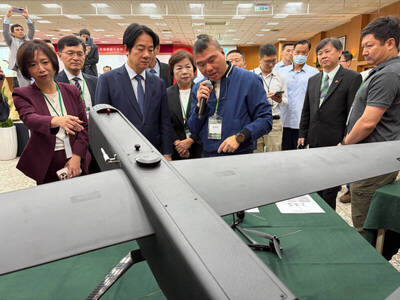
Two executives of drone supplier Jiin Ming Industry Co (錦明實業) have been detained and held incommunicado over the company's alleged use of prohibited China-made chips and camera lenses in drones supplied under recent military contracts, the Taoyuan District Prosecutors' Office said today. In a statement, prosecutors said they raided the offices of Jiin Ming — headquartered in Taoyuan — as well as those of its subsidiaries and its suppliers on Thursday last week. The raids followed a report that the company had breached its procurement contracts by putting the prohibited components into drones delivered to the military. During the raids, prosecutors summoned
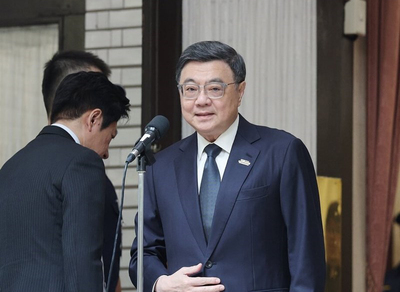
The government would continue monitoring online rumors that a pneumonic plague outbreak has spread from Russia into China and could enhance existing quarantine measures, Premier Cho Jung-tai (卓榮泰) said today. During a legislative meeting, Democratic Progressive Party Legislator Wang Ting-yu (王定宇) said rumors were circulating that the disease had spread across several Chinese provinces. He asked Cho whether the government was prepared to prevent the disease from spreading to Taiwan, given the frequent exchanges between Taiwan and China, and how concerned the government was about the alleged outbreak. The Ministry of Health and Welfare implemented border quarantine measures after briefing the Executive Yuan
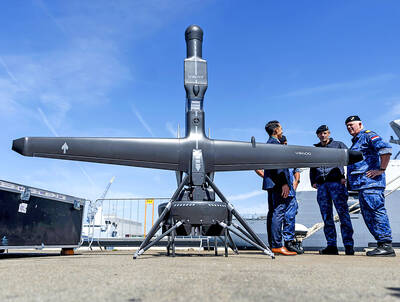
DEFENSE PROCUREMENT: Taiwan could become the largest operator of V-BAT drones outside the US once they are delivered, the Ministry of National Defense said The navy and the coast guard are acquiring 292 units of MQ-35A V-BAT vertical takeoff and landing (VTOL) surveillance drones manufactured by US-based defense technology company Shield AI, making Taiwan one of the largest buyers of the drone. The Coast Guard Administration budgeted NT$1.2 billion (US$37.1 million) to buy 12 drones, which have been delivered, Shield AI said in a report on Oct 13. The navy is planning to spend NT$36 billion under a four-year program code-named Project Yuan Xiao (遠鴞) to acquire 280 V-BAT drones, the Ministry of National Defense’s fiscal 2027 report showed. The combined procurement is expected

South Korean boy band BigBang drew 120,000 fans to three concerts at Taipei Dome from Friday through yesterday, as the band thanked them for their support over their 20-year career. The Taipei Dome concerts were part of BigBang's "2026-2027 World Tour XX: Cosmos." Friday's concert was BigBang's first performance in Taiwan in 11 years. During the encore, group leader G-Dragon (GD) shouted "I love you" in Chinese and said he was especially happy to perform in Taiwan with bandmates Taeyang and Daesung. "Taipei, I'm very grateful to you all," GD said in Chinese, asking fans to wait for the band's return. Daesung thanked


 RSS
RSS