


Former deputy minister of national defense Lin Chong-pin (林中斌) said that the Chinese People’s Liberation Army (PLA) could conquer Taiwan by force within three days, but added that a peaceful unification between Taiwan and China is likely.
In an interview with the Global Times Chinese daily published yesterday, Lin said that Taiwan’s armed forces could only resist China’s “acupuncture tactics” for 48 to 72 hours, as the PLA could paralyze Taiwan’s command system using electromagnetic weapons and digital attacks.
Democratic Progressive Party Legislator Lo Chih-cheng (羅致政) said it was likely that Lin was quoted out of context, considering the Global Times’ hawkish stance.

Photo courtesy of Public Television Service
“China already has the ability [to carry out acupuncture warfare], which would be quite difficult for Taiwan to withstand,” Lin told the Chinese newspaper. “Taiwan has admitted that [it can only defend itself for] between 48 hours and 72 hours.”
The PLA has also infiltrated Taiwan and Beijing could subdue Taiwan in a bloodless war, he said.
The possibility of US interference in an armed conflict between Taiwan and China has diminished, as China has developed advanced anti-ship missile systems and submarine-launched cruise missiles that can target US aircraft carriers, he said.
However, it is more likely that Beijing would seek peaceful unification with Taiwan, Lin said, adding that it has “super-military measures” — the projection of China’s economic, diplomatic and cultural power predicated on its strong military presence.
China has, without resorting to military means, shifted the Philippines’ tone on the South China Sea issue after the Permanent Court of Arbitration in The Hague ruled in Manila’s favor on the matter and Beijing could seek to exert the same sort of pressure on Taipei, he said.
Unificationist sentiment is on the rise in Taiwan, Lin said.
Despite President Tsai Ing-wen’s (蔡英文) administration beginning to lose support, there is still a trend toward people identifying themselves as Taiwanese, he said.
Lin was a deputy minister of national defense in 2003 and 2004 while former president Chen Shui-bian (陳水扁) was in office.
“In theory, everything is possible, such as seizing Taiwan in three days. However, in reality, [war] is contingent upon a lot of things, including Taiwan’s and the US’ reaction,” Lo said.
So-called “acupuncture warfare,” or decapitation, is one of China’s key strategies and Taiwan has countermeasures in place after years of military exercises, Lo said.
The nation’s armed forces have simulated scenarios in a series of exercises to prepare for a hypothetical PLA attempt to “decapitate” Taiwan or barricade the nation, Lo said.
The former deputy minister could not be reached for comment as of press time last night.
The Ministry of National Defense refused to comment on Lin’s remarks.

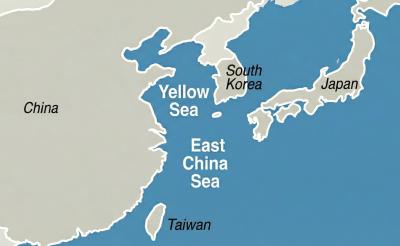
China has reserved offshore airspace in the Yellow Sea and East China Sea from March 27 to May 6, issuing alerts usually used to warn of military exercises, although no such exercises have been announced, the Wall Street Journal (WSJ) reported yesterday. Reserving such a large area for 40 days without explanation is an “unusual step,” as military exercises normally only last a few days, the paper said. These alerts, known as Notice to Air Missions (Notams), “are intended to inform pilots and aviation authorities of temporary airspace hazards or restrictions,” the article said. The airspace reserved in the alert is
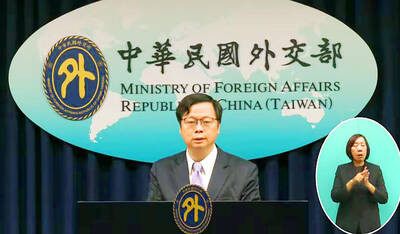
NAMING SPAT: The foreign ministry called on Denmark to propose an acceptable solution to the erroneous nationality used for Taiwanese on residence permits Taiwan has revoked some privileges for Danish diplomatic staff over a Danish permit that lists “Taiwan” as “China,” Eric Huang (黃鈞耀), head of the Ministry of Foreign Affairs’ Department of European Affairs, told a news conference in Taipei yesterday. Reporters asked Huang whether the Danish government had responded to the ministry’s request that it correct the nationality on Danish residence permits of Taiwanese, which has been listed as “China” since 2024. Taiwan’s representative office in Denmark continues to communicate with the Danish government, and the ministry has revoked some privileges previously granted to Danish representatives in Taiwan and would continue to review
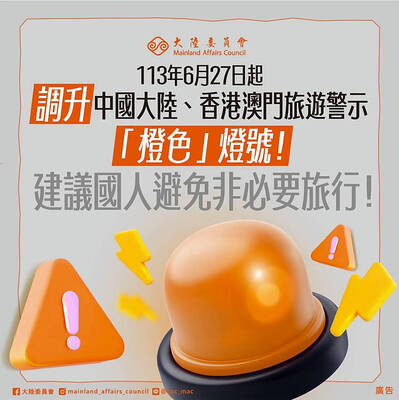
More than 6,000 Taiwanese students have participated in exchange programs in China over the past two years, despite the Mainland Affairs Council’s (MAC) “orange light” travel advisory, government records showed. The MAC’s publicly available registry showed that Taiwanese college and university students who went on exchange programs across the Strait numbered 3,592 and 2,966 people respectively. The National Immigration Agency data revealed that 2,296 and 2,551 Chinese students visited Taiwan for study in the same two years. A review of the Web sites of publicly-run universities and colleges showed that Taiwanese higher education institutions continued to recruit students for Chinese educational programs without
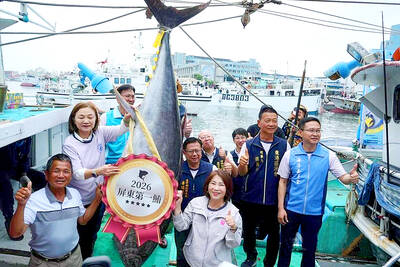
The first bluefin tuna of the season, brought to shore in Pingtung County and weighing 190kg, was yesterday auctioned for NT$10,600 (US$333.5) per kilogram, setting a record high for the local market. The auction was held at the fish market in Donggang Fishing Harbor, where the Siaoliouciou Island-registered fishing vessel Fu Yu Ching No. 2 delivered the “Pingtung First Tuna” it had caught for bidding. Bidding was intense, and the tuna was ultimately jointly purchased by a local restaurant and a local company for NT$10,600 per kilogram — NT$300 ,more than last year — for a total of NT$2.014 million. The 67-year-old skipper


 RSS
RSS