


The number of black kites seen in Taiwan has increased by 200 to 626 last year, a Raptor Research Group of Taiwan survey showed, adding that the increase might be the result of efforts to promote eco-friendly farming.
Sponsored by the Forestry Bureau, the Taipei-based group worked with bird-watchers to survey 16 locations and found that the number of birds increased from 359 in 2014 to 426 in 2015 and 626 last year. The black kite is an endangered species.
Taipei Feitsui Reservoir in northern Taiwan recorded the highest number of black kites at 109, followed by 107 in Pintung’s Sandimen Township (三地門), bir-watchers said.
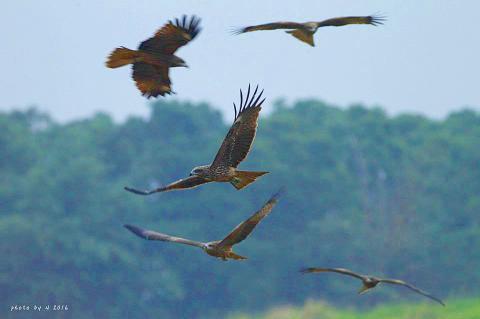
Photo: CNA, provided by the Raptor Research Group of Taiwan
Researcher Lin Hui-shan (林惠珊), who headed the survey, said that when the group started the survey three years ago, they found that many black kites died from eating other smaller birds that had died from eating crops sprayed with pesticides.
Highly toxic carbofuran has been widely used by farmers to keep birds from eating their crops, such as rice and fruit. The deaths of many birds have been linked to carbofuran.
However, over the past three years the group has urged farmers not to use pesticides to kill birds, Lin said.
The government’s campaign to promote environmentally friendly farming in recent years has helped create better conditions for black kites, Lin said.
Prior to 2013 there were fewer than 300 black kites in Taiwan according to birdwatchers’ data, Lin said.
During the Japanese colonial era, estimates put the number of black kites in Taiwan, at more than 5,000, National Pingtung University of Science and Technology Institute of Wildlife Conservation professor Sun Yuan-hsun (孫元勳) said.
The number of black kites had been declining since pesticides were introduced in 1961, Sun said.
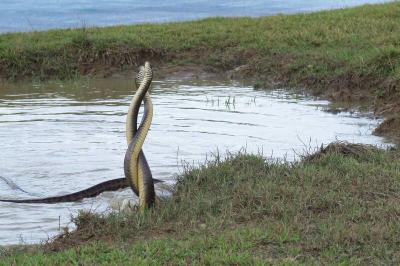
Kenting National Park service technician Yang Jien-fon (楊政峰) won a silver award in World Grand Prix Photography Awards Spring Season for his photograph of two male rat snakes intertwined in combat. Yang’s colleagues at Kenting National Park said he is a master of nature photography who has been held back by his job in civil service. The awards accept entries in all four seasons across six categories: architectural and urban photography, black-and-white and fine art photography, commercial and fashion photography, documentary and people photography, nature and experimental photography, and mobile photography. Awards are ranked according to scores and divided into platinum, gold and
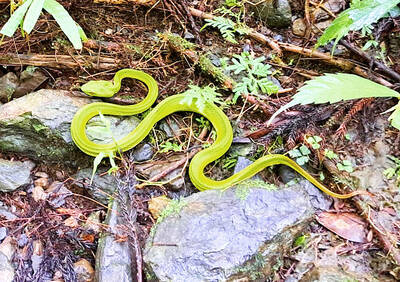
More than half of the bamboo vipers captured in Tainan in the past few years were found in the city’s Sinhua District (新化), while other districts had smaller catches or none at all. Every year, Tainan captures about 6,000 snakes which have made their way into people’s homes. Of the six major venomous snakes in Taiwan, the cobra, the many-banded krait, the brown-spotted pit viper and the bamboo viper are the most frequently captured. The high concentration of bamboo vipers captured in Sinhua District is puzzling. Tainan Agriculture Bureau Forestry and Nature Conservation Division head Chu Chien-ming (朱健明) earlier this week said that the

BREACH OF CONTRACT: The bus operators would seek compensation and have demanded that the manufacturer replace the chips with ones that meet regulations Two bus operators found to be using buses with China-made chips are to demand that the original manufacturers replace the systems and provide compensation for breach of contract, the Veterans Affairs Council said yesterday. Democratic Progressive Party Legislator Michelle Lin (林楚茵) yesterday said that Da Nan Bus Co and Shin-Shin Bus Co Ltd have fielded a total of 82 buses that are using Chinese chips. The bus models were made by Tron-E, while the systems provider was CYE Electronics, Lin said. Lin alleged that the buses were using chips manufactured by Huawei subsidiary HiSilicon Co, which presents a national security risk if the

The National Immigration Agency has banned two Chinese from returning to Taiwan, after they published social media content it described as disrespectful to national sovereignty. The agency imposed a two-month ban on a Chinese man surnamed Liang (梁) and a permanent ban on a woman surnamed Yang (楊), an influencer with 23 million followers, in October last year and last week respectively. Minister of the Interior Liu Shyh-fang (劉世芳) yesterday said on the sidelines of a legislative meeting that Chinese visitors to Taiwan are required to comply with the rules and regulations governing their entry permits. The government has handled the ban and


 RSS
RSS