


Having small nations as diplomatic allies is a burden for Taiwan, Foundation on Asia-Pacific Peace Studies chairman Hsu Hsin-liang (許信良) said yesterday.
Hsu’s remark came after Sao Tome and Principe on Wednesday announced that it is cutting diplomatic ties with Taiwan.
Hsu, a former chairman of the Democratic Progressive Party (DPP), was speaking at a seminar hosted by the foundation regarding questions over whether the Sao Tomean government’s actions will cause a cascade of diplomatic allies severing ties with Taiwan.
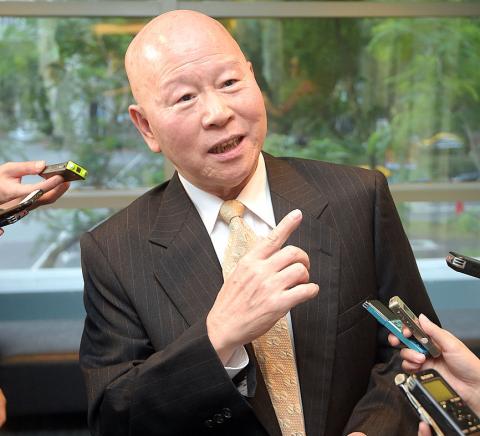
Photo: Huang Yao-cheng, Taipei Times
Any competition with China over diplomatic allies is at a distinct disadvantage, and in the end, it is up to China how many diplomatic allies we can keep, Hsu said.
We cannot do anything about it if China makes such a decision, but “the nation would very much welcome it if China attempted to take away all of Taiwan’s diplomatic allies,” Hsu said, but added that Beijing would not do such a thing.
Hsu said that having small nations as diplomatic allies is not a good thing, as they impose too much of a burden, adding that losing them “is not really important.”
Hsu said that he has lived in Taiwan his entire life and has seen how the nation gained and lost diplomatic allies over the years through international interference.
Treating an incident that is not related to the survival and development of Taiwan as a setback is not how the nation should handle its affairs, Hsu said, adding that similar incidents “have happened throughout my life” and he does not like the kind of “international situation” that Taiwan is forced into.
The real problem is not about diplomatic allies, but how the nation handles its relations with the US and China, Hsu said, adding that such issues were “matters of life and death.”
Hsu said that the nation he grew up in was constantly bickering over how to maintain its seat in the UN and whether to break ties with the US or Japan, adding that Taiwan is in a good situation in terms of international politics, and enjoys better ties with other nations than when the Republic of China (ROC) was one of the five permanent members on the UN Security Council.
China has always been hostile toward the DPP, and it is up to China to be practical and calm over cross-strait relations, Hsu said.
President Tsai Ing-wen (蔡英文) has made it clear that her administration will not antagonize China, Hsu said, adding that the Tsai administration’s cross-strait policies was no different from the Chinese Nationalist Party’s (KMT).
The government has agreed to treat cross-strait relations as designated in the Constitution, and it sought members of the pan-blue camp as officials in the Mainland Affairs Council and the Straits Exchange Foundation, Hsu said.
The president’s treatment of cross-strait relations is pragmatic, rational and avoids breaching China’s core interests and red lines, Hsu said, adding that it was up to China to adopt a similar attitude on cross-strait issues.

FUKUOKA SITUATION: Japanese media reported that the pathogen is expected to be identified by the summer, while the CDC downplayed the idea that it was hMPV A “mysterious cold-like illness” reported in Japan’s Fukuoka Prefecture does not seem to be a new disease, but Japanese authorities have been asked about the situation, the Centers for Disease Control (CDC) said yesterday. The Fukuoka Prefectural Medical Association on Wednesday told a news conference that a “mystery cold” that has become a hot topic on social media is “highly likely to be caused by some kind of viral infection,” Japan’s KBC News reported. “Many people are experiencing symptoms starting with a sore throat, followed by a runny nose, phlegm and a severe cough,” KBC News reported, citing association officials. Health authorities are

Nvidia Corp CEO Jensen Huang (黃仁勳) arrived in Taiwan yesterday ahead of upcoming AI and technology events, saying he plans to meet with clients and Taiwan Semiconductor Manufacturing Co Chairman C.C. Wei (魏哲家) during his visit. After landing at Taipei Songshan Airport, Huang posed for photos with fans and handed out Yakult drinks to reporters and supporters waiting at the scene, saying he has “a lot to do” during the trip. Asked about reports that Nvidia’s planned headquarters site in Taipei’s Beitou Shilin Technology Park could break ground on May 27, Huang said that if the company holds an event, he would

Carrefour Taiwan is to begin using a new name from the start of July, but it cannot divulge the name until then, the chairman of the supermarket chain's parent company said today. President Chain Store Co chairman Lo Chih-hsien (羅智先) was asked by reporters after a shareholders' meeting to confirm whether the company has settled on a new name for the supermarket brand. In March, the government-registered name of two Carrefour Taiwan branches was quietly changed to "Le Chia Kang" (樂家康) in Chinese, raising speculation that has been selected as the name. Lo said that because of local regulations and contractual obligations, the
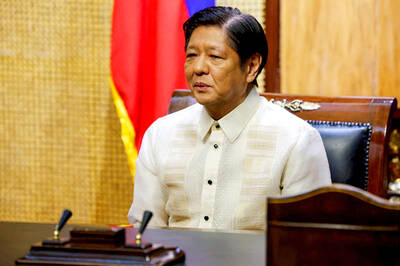
The Philippines would likely be involved in any conflict over Taiwan due to its proximity to the democracy claimed by China, President Ferdinand Marcos Jr said, reiterating a stance that risks angering Beijing. “In the Philippines, we do not have a choice because Taiwan is so close to the Philippines and we have almost 200,000 Filipino nationals living and working in Taiwan,” Marcos said in an interview with Japanese media in Manila on Monday. The Philippine leader’s comments come ahead of a state visit to Japan next week, where he is to meet with Japanese Prime Minister Sanae Takaichi to discuss security


 RSS
RSS