


The Chinese Nationalist Party (KMT) caucus yesterday revealed that it was unaware of plans by the party’s headquarters to demand a recall of Democratic Progressive Party (DPP) legislators, saying it learned of the issue from the media.
KMT caucus convener Sufin Siluko (廖國棟) said that demands for a recall of DPP legislators being made by the KMT headquarters were never communicated to the party’s caucus.
Sufin said the KMT caucus only learned about the demands by reading about them in newspaper reports.
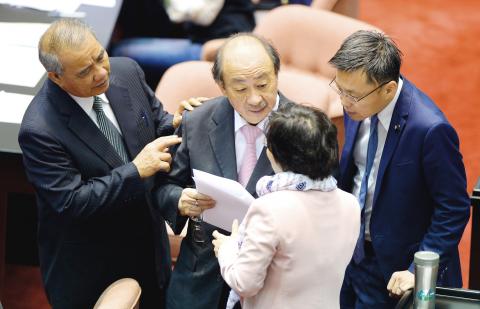
Photo: Lin Cheng-kun, Taipei Times
The DPP caucus has responded by saying that if the KMT “plays with fire it will get burned.”
DPP caucus whip Ker Chien-ming (柯建銘) said the KMT was acting like a group without a leader, comparing their actions to the failed Qing-era Boxer Rebellion, in which an anti-foreign militia believed itself to be invulnerable.
Ker said that removing people from posts and calling for legislative elections would not put the KMT in a good light, adding that people should only be removed from their positions for legitimate reasons.
“Support for the KMT is at an all-time low right now. In the end we will see who gets removed from their post,” Ker said.
KMT Central Policy Committee director Alex Tsai (蔡正元) has said that a public opinion survey would be used to determine which legislators would be brought up for removal from posts.
Sufin yesterday told reporters that he does not know what the KMT headquarters is planning, adding that it would be a bit early to recall legislators now, as they have not completed a year in their posts.
He said that a recall would be met with opposition, adding that the party’s caucus is more conservative on the issue than the party headquarters is.
“Although opposition to a referendum banning the import of food from nuclear disaster areas is a good reason for a recall, whether that would be enough for across-the-board removal of legislators is yet to be seen,” he said.
Sufin denied the prevailing view that the caucus sides with KMT Vice Chairman Hau Lung-bin (郝龍斌) as they cooperated on proposing a referendum to oppose the import of food from Japan’s disaster-stricken Fukushima Prefecture, saying: “When goals are clear [and similar] people will naturally work together.”
“We are not standing on anyone’s side,” he said.
He said that KMT headquarters had failed by not informing the caucus about the plans to bring up a recall, adding that no sufficient reason for the plan was given and that he was worried the DPP might “respond to evil with evil” by bringing up their own demands for a recall of KMT legislators.
KMT Culture and Communications Committee Deputy Director Hu Wen-chi (胡文琦) said the KMT headquarters would find time to communicate with the caucus on the issue.
Hu said the KMT would bring up the recall on Feb. 1, adding that it would plan carefully before then.
Although the party headquarters was slow in communicating with the caucus, it sees the entities as “one family,” Hu said.
“I hope the caucus will understand our strategic approach. We will step up communication with caucus members in the coming days,” Hu said.
Responding to Sufin’s concerns about retaliation from the DPP, Hu said he respects Sufin’s thinking, adding that the DPP will not take such action, as the KMT’s demands are “socially just, fair, in opposition to wrongdoing and consistent with the law and the Constitution.”
Additional reporting by Shih Hsiao-kuang
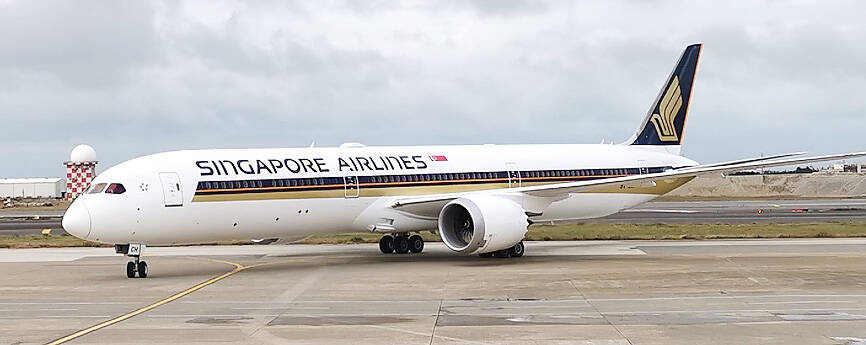
INCREASED CAPACITY: The flights on Mondays, Wednesdays, Fridays and Sundays would leave Singapore in the morning and Taipei in the afternoon Singapore Airlines is adding four supplementary flights to Taipei per week until May to meet increased tourist and business travel demand, the carrier said on Friday. The addition would raise the number of weekly flights it operates to Taipei to 18, Singapore Airlines Taiwan general manager Timothy Ouyang (歐陽漢源) said. The airline has recorded a steady rise in tourist and business travel to and from Taipei, and aims to provide more flexible travel arrangements for passengers, said Ouyang, who assumed the post in July last year. From now until Saturday next week, four additional flights would depart from Singapore on Monday, Wednesday, Friday
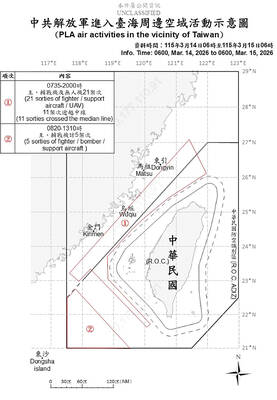
The Ministry of National Defense yesterday reported the return of large-scale Chinese air force activities after their unexplained absence for more than two weeks, which had prompted speculation regarding Beijing’s motives. China usually sends fighter jets, drones and other military aircraft around the nation on a daily basis. Interruptions to such routine are generally caused by bad weather. The Ministry of National Defense said it had detected 26 Chinese military aircraft in the Taiwan Strait over the previous 24 hours. It last reported that many aircraft on Feb. 25, when it spotted 30 aircraft, saying Beijing was carrying out another “joint combat

Taiwan successfully defended its women’s 540 kilogram title and won its first-ever men’s 640 kg title at the 2026 World Indoor Tug of War Championships in Taipei yesterday. In the women’s event, Taiwan’s eight-person squad reached the final following a round-robin preliminary round and semifinals featuring teams from Ukraine, Japan, Thailand, Vietnam, the Basque Country and South Korea. In the finals, they swept the Basque team 2-0, giving the team composed mainly of National Taiwan Normal University students and graduates its second championship in a row, and its fourth in five years. Team captain
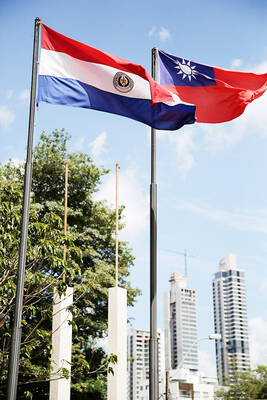
When Paraguayan opposition lawmaker Leidy Galeano returned from an all-expenses-paid tour of six Chinese cities late last year, she was convinced Paraguay risked missing out on major economic gains by sticking with longtime ally Taipei over Beijing — a message that participants on the trip heard repeatedly from Chinese officials. “Everything I saw there, I wanted for my country,” said Galeano, a member of the newly-formed Yo Creo party whose senior figures have spoken favorably about China. This trip and others like it — which people familiar with the visits said were at the invitation of the Chinese consulate in Sao Paulo


 RSS
RSS