


The Taipei Association of Travel Agents yesterday vowed to seek compensation from the government for its members’ financial losses following TransAsia Airways’ unexpected suspension of flights, should the Civil Aeronautics Administration be found negligent in supervising the airline’s operation.
“We strongly condemn TransAsia Airways for halting flights without prior notice, causing inconvenience to both travelers and travel agencies,” the association said. “The suspension has also caused the public to panic. As such, the airline should promise to cover all losses by consumers and travel agencies as part of its corporate responsibility.”
The association also requested that the administration provide an effective solution to deal with the effects of the suspension, saying that it should establish an emergency task force to administer flights to protect travelers’ rights.
The administration should also oversee TransAsia to ensure that it fulfills its responsibility of compensating travelers, the association said.
The association does not exclude the possibility of filing a lawsuit on behalf of travel agencies affected by the suspension should the airline fail to take responsibility for losses, it said, adding that it might ask the government to reimburse losses if the agency is found negligent in its oversight of TransAsia’s operations.
The Travel Quality Assurance Association (TQAA), of which 90 percent of the nation’s travel agencies are members, said that the airline’s suspension of flights was not the only crisis the industry has faced in recent years.
Far Eastern Air Transport and Angkor Airways suspended services in 2008 because of financial problems, as did Tonlesap Airlines in 2013, it said, adding that travel agencies and travelers were left to deal with these crises by themselves.
The administration has failed to demand that TransAsia provide a practical plan to help bring home travelers stranded overseas, TQAA said, adding that the agency did not include travel agencies in planning a response to the unexpected suspension.
The administration’s Air Transport Division Director Han Chen-hua (韓振華) said the agency has monitored TransAsia’s progress in addressing aviation safety issues following two plane crashes in 2014 and last year.
TransAsia’s financial status has also been under the agency’s scrutiny, he said, adding that the airline is obligated to submit certified quarterly reports for review.
“Based on last month’s figures, TransAsia does not face any immediate financial risks. As of today, the company has more than NT$10 billion [US$313 million] in cash and its stock is worth NT$7 per share,” Han said.
“Unlike Far Eastern Air Transport, TransAsia did not choose to dissolve its business because it is unable to pay its employees’ salaries. It decided to dissolve its business because it did not see how to turn the business around,” he added.
There are about 10,000 travelers stranded overseas because of TransAsia’s suspension, Han said, adding that China Airlines has promised to offer them a 35 percent or greater discount on one-way tickets to Taiwan.
EVA Air and its subsidiary Uni Air announced that they would offer stranded travelers a 50 percent discount on tickets.

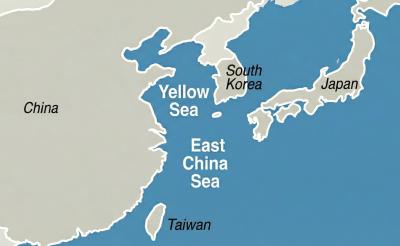
China has reserved offshore airspace in the Yellow Sea and East China Sea from March 27 to May 6, issuing alerts usually used to warn of military exercises, although no such exercises have been announced, the Wall Street Journal (WSJ) reported yesterday. Reserving such a large area for 40 days without explanation is an “unusual step,” as military exercises normally only last a few days, the paper said. These alerts, known as Notice to Air Missions (Notams), “are intended to inform pilots and aviation authorities of temporary airspace hazards or restrictions,” the article said. The airspace reserved in the alert is

NAMING SPAT: The foreign ministry called on Denmark to propose an acceptable solution to the erroneous nationality used for Taiwanese on residence permits Taiwan has revoked some privileges for Danish diplomatic staff over a Danish permit that lists “Taiwan” as “China,” Eric Huang (黃鈞耀), head of the Ministry of Foreign Affairs’ Department of European Affairs, told a news conference in Taipei yesterday. Reporters asked Huang whether the Danish government had responded to the ministry’s request that it correct the nationality on Danish residence permits of Taiwanese, which has been listed as “China” since 2024. Taiwan’s representative office in Denmark continues to communicate with the Danish government, and the ministry has revoked some privileges previously granted to Danish representatives in Taiwan and would continue to review

More than 6,000 Taiwanese students have participated in exchange programs in China over the past two years, despite the Mainland Affairs Council’s (MAC) “orange light” travel advisory, government records showed. The MAC’s publicly available registry showed that Taiwanese college and university students who went on exchange programs across the Strait numbered 3,592 and 2,966 people respectively. The National Immigration Agency data revealed that 2,296 and 2,551 Chinese students visited Taiwan for study in the same two years. A review of the Web sites of publicly-run universities and colleges showed that Taiwanese higher education institutions continued to recruit students for Chinese educational programs without
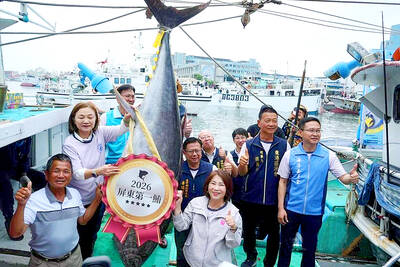
The first bluefin tuna of the season, brought to shore in Pingtung County and weighing 190kg, was yesterday auctioned for NT$10,600 (US$333.5) per kilogram, setting a record high for the local market. The auction was held at the fish market in Donggang Fishing Harbor, where the Siaoliouciou Island-registered fishing vessel Fu Yu Ching No. 2 delivered the “Pingtung First Tuna” it had caught for bidding. Bidding was intense, and the tuna was ultimately jointly purchased by a local restaurant and a local company for NT$10,600 per kilogram — NT$300 ,more than last year — for a total of NT$2.014 million. The 67-year-old skipper


 RSS
RSS