


The Chinese Nationalist Party (KMT) yesterday blamed the government for TransAsia Airways’ demise, saying President Tsai Ing-wen’s (蔡英文) cross-strait policy and a decline in the number of Chinese tourists were responsible for the airline’s dissolution.
Although TransAsia “admittedly has internal problems,” the losses incurred by the declining number of Chinese tourists that occurred under the Tsai administration made TransAsia vulnerable, as cross-strait travel comprised 40 percent of the airline’s operations, KMT Culture and Communications Committee deputy director Tang Te-ming (唐德明) said at a news conference.
TransAsia, an ailing company founded in 1951, is estimated to have paid nearly NT$1.2 billion (US$37.6 million) in compensation to victims and their families of two deadly crashes in July 2014 and February last year.
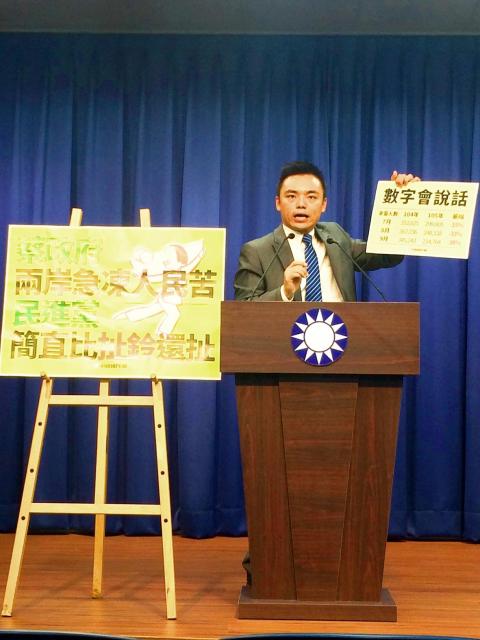
Photo: Lu Yi-hsuan, Taipei Times
“The Democratic Progressive Party [DPP] government’s policies have led to a cooling of cross-strait relations, which affected cross-strait flights. Those issues were probably the last straw for TransAsia,” Tang said, citing a recent poll that showed Tsai’s disapproval rating has climbed to nearly 60 percent and identified her cross-strait policy as causing the “suffering of the public.”
The number of Chinese tourists showed annual declines of 15 percentage points in July, 33 percentage points in August and 38 percentage points in September, KMT Culture and Communications Committee deputy director Hung Meng-kai (洪孟楷) said.
Statistics have shown that the average Chinese tourist spends about US$295 on goods and services during their stay in Taiwan, with the decline of 100,000 Chinese tourists in September causing a loss of NT$900 million for the nation’s tourism industry, Hung said, adding that at this rate, “losses for the year will total NT$12 billion.”
The Tsai administration has “economically victimized” the private sector, Hung said, adding: “Tsai should accept the fact that the number of Chinese tourists has dropped by a significant amount and stop leading the nation with ideology.”
Beijing has imposed a series of punitive measures against the DPP government over its refusal to acknowledge the so-called “1992 consensus,” such as suspending official cross-strait communication mechanisms and reducing the number of Chinese tourists allowed to visit Taiwan.
The “1992 consensus” refers to a tacit understanding between the KMT and the Chinese Communist Party that both sides of the Taiwan Strait acknowledge that there is “one China,” with each side having its own interpretation of what “China” means. Former Mainland Affairs Council chairman Su Chi (蘇起) in 2006 admitted to making up the term in 2000.
TransAsia had more passengers in the first three quarters of this year than it did last year and in 2014, suggesting that Chinese tourists had “little effect” on its business, DPP Legislator Wang Ding-yu (王定宇) said.
“TransAsia’s sudden suspension of flights and ensuing dissolution should be seen as a reflection of its flight safety practices, corporate mismanagement and the allocation of its funds. It is not a situation that can be attributed to a single factor,” Wang said.
“The KMT has not conducted any research to back up its claims that the fall in the number of Chinese tourists and the Tsai administration are to blame,” he said. “It is not a political party accustomed to using its brain.”

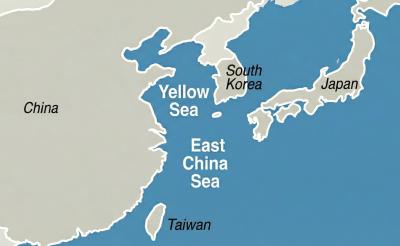
China has reserved offshore airspace in the Yellow Sea and East China Sea from March 27 to May 6, issuing alerts usually used to warn of military exercises, although no such exercises have been announced, the Wall Street Journal (WSJ) reported yesterday. Reserving such a large area for 40 days without explanation is an “unusual step,” as military exercises normally only last a few days, the paper said. These alerts, known as Notice to Air Missions (Notams), “are intended to inform pilots and aviation authorities of temporary airspace hazards or restrictions,” the article said. The airspace reserved in the alert is

NAMING SPAT: The foreign ministry called on Denmark to propose an acceptable solution to the erroneous nationality used for Taiwanese on residence permits Taiwan has revoked some privileges for Danish diplomatic staff over a Danish permit that lists “Taiwan” as “China,” Eric Huang (黃鈞耀), head of the Ministry of Foreign Affairs’ Department of European Affairs, told a news conference in Taipei yesterday. Reporters asked Huang whether the Danish government had responded to the ministry’s request that it correct the nationality on Danish residence permits of Taiwanese, which has been listed as “China” since 2024. Taiwan’s representative office in Denmark continues to communicate with the Danish government, and the ministry has revoked some privileges previously granted to Danish representatives in Taiwan and would continue to review

More than 6,000 Taiwanese students have participated in exchange programs in China over the past two years, despite the Mainland Affairs Council’s (MAC) “orange light” travel advisory, government records showed. The MAC’s publicly available registry showed that Taiwanese college and university students who went on exchange programs across the Strait numbered 3,592 and 2,966 people respectively. The National Immigration Agency data revealed that 2,296 and 2,551 Chinese students visited Taiwan for study in the same two years. A review of the Web sites of publicly-run universities and colleges showed that Taiwanese higher education institutions continued to recruit students for Chinese educational programs without
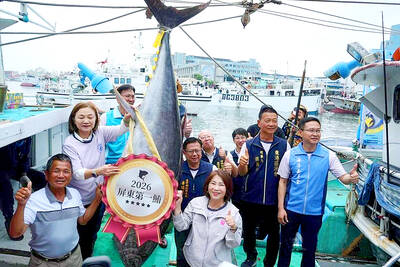
The first bluefin tuna of the season, brought to shore in Pingtung County and weighing 190kg, was yesterday auctioned for NT$10,600 (US$333.5) per kilogram, setting a record high for the local market. The auction was held at the fish market in Donggang Fishing Harbor, where the Siaoliouciou Island-registered fishing vessel Fu Yu Ching No. 2 delivered the “Pingtung First Tuna” it had caught for bidding. Bidding was intense, and the tuna was ultimately jointly purchased by a local restaurant and a local company for NT$10,600 per kilogram — NT$300 ,more than last year — for a total of NT$2.014 million. The 67-year-old skipper


 RSS
RSS