


National Security Bureau (NSB) Director-General Peng Sheng-chu (彭勝竹) on Monday described the cross-strait situation over the past five months as “lax outside, but tense inside,” adding that he expects official exchanges to become even more limited.
Peng, a former air force commander, said that in many ways, China has seemed to maintain its attitude toward Taiwan from before May 20, when President Tsai Ing-wen (蔡英文) assumed office, but it has suppressed Taiwan on various occasions.
He also said China is still watching the words and deeds of Tsai and has yet to set a tone in dealing with the Tsai administration.
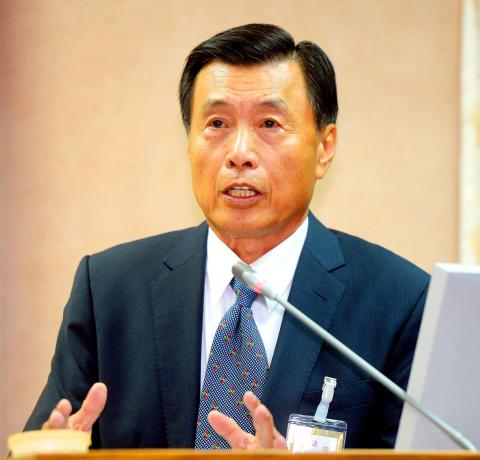
Photo: Lin Cheng-kung, Taipei Times
At organizations in which Taiwan is a member, China would continue to let Taiwan participate, but it would rigorously demand that Taiwan follow regulations, Peng said.
At organizations in which Taiwan is yet to become a member, its entry would depend on China’s assessment and Beijing would only consider it if the nation’s participation benefits both sides, he said.
Asked whether China would initiate a diplomatic war, Peng said such a possibility exists, but added that while pressure would continue to mount, it should not reach a breaking point.
Taiwan was unable to take part in this year’s International Civil Aviation Organization Assembly as well as an Interpol meeting mainly due to China’s objections.
Beijing has cooled ties with Taipei because the Tsai administration refuses to recognize the so-called “1992 consensus.”
The “1992 consensus,” a term former Mainland Affairs Council chairman Su Chi (蘇起) in 2006 admitted making up in 2000, refers to a tacit understanding between the Chinese Nationalist Party (KMT) and the Chinese government that both sides of the Strait acknowledge there is “one China,” with each side having its own interpretation of what “China” means.
The DPP has said that no “consensus” ever existed — although Tsai said in her inauguration speech that the two sides “arrived at various joint acknowledgements and understandings” in a “spirit of mutual understanding and a political attitude of seeking common ground while setting aside differences.”
It says the “consensus” brands Taiwan as a part of China, which a majority of Taiwanese do not agree with.
Beijing sees the “consensus” as the political foundation for dialogue between Taiwan and China and has frozen dialogue with Taipei and put increasing pressure on it in the international community.

LOUD AND PROUD Taiwan might have taken a drubbing against Australia and Japan, but you might not know it from the enthusiasm and numbers of the fans Taiwan might not be expected to win the World Baseball Classic (WBC) but their fans are making their presence felt in Tokyo, with tens of thousands decked out in the team’s blue, blowing horns and singing songs. Taiwanese fans have packed out the Tokyo Dome for all three of their games so far and even threatened to drown out home team supporters when their team played Japan on Friday. They blew trumpets, chanted for their favorite players and had their own cheerleading squad who dance on a stage during the game. The team struggled to match that exuberance on the field, with
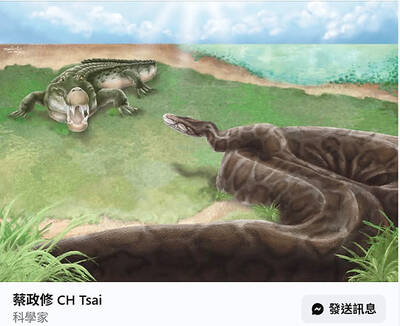
Taiwanese paleontologists have discovered fossil evidence that pythons up to 4m long inhabited Taiwan during the Pleistocene epoch, reporting their findings in the international scientific journal Historical Biology. National Taiwan University (NTU) Institute of Ecology and Evolutionary Biology associate professor Tsai Cheng-hsiu (蔡政修) led the team that discovered the largest snake fossil ever found in Taiwan. The single trunk vertebra was discovered in Tainan at the Chiting Formation, dated to between 400,000 and 800,000 years ago in the Middle Pleistocene, the paper said. The area also produced Taiwan’s first avian fossil, as well as crocodile, mammoth, saber-toothed cat and rhinoceros fossils, it said. Discoveries

Taiwanese paleontologists have discovered fossil evidence that pythons up to 4m long inhabited Taiwan during the Pleistocene epoch, reporting their findings in the international scientific journal Historical Biology. National Taiwan University (NTU) Institute of Ecology and Evolutionary Biology associate professor Tsai Cheng-hsiu (蔡政修) led the team that discovered the largest snake fossil ever found in Taiwan. A single trunk vertebra was discovered in Tainan at the Chiting Formation, dated to between 800,000 to 400,000 years ago in the Middle Pleistocene, the paper said. The area also produced Taiwan’s first avian fossil, as well as crocodile, mammoth, sabre-toothed cat and rhinoceros fossils, it said. Discoveries

Whether Japan would help defend Taiwan in case of a cross-strait conflict would depend on the US and the extent to which Japan would be allowed to act under the US-Japan Security Treaty, former Japanese minister of defense Satoshi Morimoto said. As China has not given up on the idea of invading Taiwan by force, to what extent Japan could support US military action would hinge on Washington’s intention and its negotiation with Tokyo, Morimoto said in an interview with the Liberty Times (sister paper of the Taipei Times) yesterday. There has to be sufficient mutual recognition of how Japan could provide


 RSS
RSS