


Four foundations affiliated with the Chinese Nationalist Party (KMT) secured government tenders worth NT$170 million (US$5.35 million at current exchange rates) during former president Ma Ying-jeou’s (馬英九) terms, prompting legislators to accuse the previous administration of channeling public money into private hands and using political influence for private gain.
The National Policy Foundation, the Chinese Youth Peace Corps, the Chang Ching Charity Foundation and the Parasite Control Organization won several government tenders and contracts between 2008 and this year while they were directly or indirectly funded by the KMT, according to public data compiled by the Judicial Yuan.
KMT Chairwoman Hung Hsiu-chu (洪秀柱) also chairs the National Policy Foundation — a KMT think tank — as well as the Chinese Youth Peace Corps and the Chang Ching Charity Foundation, the data showed.
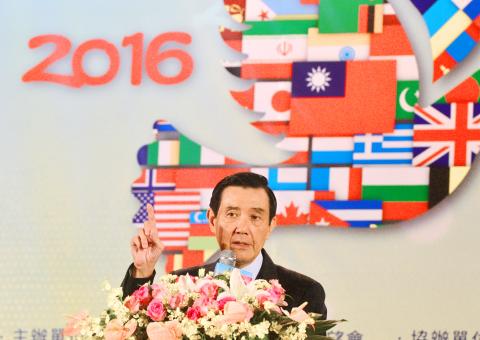
Photo: Wang Yi-song, Taipei Times
The Parasite Control Organization assigned former government officials as chairperson and director in patronage appointments, Democratic Progressive Party (DPP) Legislator Tuan Yi-kang (段宜康) said.
The Ill-gotten Party Assets Settlement Committee has launched a new wave of investigations into KMT-affiliated organizations, including foundations established by the party and entities it invested in.
It is to be determined if the foundations are indeed KMT affiliates, and if that is the case, their participation in government tenders during the KMT administration was obviously inappropriate, regardless of whether corruption was involved, DPP caucus chief executive Wu Ping-jui (吳秉叡) said.
“Would it be appropriate for me to bid for a government project while the DPP heads the government?” Wu asked.
New Power Party caucus chief executive Hsu Yung-ming (徐永明) said the KMT might use its political resources to divert government resources to the party and convert public assets into party assets.
The committee should look into whether the foundations were used as a means to siphon off government funds and whether there were government officials involved in such activities who secured high-level jobs at the foundations, Hsu said.
If the foundations are presumed to be funded via ill-gotten assets, the committee has to ask them to declare their financial status and return ill-gotten properties, he said.
“Hung has assigned senior KMT officials to manage foundations and it is a concern that the KMT might dispose of or privatize party assets, or even launder the money,” he said, adding that an investigation should also be launched into whether the foundations used government subsidies according to the rules.
KMT Culture and Communications Committee deputy director Hu Wen-chi (胡文琦) said the committee is unconstitutional and it has made itself a political tool of President Tsai Ing-wen (蔡英文) with relentless and false charges against the KMT.
All foundations under the KMT have been legally operated and there is no flaw in their conducting procurements and bidding for tender offers, Hu said, calling on the committee to apply the same standard to the DPP’s many foundations.

Taiwan has received more than US$70 million in royalties as of the end of last year from developing the F-16V jet as countries worldwide purchase or upgrade to this popular model, government and military officials said on Saturday. Taiwan funded the development of the F-16V jet and ended up the sole investor as other countries withdrew from the program. Now the F-16V is increasingly popular and countries must pay Taiwan a percentage in royalties when they purchase new F-16V aircraft or upgrade older F-16 models. The next five years are expected to be the peak for these royalties, with Taiwan potentially earning
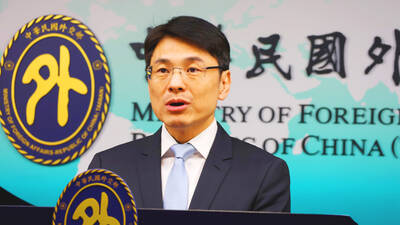
STAY IN YOUR LANE: As the US and Israel attack Iran, the ministry has warned China not to overstep by including Taiwanese citizens in its evacuation orders The Ministry of Foreign Affairs (MOFA) yesterday rebuked a statement by China’s embassy in Israel that it would evacuate Taiwanese holders of Chinese travel documents from Israel amid the latter’s escalating conflict with Iran. Tensions have risen across the Middle East in the wake of US and Israeli airstrikes on Iran beginning Saturday. China subsequently issued an evacuation notice for its citizens. In a news release, the Chinese embassy in Israel said holders of “Taiwan compatriot permits (台胞證)” issued to Taiwanese nationals by Chinese authorities for travel to China — could register for evacuation to Egypt. In Taipei, the ministry yesterday said Taiwan
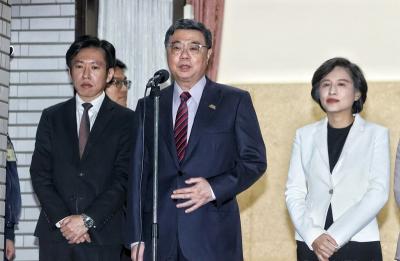
Taiwan is awaiting official notification from the US regarding the status of the Agreement on Reciprocal Trade (ART) after the US Supreme Court ruled US President Donald Trump's global tariffs unconstitutional. Speaking to reporters before a legislative hearing today, Premier Cho Jung-tai (卓榮泰) said that Taiwan's negotiation team remains focused on ensuring that the bilateral trade deal remains intact despite the legal challenge to Trump's tariff policy. "The US has pledged to notify its trade partners once the subsequent administrative and legal processes are finalized, and that certainly includes Taiwan," Cho said when asked about opposition parties’ doubts that the ART was
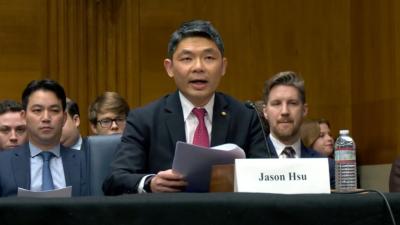
If China chose to invade Taiwan tomorrow, it would only have to sever three undersea fiber-optic cable clusters to cause a data blackout, Jason Hsu (許毓仁), a senior fellow at the Hudson Institute and former Chinese Nationalist Party (KMT) legislator, told a US security panel yesterday. In a Taiwan contingency, cable disruption would be one of the earliest preinvasion actions and the signal that escalation had begun, he said, adding that Taiwan’s current cable repair capabilities are insufficient. The US-China Economic and Security Review Commission (USCC) yesterday held a hearing on US-China Competition Under the Sea, with Hsu speaking on


 RSS
RSS