


Gobo Group (國寶集團) president Chu Guo-rong (朱國榮), detained in relation to allegations of embezzlement in the CTBC Financial Holding Co (中信金) case, was yesterday released on a record-setting NT$400 million (US$12.74 million) bail.
Former CTBC executives Wu Feng-fu (吳豐富) and Chang Yu-chen (張友琛) were also released after a bail hearing at the Taipei District Court. Wu’s bail was set at NT$35 million, while Chang’s was NT$1.5 million.
The court set conditions on Chu and Wu’s release, with restrictions on their movement, including staying in their own residences, not leaving the nation and reporting to their local police station every day.
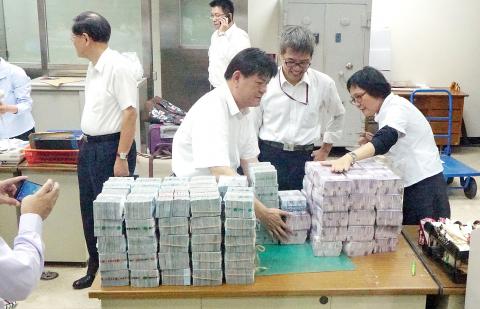
Photo: George Tsorng, Taipei Times
The Supreme Prosecutors’ Office Special Investigation Division on Wednesday indicted Jeffrey Koo Jr (辜仲諒) and seven others, including CTBC and Gobo Group executives, for allegedly embezzling company funds and other illegal financial dealings, and contravening the Securities and Exchange Act (證券交易法), the Money Laundering Control Act (洗錢防制法) and the Insurance Act (保險法).
Prosecutors have alleged that Chu might have made illegal profits of about NT$358 million through his company’s dealings with CTBC and on Wednesday they asked the judges set a very high figure for Chu’s bail.
Chu was unable to come up with the required amount on Wednesday and spent another night at the Taipei Detention Center, where he has been held for almost four months.
Chu’s family and friends yesterday paid NT$120.5 million of the bail in cash and the remainder in certified checks.
Chu’s sister was accompanied by a lawyer as she brought three suitcases and two bags of cash to the court in the afternoon to post the bail.
The NT$400 million bail set a new record in Taiwan, surpassing the NT$350 million imposed on former Eastern Multimedia Group (EMG) chairman Gary Wang (王令麟) in a 2008 EMG assets scandal.
The record cumulative bail for one person was for former Ting Hsin International Group executive Wei Ying-chun (魏應充) at NT$1.6 billion, which involved several cases against him stemming from a tainted oil scandal in 2013 and subsequent litigation.
CTBC lawyers yesterday released a statement saying that there is no concrete evidence of wrongdoing, and that “we regret that prosecutors made indictments based only on inference and conjecture.”
“Jeffrey Koo Sr (辜濂松) was the founder of CTBC Financial and he was the soul and leader of Chinatrust Group companies. He played important roles in the nation’s business community and government’s cross-strait affairs and had been one of the most respected business leaders in this nation... Therefore all CTBC employees were shocked and feel regret over the charges by prosecutors against Jeffrey Koo Sr,” the lawyers said.
Although Koo Sr died in December 2012, prosecutors also investigated him as part of the probe before dropping all charges against him.

Taiwanese can file complaints with the Tourism Administration to report travel agencies if their activities caused termination of a person’s citizenship, Mainland Affairs Council Minister Chiu Chui-cheng (邱垂正) said yesterday, after a podcaster highlighted a case in which a person’s citizenship was canceled for receiving a single-use Chinese passport to enter Russia. The council is aware of incidents in which people who signed up through Chinese travel agencies for tours of Russia were told they could obtain Russian visas and fast-track border clearance, Chiu told reporters on the sidelines of an event in Taipei. However, the travel agencies actually applied

New measures aimed at making Taiwan more attractive to foreign professionals came into effect this month, the National Development Council said yesterday. Among the changes, international students at Taiwanese universities would be able to work in Taiwan without a work permit in the two years after they graduate, explainer materials provided by the council said. In addition, foreign nationals who graduated from one of the world’s top 200 universities within the past five years can also apply for a two-year open work permit. Previously, those graduates would have needed to apply for a work permit using point-based criteria or have a Taiwanese company
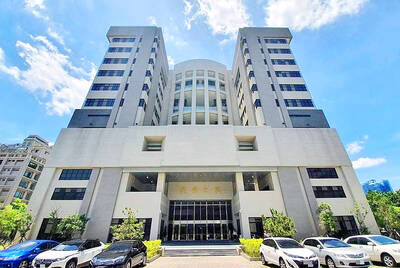
The Shilin District Prosecutors’ Office yesterday indicted two Taiwanese and issued a wanted notice for Pete Liu (劉作虎), founder of Shenzhen-based smartphone manufacturer OnePlus Technology Co (萬普拉斯科技), for allegedly contravening the Act Governing Relations Between the People of the Taiwan Area and the Mainland Area (臺灣地區與大陸地區人民關係條例) by poaching 70 engineers in Taiwan. Liu allegedly traveled to Taiwan at the end of 2014 and met with a Taiwanese man surnamed Lin (林) to discuss establishing a mobile software research and development (R&D) team in Taiwan, prosecutors said. Without approval from the government, Lin, following Liu’s instructions, recruited more than 70 software

Chinese spouse and influencer Guan Guan’s (關關) residency permit has been revoked for repeatedly posting pro-China videos that threaten national security, the National Immigration Agency confirmed today. Guan Guan has said many controversial statements in her videos posted to Douyin (抖音), including “the red flag will soon be painted all over Taiwan” and “Taiwan is an inseparable part of China,” and expressing hope for expedited reunification. The agency last year received multiple reports alleging that Guan Guan had advocated for armed reunification. After verifying the reports, the agency last month issued a notice requiring her to appear and explain her actions. Guan


 RSS
RSS