

The military’s sudden cancelation of a precision weapons strike exercise on Wednesday was a cautionary measure to prevent China from gathering intelligence about Taiwan’s missile capabilities, Minister of National Defense Feng Shih-kuan (馮世寬) said yesterday.
The live-fire exercise plan was to have a Patriot II surface-to-air missile intercept a locally developed Sky Bow II (天弓二型) missile, but it was called off after a Chinese coast guard ship was detected in international waters to the southeast of Orchid Island (Lanyu, 蘭嶼).
Foreign and National Defense Committee legislators said that the ministry should come up with a solution rather than canceling exercises whenever Chinese ships or airplanes are in the region.
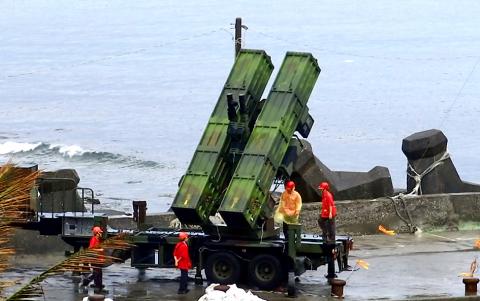
Photo: CNA
In response to Democratic Progressive Party (DPP) Legislator Wang Ding-yu’s (王定宇) question on whether the ministry has alternative solutions when weapons containing sensitive information were to be used in an exercise, Deputy Chief of the General Staff Admiral Pu Tze-chun (蒲澤春) said that the ministry was still looking into such possibilities.
Wang asked if the ministry had considered cooperating with other nations due to the limited locations where Taiwan could test-fire missiles, to which Pu said such cooperation would be difficult.
The ministry is maintaining its stance of halting exercises in the event of suspected information gathering by other nations, but would continue to look for alternatives, he said.
However, Pu said the military’s radar coverage of the Taiwan Strait was excellent and could tell friend from foe.
He said the ministry only halted exercises when weapons of a sensitive nature, such as the Sky Bow II missiles, were used in exercises.
“Otherwise, we continue as usual,” Pu said.
Chinese Nationalist Party (KMT) Legislator Lu Yu-ling (呂玉玲) asked whether the appearance of the Chinese coast guard ship was uncommon.
Pu said it was, adding that “the ship should not have been where it was.”
However, it has become increasingly common for Beijing to dispatch coast guard vessels or aircraft geared for intelligence gathering when Taiwan is conducting military exercises, the ministry said.
The military detected a Chinese coast guard ship during the test-fire exercise of the Patriot II missile system in Pingtung in May last year, forcing it to terminate the exercise, the ministry said.
The military also discovered an unidentified aircraft west of the median line in the Taiwan Strait during the Han Kuang exercises in August, the ministry said.
The military kept close tabs on the plane and there were no “surprises,” the ministry said.
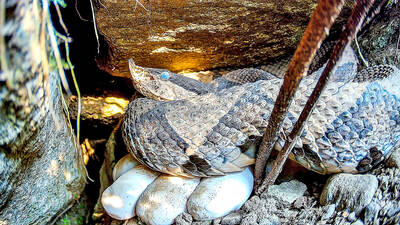
NATURE TAKES ITS COURSE: The agency’s head said he felt a sense of loss watching red-banded snakes eat the babies, as they had decided on non-intervention The Forestry and Nature Conservation Agency yesterday released a documentary on a hundred-pace viper that had incubated 16 eggs, all of which hatched, but only a baby viper escaped after they were attacked by red-banded snakes. The agency’s Taichung branch last year launched the viper reproduction monitoring project soon after forest rangers Lin Chun-yu (林俊佑) and Chou Chia-cheng (周家成) spotted a pregnant hundred-pace viper in a grass-covered burrow near a parking lot in Tbulan Village (松鶴部落). The Atayal village, in Taichung’s Heping District (和平), is headed by Ecyang Yapu, who was positive about the project and assisted in access control and power
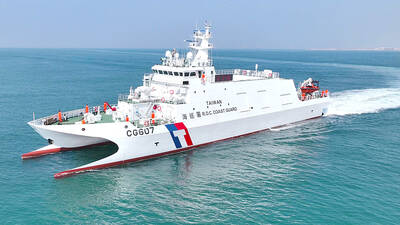
The Coast Guard Administration (CGA) yesterday said that it had deployed vessels to “monitor” Chinese ships operating in waters off the east coast. The CGA said it dispatched vessels in response to a China Coast Guard announcement that it had carried out another “routine law-enforcement patrol” in waters off the east coast. “The CGA firmly rejects China’s cognitive warfare campaign of ‘law enforcement in name, jurisdictional expansion in practice,’” it said on X. As of 11am yesterday, two China Coast Guard ships were “loitering and drifting” about 105 nautical miles (195km) and 74 nautical miles east of Green Island (綠島) respectively, it said. It
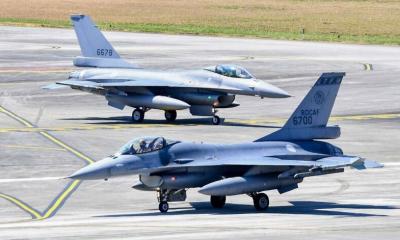
The first two F-16V Block 70 jets Taiwan purchased from the US were spotted unexpectedly turning back after departing from Hawaii yesterday, potentially further delaying delivery of the aircraft. Taiwan has purchased 66 of the F-16 C/D Block 70 jets to be deployed at Chihhang Air Base (志航基地) in Taitung County and operated by the air force's 7th Tactical Fighter Wing to defend Taiwan’s eastern region. Two single-seat jets, bearing serial No. 6727 and 6728, were spotted taking off from Hickam Field in Hawaii yesterday, observers said. Based on the precedent set during the delivery of Taiwan's older F-16 Block 20s, the new

Taiwan’s growing defense preparations might be sending a stronger signal to the US than to Beijing, highlighting the need for Taipei to tailor its deterrence efforts to different audiences, a US security academic said yesterday. Stanford University Freeman Spogli Institute for International Studies fellow Oriana Skylar Mastro made the comment during a Taipei Security Dialogue panel examining lessons Taiwan could draw from the wars in Ukraine and the Middle East. Mastro said she was impressed by Taiwan’s increased defense spending, emphasis on asymmetric capabilities and efforts to prepare society for conflict, but questioned whom those initiatives were influencing. She said when she asked


 RSS
RSS