

Liberty Times (LT): How should leaders make decisions?
Ting Yu-chou (丁渝洲): Decisionmaking is the art of choosing. Everyone makes choices throughout their lives, and the quality of their decisionmaking makes success or failure in their lives. Decisionmaking is the most important and the most difficult. Leaders must take full responsibility for the operational outcomes of their organization and consider decisionmaking their unquestionable duty. To make and keep organizational success, its leadership necessarily has to make the right call at every crucial point in its history.
In recent years our government officials have made decisions of profoundly dubious procedural soundness and quality. I have been thinking on the reason why had these intellectuals and professional elite made decisions that clearly failed to withstand the tests. Decisionmaking is not merely a matter of logic; it requires experience, values and audacity.
I once talked to the Dalai Lama, who said to me out of the blue: “We lamas are divided into two camps. One camp believes we should return to Tibet; the other camp says we should remain overseas,” and asked me to weigh in.
I said: “I believe that a man of your high wisdom must have made up his mind already, and this is a quiz for me. So I report in all honesty: If you return to Tibet, you should have influence for one year, but if you remain overseas, your influence will be forever.” It has been more than 10 years, and he is still overseas. It tells us that the wise always ask other people’s opinions to perfect their decisions.
When the Korean War broke out, the South Korean forces lost battle after battle and fell back to the peninsula’s southernmost point of Pusan [now known as Busan]. US General Douglas MacArthur’s able staff made a great many suggestions, but he disagreed with them all and proposed an amphibious landing on Inchon [now known as Incheon], a plan opposed by all of his subordinates; even the US Department of Defense voiced misgivings. Inchon did not meet any of the doctrinal criteria for conducting an amphibious operation, as it had a massive tide range that would, if a failed assault on the beachhead was not withdrawn immediately, make his forces perfect targets for the enemy. The navigation lane had insufficient width, and rocks constricted traffic in the middle. Those were the reasons that the landing plan met universal disapproval.
However, MacArthur was unswayed by their objections. First, he had studied the hydrographical data and enemy dispositions in detail and made his decision after careful thought on the situation.
Second, he was convinced that if his own men did not believe he could land in Inchon, the enemy would certainly not believe he could. If secrecy could be maintained, success was guaranteed.
Third, had the landing failed, MacArthur was determined to direct the retreat in person and on the front, using his honor of a lifetime to vouch for the operation.
Making a decision is hard, and it is even harder when you are challenged by everyone around you. From this example, we see that MacArthur’s self-confidence is the product of his strong sense of responsibility and high professional competence. Therefore decisionmaking is an activity that imposes great difficulties and challenges, while demanding great wisdom.
LT: How do you treat the problem of appointing people to responsibilities?
Ting: Selecting personnel is the key to doing a leader’s job. Well-chosen subordinates solves all problems; like meeting the right spouse leads to happiness, or good teachers and friends lead to success, a government with the right officials will be able to benefit the public. The selection of personnel is the core concern of leadership.
Why is personnel selection so prone to error? In addition to the complexity and changeability of human nature, mistakes are also the direct result of leadership style. When Ma Ying-jeou (馬英九) was the president, he was most often criticized for his appointments. One person said that Ma looked in the mirror for people to recruit, a jab at his penchant of picking officials from a small circle. It fostered a homogeneity in officialdom for people who resembled him. This method rarely brings real talent.
In comparison, the biggest challenge that our new 100-day government confronts is also that of selecting personnel; some of those it called had not stood to the test of their responsibilities.
Every leader has a unique style of promoting and selecting people. [Former Singaporean prime minister] Lee Kuan Yew’s (李光耀) first priority in selecting officials was to find the best person to serve the people of Singapore; as a result, more than half of his ministers came from outside of Singapore. He made few mistakes because he employed experts in psychology, biology, medicine and other related fields to establish a system to identify people. His success in putting the right people for the job created modern Singapore.
In my experience, a leader must first know whom not to use; for example those lacking in honesty, those with severe character flaws, or those lacking in a sense of responsibility.
Second, one must have a nose for talent and ability to accommodate. People should be placed in the positions that are most suited to their talents, and given trust and encouragement that allow them to realize their full potential. This is the most difficult and highest art of handling personnel.
Third, it is a commonplace fact that mistakes are unavoidable. When you see that you have made a mistake in selecting a subordinate, you must act with skill, intelligence and decisiveness to avoid greater harm to your organization.
Steve Jobs said problems are solved when the right people put are on the job, and created when the wrong people are on the job. Talented personnel are the most valuable asset in any organization.
LT: How should a leader act?
Ting: The famous British commander the Duke of Wellington said that Napoleon’s presence on the battlefield was worth 40,000 men. In World War II, the Allies said when [German field marshal] Erwin Rommel entered the battlefield, it was as if another Panzer division had joined the fray. This says volumes about the power of a leader’s actions.
My personal views are the following:
First, a leader must make a personal appearance at crucial moments. At the height of cross-strait tensions in September 1954, Yu Ta-wei (俞大維) was ordered to take over the Ministry of National Defense, and immediately after taking his oath, instead of going to his office, he walked out of the Presidential Office Building, got into his car, and proceeded directly to the air base to take a reconnaissance flight to observe Communist Chinese deployments on the southeastern coast [of China] in person. He discovered the Communists’ combat preparations, and took countermeasures that reduced their harm to the nation to a minimum.
Second, a leader’s presence in a crisis must be timely. Right after the [terrorist attack] on September 11 [2001], New York City mayor Rudy Giuliani arrived at the scene to comfort the relatives of the victims and bolster the morale of rescuers, and at the same time he spoke of his vision for effective post-disaster plans that brought hope to the people. Giuliani rose from a mundane city mayor to the ranks of a great leader through his effective personal management of a crisis.
In comparison, in Taiwan during the flooding on Aug. 8, 2009 [during Typhoon Morakot], the premier was at his barber’s, and the secretary-general [of the Executive Yuan] was celebrating Father’s Day.
My sense is that those actions do not materially affect the handling of crises or their command of the situation, but the problem is, people expect leaders to be present in the office or at the disaster relief center or touring the disaster area, and your absence tells the public that your heart and mind is not in dealing with the disaster. This is a classic case of leaders who do not understand what positions they must assume in a contingency.
Third, when trouble arises, you must analyze it, understand it and deal with it.
A leader should attend in person to reward meritorious work, inspire morale, lift spirits and manage major incidents that had resulted in casualties; that is the path to stabilizing morale and bringing hope.
Finally, I must emphasize command ethics. Ethics is the soul and lifeline of every individual, and an asset that would never depreciate in value. A mistaken decision could be made good, but ethical failings are next to impossible to redeem. There are three levels of ethics: personal, professional and, for those in a position of leadership, command.
What is command ethics? It is the determination to seek no vainglory in success and to take blame in failure; sharing credit for others and shouldering responsibility for blame. That is the way for leaders to build trust with subordinates and to inspire them to selfless efforts.
Translated by Jake Chung and Jonathan Chin
This is part II of a two-part interview. Part I was published yesterday.

NATURE TAKES ITS COURSE: The agency’s head said he felt a sense of loss watching red-banded snakes eat the babies, as they had decided on non-intervention The Forestry and Nature Conservation Agency yesterday released a documentary on a hundred-pace viper that had incubated 16 eggs, all of which hatched, but only a baby viper escaped after they were attacked by red-banded snakes. The agency’s Taichung branch last year launched the viper reproduction monitoring project soon after forest rangers Lin Chun-yu (林俊佑) and Chou Chia-cheng (周家成) spotted a pregnant hundred-pace viper in a grass-covered burrow near a parking lot in Tbulan Village (松鶴部落). The Atayal village, in Taichung’s Heping District (和平), is headed by Ecyang Yapu, who was positive about the project and assisted in access control and power
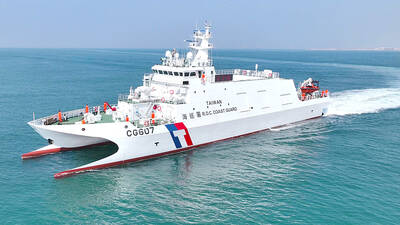
The Coast Guard Administration (CGA) yesterday said that it had deployed vessels to “monitor” Chinese ships operating in waters off the east coast. The CGA said it dispatched vessels in response to a China Coast Guard announcement that it had carried out another “routine law-enforcement patrol” in waters off the east coast. “The CGA firmly rejects China’s cognitive warfare campaign of ‘law enforcement in name, jurisdictional expansion in practice,’” it said on X. As of 11am yesterday, two China Coast Guard ships were “loitering and drifting” about 105 nautical miles (195km) and 74 nautical miles east of Green Island (綠島) respectively, it said. It
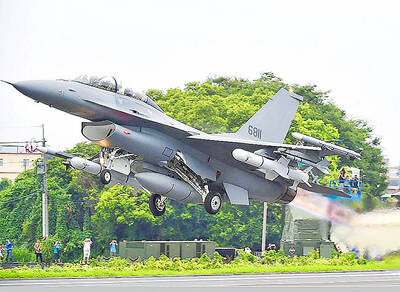
A sharp rise in compensation to be paid by air force officers who leave before completing their required service could indicate an increase in pilots leaving the military early, an analyst said on Friday, warning that the trend could worsen a shortage of experienced personnel. Chieh Chung (揭仲), a researcher at the Association for Strategic Foresight, issued the warning even though the number of volunteer military personnel is expected to increase next year. The planned headcount for volunteer military personnel, covering officers, noncommissioned officers (NCO) and enlisted soldiers, is 158,223 for next year, up 4,258 from 153,965 this year, Chieh said. The increase
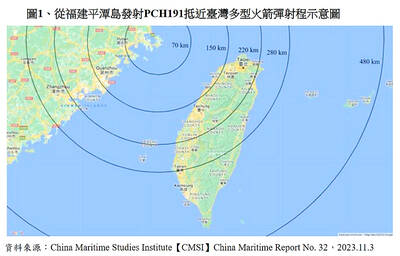
Potential improvements to munitions used by China’s long-range rocket-artillery units could extend their range to cover the entire Miyako Strait, which might give the Chinese People’s Liberation Army (PLA) the ability to secure the strategic waterway, the Mainland Affairs Council (MAC) said in a report. The PLA’s long-range rocket-artillery units deployed along the Taiwan Strait are concentrated along the coast of Fujian Province, including Changle, Pingtan and Shishi, the quarterly report on China said. The artillery brigades of the PLA’s 71st, 72nd and 73rd group armies have been deployed, with preparations for potential battlefield operations under way since August 2022, the report


 RSS
RSS