


The passage of the Act Governing the Handling of Ill-gotten Properties by Political Parties and Their Affiliate Organizations (政黨及其附隨組織不當取得財產處理條例) on Monday was the culmination of a 14-year quest by the Democratic Progressive Party (DPP), pursued by party leaders and rank-and-file supporters through five legislative elections and three presidential administrations.
In 2002, the DPP administration of then-president Chen Shui-bian (陳水扁) introduced via the Executive Yuan a draft bill — the act governing the handling of ill-gotten properties by political parties — which was effectively to target the Chinese Nationalist Party’s (KMT) assets, which critics said were seized by illegal or extralegal means during the period of single-party rule.
However, the DPP did not have a legislative majority, while the pan-blue camp — which at that time was comprised of the KMT and its coalition partner, the People First Party (PFP) — did have a majority and stalled the bill 75 times via parliamentary maneuvering in the fifth legislature’s Procedure Committee.
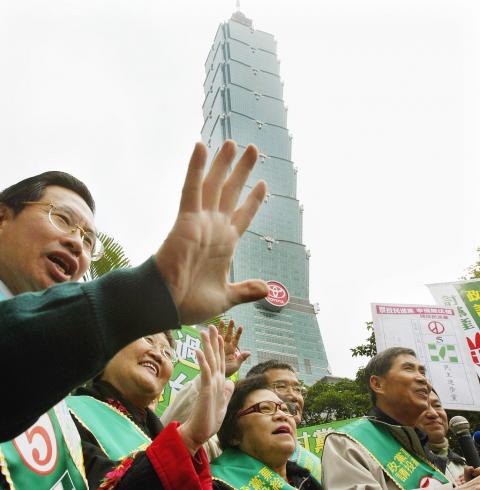
Photo: Lin Cheng-kung, Taipei Times
In the sixth legislature, the pan-blue camp retained its majority and stalled the bill an additional 26 times in the committee and in 2006, when the Executive Yuan-sponsored bill was for the first time submitted to review at the committee level, KMT members on the committee three times terminated the review process, blocking the bill from reaching the general assembly.
In 2008, the seventh legislature pushed the bill through the committee to the review stage, but by then the DPP administration had been voted out of office, and when then-president Ma Ying-jeou’s (馬英九) Cabinet was sworn in, Ma withdrew the bill from the legislature, effectively freezing party-assets reform for the eight years of his presidency.
KMT lawmakers had since 2002 blocked bills pertaining to the reform of party assets 306 times.
Although Chen’s path to reform stalled at the legislature, he engaged the issue with other strategies, including administrative investigations, filing litigation over alleged KMT expropriation of national properties and initiating a Control Yuan investigation in 2000.
According to a special report by the Ministry of Finance to the legislature in March, governmental agencies had filed eight lawsuits against the KMT over alleged expropriation of national properties and assets, with five wins and two losses for the government.
One case ended with an out of court settlement.
The Ministry of Transportation and Communications from 2003 to 2006 initiated five lawsuits against Broadcasting Corp of China (中廣公司) over a property in New Taipei City’s Banciao District (板橋), with public prosecutors filing the first indictment in November 2004, the report said.
Over nearly a decade of litigation, the ministry won all five suits it filed, with the courts ruling in its favor in August 2014.
Three lawsuits filed by the Ministry of Education and the National Property Administration ended in either losses or settlement.
In 2004, the Ministry of Finance established a task force to regulate party assets, but the group was disbanded by the Ma administration on Jan. 12, 2009.
On April 13 of that year, the Ma administration terminated the Executive Yuan’s protocol regulating the negotiation and handling of political parties and affiliates that had expropriated national assets and properties.
In 2006, former premier Yu Shyi-kun, then-chairman of the DPP, launched a referendum to push for a bill to deal with illegal party assets, which was held concurrently with the legislative election in January 2008. The referendum failed to pass the legal threshold for voter participation and was defeated.
Following the presidential and legislative elections in January that resulted in the DPP winning the presidency and securing a clear majority in the ninth legislature, it revived its mission to pass the ill-gotten party assets bill.
That goal was achieved on Monday.
Translated by staff writer Jonathan Chin
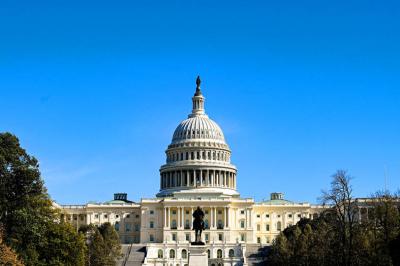
The US House of Representatives yesterday passed the PROTECT Taiwan Act, which stipulates that Washington would exclude China from participating in major global financial organizations if its actions directly threaten Taiwan’s security. The bill, proposed by Republican US Representative Frank Lucas, passed with 395 votes in favor and two against. It stipulates that if China’s actions pose any threat to Taiwan’s security, economic or social systems, the US would, “to the maximum extent practicable,” exclude China from international financial institutions, including the G20, the Bank for International Settlements and the Financial Stability Board. The bill makes it clear that China

Taiwan’s Li Yu-hsiang performs in the men’s singles figure skating short program at the Milano-Cortina Winter Olympics, in Milan, Italy, on Tuesday. Li finished 24th with a score of 72.41 to advance to Saturday’s free skate portion of the event. He is the first Taiwanese to qualify for the free skate of men’s singles figure skating at the Olympics since David Liu in 1992.
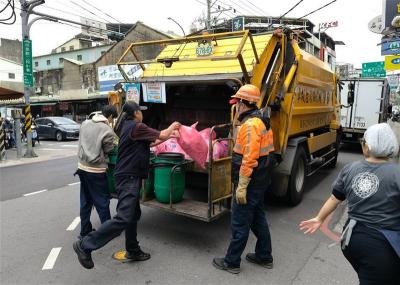
Garbage and recycling schedules are to vary from Saturday through Sunday next week over the Lunar New Year holiday period. The following collection information is from the governments of the six special municipalities. Taipei Regular service: Sunday to Monday next week. No service: Tuesday to Thursday next week. Extra service: Friday next week. Regular service resumes: Saturday next week. New Taipei City Extra service: Sunday. Adjusted collection time: Monday next week — garbage collection is to begin in the morning and end at 6pm. No service: Tuesday to Thursday next week. Regular service resumes: Friday next week. Note: Garbage can be dropped off at 70
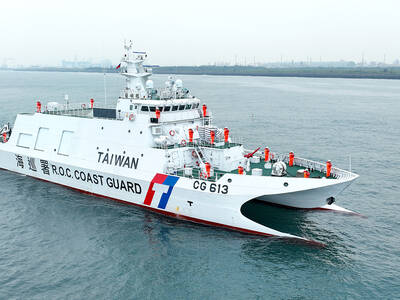
The Coast Guard Administration (CGA) yesterday held a ceremony marking the delivery of its 11th Anping-class offshore patrol vessel Lanyu (蘭嶼艦), saying it would boost Taiwan’s ability to respond to Beijing’s “gray zone” tactics. Ocean Affairs Council Deputy Minister Chang Chung-Lung (張忠龍) presided over the CGA event in the Port of Kaoshiung. Representatives of the National Security Council also attended the event. Designed for long-range and protracted patrol operations at sea, the Lanyu is a 65.4m-long and 14.8m-wide ship with a top speed of 44 knots (81.5kph) and a cruising range of 2,000 nautical miles (3704km). The vessel is equipped with a


 RSS
RSS