


A two-part documentary showcasing nine of Taiwan’s medical achievements, breakthroughs and international contributions is to debut on Wednesday next week, the Discovery Channel said at a premiere event in Taipei on Tuesday.
The documentary, titled Taiwan Revealed: Medical Elite, is the third in a series made in collaboration with the Ministry of Foreign Affairs.
The seris aims to introduce Taiwan’s diverse culture and world-class achievements in various fields to the world through the Discovery Channel’s international platform.

Photo: CNA
Vice President Chen Chien-jen (陳建仁), a public health specialist who was among those interviewed in the documentary, said that “in the past, the international community helped Taiwan eradicate several communicable diseases. Today, as a nation with advanced medicine and healthcare, Taiwan is returning the favor.”
He said that in the past 50 years, Taiwan has managed or controlled more than a dozen communicable diseases, including malaria, black-foot disease and polio, which was achieved with foreign assistance and the diligence of Taiwan’s medical practitioners.
“Lien Jih-ching (連日清) is a specialist in mosquito-borne diseases and helped eradicate malaria in Taiwan by reducing the number of endemic cases from more than 1 million to zero within a decade,” Chen said, adding that Lien helped Taiwan become the first nation in the world to be declared “malaria-free” by the WHO in 1965.
“People call me the ‘mosquito man,’” said Lien, who is nearly 90 years old.
Lien also helped to significantly reduce the prevalence of malaria in Sao Tome and Principe — an island nation in western Africa — as depicted in the second part of the documentary.
“The prevalence of malaria was about 40 percent in 2000 … after we applied mosquito prevention measures, the numbers of patients hospitalized for malaria in Sao Tome and Principe dropped to zero in 2003,” Lien said in the documentary.
The use of an insecticide called dichlorodiphenyltrichloroethane is credited with the eradication of malaria in Taiwan, but it was not as effective in Sao Tome and Principe, Lien said, adding that he instead used alpha-cypermethrin, which had proven effective in southern Taiwan against dengue fever.
Other stories include that of Chang Yu-tai (張裕泰) who has led a medical mission in Sao Tome and Principe since 2010, hoping to improve local healthcare, Tu Yong-kwang (杜永光), who in the documentary is seen helping restore the eyesight of a person with a rare condition using extremely difficult surgery, and Chang Mei-hwei (張美惠), who developed the world’s first “newborn stool color screening card” that allows for the early detection of biliary atresia in infants.
Episode one covers the invention of high-tech “smart” glasses that allow surgeons to see real-time X-ray images while performing surgery; Chen Yuan-tsong (陳垣崇), whose medical team spent 15 years developing a cure for Pompe disease, making Taiwan the first nation to offer newborns screening for the disease; and Lo Lun-jou (羅綸洲) who has had medical missions in Cambodia since 1999, performing reconstructive surgeries on people with orofacial clefts.
Also featured Chen Hung-chi (陳宏基), a doctor who developed the world’s first autotransplantation of small intestine for vocal cord reconstruction, and the invention of a mobility assistive exosuit by the Industrial Technology Research Institute that helps patients with spinal cord injuries stand again.
Episode one premieres at 10pm on Wednesday and episode two on July 27.
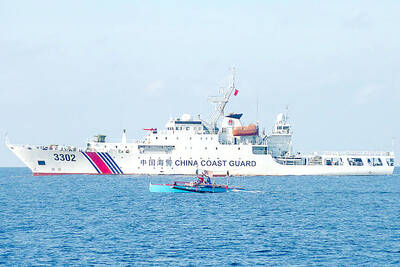
EXPANSIONIST: China deploys an average of 40 to 50 warships and coast guard vessels daily in the South China Sea, despite pledges not to militarize the region, an official said China is attempting to expand its influence across the First Island Chain and increase pressure on Japan by sending coast guard vessels into waters off of Taiwan under the pretext of maritime negotiations with Japan and the Philippines, a national security official said yesterday. China’s recent actions in the waters east of Taiwan and Japan and the Philippines’ exclusive economic zones (EEZ) are attempts to establish dominance in First Island Chain waters, said the official who declined to be named, adding that this is “expansion disguised as law enforcement.” Framing China’s actions solely as a cross-strait issue is a serious misjudgment that
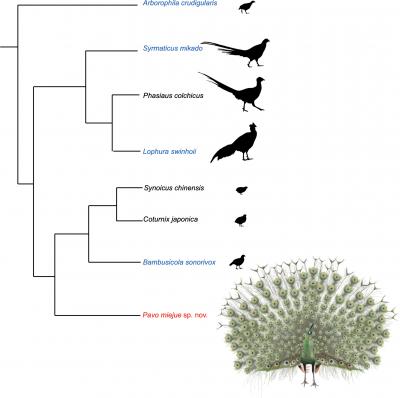
Through analyzing fossil evidence, a research team at National Taiwan University (NTU) discovered the largest endemic bird to have lived in Taiwan, naming it Pavo miejue, or extinct peafowl (滅絕孔雀). The Mikado pheasant, which is printed on the back of the NT$1,000 bank note, was previously believed to be the biggest endemic bird to Taiwan. The research team’s findings suggest that Pavo miejue lived during the Pleistocene epoch tens of thousands of years ago. It is the first endemic extinct bird species discovered and formally named in Taiwan. The study was coauthored by NTU Institute of Ecology and Evolutionary Biology professor Tsai Cheng-hsiu (蔡政修),
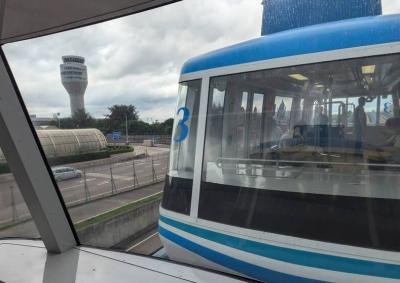
Taiwan Taoyuan International Airport is to suspend its automated Skytrain service connecting Terminal 1 and Terminal 2 starting on July 1 to facilitate connection works for the upcoming Terminal 3, the airport operator said today. Passengers and staff who need to travel between the two terminals after the suspension can instead use the Taoyuan MRT or the airport's 24-hour shuttle bus service, Taoyuan International Airport Corp said. The Taoyuan MRT Airport Line directly links the two terminals, while the shuttle buses are to operate around the clock, the company added. The Skytrain provides free transportation between the airport’s two terminals for travelers and
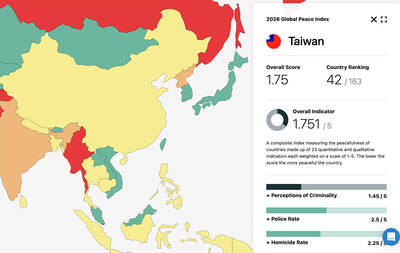
Taiwan ranked 42nd in terms of peacefulness among 163 countries, down five places from last year, according to this year’s Global Peace Index. With an overall score of 1.751, Taiwan dropped from 37th last year, the report published by the global Institute for Economics and Peace showed. The overall score measures a country’s level of peacefulness using 23 quantitative and qualitative indicators across three domains — ongoing domestic and international conflict, societal safety and security, and militarization. While Taiwan ranked 42nd worldwide, it was listed in ninth place among the 19 Asian-Pacific countries in the report, after New Zealand, Singapore, Japan, Malaysia,


 RSS
RSS