


Several labor agencies and workers’ rights groups yesterday held separate news conferences outside the legislature in Taipei to appeal to lawmakers about a proposed amendment that would allow foreign blue-collar workers to remain in Taiwan without having to leave the nation every three years.
However, the amendment to the Employment Service Act (就業服務法) was not dealt with yesterday, although it had been scheduled to be brought to the legislative floor for a final reading.
Representatives from the employment service institute associations of the six special municipalities, labor agencies and employers’ groups said that the amendment would grant foreign workers 35 days of paid leave — including 21 days of paid leave to visit their families — every three years, in addition to seven days of paid leave each year, and burden employers with paying for the plane tickets of 600,000 foreign workers, which would cost the employers at least NT$12 billion (US$371.7 million) every three years.
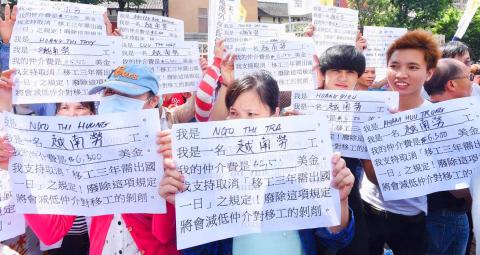
Photo: Liu Hsin-de, Taipei Times
They also said that foreign workers would become immigrants if they were allowed to stay in Taiwan for 12 consecutive years and change their workplace “whenever they want,” adding that the foreign workers would “snatch job opportunities from local workers” if the amendment is passed.
The claim that foreign workers would get 35 days of paid leave was last month described as “groundless” by Democratic Progressive Party (DPP) Legislator Lin Shu-fen (林淑芬), one of the lawmakers who proposed the amendment.
Lin said that foreign blue-collar workers are entitled to seven days off each year if they have worked for the same employer for at least one year, adding that foreign workers are not protected by the Labor Standards Act (勞動基準法) and have to negotiate paid leave with their employer.
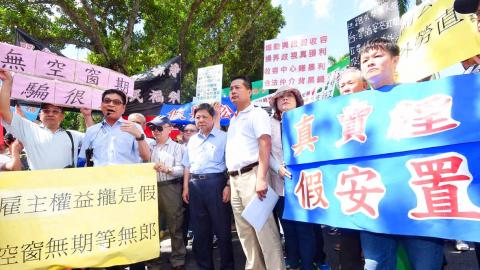
Photo: Liu Hsin-de, Taipei Times
Taiwan International Workers’ Association (TIWA) spokesperson Chen Hsiu-lien (陳秀蓮) said that she did not understand how the employers’ groups came up with the figure of NT$12 billion, adding that foreign workers are already granted seven days off each year.
“The claim about foreign workers becoming immigrants after 12 years is likewise baseless, as the existing law stipulates that foreign blue-collar workers on working visas would not be able to count those working years toward the the years required to apply to immigrate,” Chen added.
More than 10 workers’ rights groups, including the TIWA, urged the government to stop the exploitation of foreign workers, asking lawmakers to “hold the defensive line of human rights” against the labor agencies’ lobbying until the amendment passes the legislative floor.
Several foreign workers also appeared at the news conference, holding up placards showing their names and the amount of money they had to pay brokers, saying that they support abolishing the rule that requires them to exit the nation every three years and pay new brokerage fees.
The amounts shown on the placards ranged between US$2,570 and US$6,500.
“What we earn is not much and the brokers take almost as much as we have earned,” a Vietnamese worker surnamed Nguyen said.
Taiwan Association of Hope Construction for People with Disabilities president Vincent Huang (黃智堅), as an employer of foreign workers, voiced his support for the amendment, saying that the information provided by the labor agencies was misleading and distorted, and that many people with disabilities support the migrant workers’ cause.
Chen Hsiu-lien said that people with disabilities and foreign blue-collar workers, both vulnerable groups, should not be pitted against each other.
Taoyuan Confederation of Trade Unions chairman Mao Chen-fei (毛振飛) said if there are exploited foreign workers, there are also exploited domestic workers.
“Seeing how the labor agencies [treat foreign workers] makes people feel that there are still businesses in Taiwan that rely on [sucking] human blood and [consuming] human flesh for profit,” Mao said.

NATIONAL SECURITY: Authorities are working to confirm the identities of the military personnel involved and investigating possible illegal conduct and regulatory violations Authorities are probing possible national security implications after Kinmen police and immigration officers on Sunday found a Chinese woman allegedly posing as a tourist while engaging in prostitution involving more than 10 military personnel. The woman, surnamed Chen (陳), has since been deported, authorities said, adding that investigators are still working to confirm the identities of those implicated, as the records only listed code names and aliases. The case stemmed from a report received by the Kinmen District Prosecutors’ Office on Friday last week from the Jinhu Precinct of the Kinmen County Police Bureau. On Sunday, police, along with the National Immigration

GLOBALGIVING: ‘ Caving to external pressure is not acceptable for an organization that has cultivated justice reform and human rights for 30 years,’ one NGO said A slew of non-government organizations (NGOs) have withdrawn from the GlobalGiving fundraising platform after it announced it would use “Chinese Taipei” instead of “Taiwan” from next month. The Taiwan Good Rice Association wrote on Facebook on Friday that it was informed on April 28 via a teleconference call of the change, which was made because the platform wanted to operate in China. Taiwan Good Rice is to terminate all cooperative relationships with GlobalGiving in response to the platform’s “unilateral and non-negotiable” decision to remove references to Taiwan, the NGO said. “Taiwan is in the official name of Taiwan Good Rice Association and the

REASONS FOR TRAVEL: An assistant professor said that proposed amendments to penalize drivers if they used drugs overseas would not deter people from traveling People who operate a motor vehicle under the influence of marijuana would have their driver’s license revoked, even if they used the substance while overseas, the Ministry of Transportation and Communications said yesterday, citing proposed amendments to the Road Traffic Management and Penalty Act (道路交通管理處罰條例). The amendments would also authorize the government to revoke the licenses of people determined to have used Category 1 or Category 2 narcotics, even if they were not operating a vehicle while under the influence of drugs, as well as ban them from taking the license test for three years, the ministry said. People aged 18 or

HEAVY WEATHER: Typhoon Jangmi is due to crash straight into the Ryukyus as airlines look to shift flights to larger aircraft or cancel flights to Okinawa entirely Taiwan’s international air carriers announced flight adjustments over the weekend as Typhoon Jangmi is forecast to hit the Ryukyu Islands today and tomorrow. The Central Weather Administration (CWA) upgraded Jangmi from a tropical storm to a typhoon at 8am yesterday, with the eye located 580km south of Naha city. It was moving north at 19kph. Today, China Airlines’ CI-120, CI-121, CI-122 and CI-123 flights between Taoyuan and Naha, Okinawa, have been canceled as well as CI-132 and CI-133 between Kaohsiung and Naha. EVA Air’s BR-112, BR-113, BR-186 and BR-185 flights between Taoyuan and Naha are also canceled. Low-cost carrier Tigerair Taiwan canceled IT-230,


 RSS
RSS