


A proposal by online news outlet My-Formosa.com vice chairman Wu Tzu-chia (吳子嘉) and former Democratic Progressive Party (DPP) legislator Kuo Cheng-liang (郭正亮) — both DPP members — to revise the party charter’s clauses on Taiwanese independence drew mixed reactions.
“We are not trying to freeze the clauses on Taiwanese independence, we are not even proposing anything concrete,” Wu told reporters at the DPP headquarters in Taipei. “The party charter and many of the party’s major resolutions contradict each other and the charter denies the Republic of China [ROC], which is not in accordance with the political situation.”
“The political situation is that President Tsai Ing-wen (蔡英文) was sworn in as the ROC president under the ROC Constitution — the party should catch up with the president and the government,” Wu said.
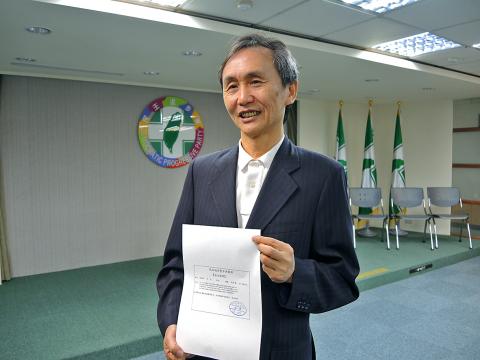
Photo: CNA
Article 1 of the DPP charter, passed in 1991, states that it is the party’s objective to establish a sovereign and independent Republic of Taiwan.
In 1999, the DPP adopted the Resolution on Taiwan’s Future, which says that Taiwan is already a sovereign and independent nation, and therefore any change of status must be decided by the people of Taiwan.
In 2007, the DPP passed the Resolution on Normalization of the Nation, which reaffirmed that Taiwan is a sovereign and independent state, but added that due to pressure from China, Taiwan could not sustain a role in the international community as a “normal nation,” and therefore the party would push for the “normalization” of Taiwan’s status in the international community.
Wu and Kuo said that as Tsai’s proposal to maintain the cross-strait “status quo” won overwhelming public support in the presidential and legislative elections in January, it is time for the DPP to catch up with mainstream public opinion and propose something new in the party charter.
The proposal asks the DPP’s Central Executive Committee to amend the party charter, Wu said.
Formally proposed by 32 party delegates and endorsed by 35, the proposal would be discussed in the DPP national congress next month.
Wu said that he is just a member so he and Kuo are only the planners of the proposal.
DPP spokesperson Wang Min-sheng (王閔生) said that every party delegate has the right to make proposals and any proposal may be discussed in the party’s national congress.
“However, the core value of the DPP that the future of Taiwan should be decided by its people will absolutely not change,” Wang said.
Taoyuan Mayor Cheng Wen-tsang (鄭文燦), when asked to comment on the issue in a radio interview, said that while it does not hurt to have such discussions in the party’s national congress meeting, “the existing Resolution of Taiwan’s Future already includes the idea of maintaining the cross-strait ‘status quo.’”
Former DPP legislator Lin Cho-shui (林濁水) criticized the new proposal.
“Recently some people have been criticizing ‘independence’ as an extreme political doctrine, therefore the DPP should adopt a clause to maintain the ‘status quo’ and give up Taiwanese independence,” Lin said. “Why is every American saying that the US is an independent nation? Why are China, Japan, Germany and all nations believe they are independent nations?”
“Perhaps the truth is that every nation in the world follows some extreme political doctrine and Taiwan should be the only ‘non-independent’ nation in the world to be non-extreme,” Lin said.

FUKUOKA SITUATION: Japanese media reported that the pathogen is expected to be identified by the summer, while the CDC downplayed the idea that it was hMPV A “mysterious cold-like illness” reported in Japan’s Fukuoka Prefecture does not seem to be a new disease, but Japanese authorities have been asked about the situation, the Centers for Disease Control (CDC) said yesterday. The Fukuoka Prefectural Medical Association on Wednesday told a news conference that a “mystery cold” that has become a hot topic on social media is “highly likely to be caused by some kind of viral infection,” Japan’s KBC News reported. “Many people are experiencing symptoms starting with a sore throat, followed by a runny nose, phlegm and a severe cough,” KBC News reported, citing association officials. Health authorities are

Nvidia Corp CEO Jensen Huang (黃仁勳) arrived in Taiwan yesterday ahead of upcoming AI and technology events, saying he plans to meet with clients and Taiwan Semiconductor Manufacturing Co Chairman C.C. Wei (魏哲家) during his visit. After landing at Taipei Songshan Airport, Huang posed for photos with fans and handed out Yakult drinks to reporters and supporters waiting at the scene, saying he has “a lot to do” during the trip. Asked about reports that Nvidia’s planned headquarters site in Taipei’s Beitou Shilin Technology Park could break ground on May 27, Huang said that if the company holds an event, he would

The Ministry of Finance this afternoon announced the winning numbers for the March-April uniform invoice lottery. The winning number for the NT$10 million (US$318,060) special prize is 19531471, and the winning number for the NT$2 million grand prize is 85941329. Three numbers were drawn for the NT$200,000 first prize: 07225810, 20231230 and 83518781. Those with receipts matching the last seven digits of any of the first-prize numbers will win the NT$40,000 second prize, while those matching the last six digits will win the NT$10,000 third prize. Those whose receipts match the last five digits of the first-prize numbers can claim the NT$4,000 fourth prize,

Taiwan Travelogue (臺灣漫遊錄), which earlier this week became the first Taiwanese novel to win the International Booker Prize, is to be adapted into a television series through a Taiwan-Japan coproduction, producer Chang Chen-yu (張辰漁) said yesterday. Chang, a producer at World Softest Production Film Co, wrote on Facebook that the company had been searching for projects with international appeal that retain a strong Taiwanese identity after colleagues and Japanese partners strongly recommended the novel. After reading the book, Chang said he immediately decided to pursue the screen rights. “A great story has the power to transcend time and borders, and connect countless people,”


 RSS
RSS