


“Taiwan is not a problem. It’s a friend,” the Washington Post said on Thursday on its op-ed page.
American Enterprise Institute security studies expert Gary Schmitt wrote the article, which said that the US should improve military, economic and diplomatic ties with Taiwan.
“Given Taiwan’s democracy, it is also the right thing to do,” Schmitt wrote.
“I have already heard that some members of Congress support it,” a Washington-based Taiwan-watcher said.
“I don’t expect it will have any immediate impact, but it has put Taiwan on a lot of radar screens,” he said about the article.
The article said that Washington’s “one China” policy is a relic of a bygone era, adding that “it seems we can bring Cuba in from the cold, but not Taiwan.”
Schmitt srote that US policymakers see Taiwan as a problem, but that it should be seen as a contributor to the US strategic position in Asia.
He said that Taiwan is a model of democratic governance, an important trading partner and home to some of the world’s most innovative companies.
Taiwan is sitting astride vital sea-trade lanes and that an intelligent defense plan would help build a key link in East Asia’s first island chain, Schmitt wrote.
Such a plan, he said, would lessen the ability of Chinese air and naval forces to move into the broader Pacific and threaten US forces at sea and on Guam.
“US policy toward Taiwan remains stuck in neutral because of a reluctance to put aside the fiction of ‘one China,’” Schmitt wrote.
“During her campaign and time as president-elect, Tsai [Ing-wen (蔡英文)] has made it clear that she has no intention of roiling the waters with the People’s Republic of China by pushing forward with an explicit claim of independence,” he wrote. “But there is little doubt that a US policy to further normalize relations with Taiwan would increase tensions with Beijing.”
Schmitt said it is an “illusion” to think there is a way forward that does not involve tension with China.
“The only question is whether we use all of our assets or fail to, as the Chinese employ all of theirs,” Schmitt wrote.
“Answering this question is all the more urgent in light of the more assertive and ambitious policies of China’s current leader, [President] Xi Jinping [習近平],” he added.
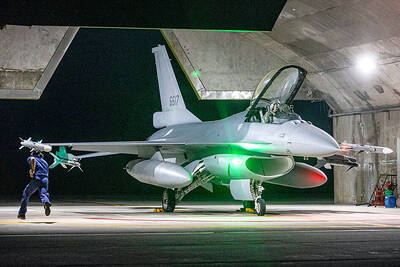
Taiwan has received more than US$70 million in royalties as of the end of last year from developing the F-16V jet as countries worldwide purchase or upgrade to this popular model, government and military officials said on Saturday. Taiwan funded the development of the F-16V jet and ended up the sole investor as other countries withdrew from the program. Now the F-16V is increasingly popular and countries must pay Taiwan a percentage in royalties when they purchase new F-16V aircraft or upgrade older F-16 models. The next five years are expected to be the peak for these royalties, with Taiwan potentially earning
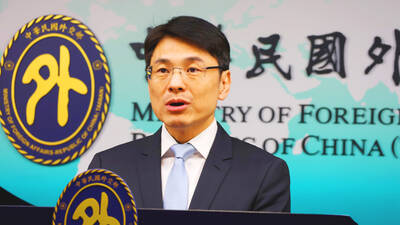
STAY IN YOUR LANE: As the US and Israel attack Iran, the ministry has warned China not to overstep by including Taiwanese citizens in its evacuation orders The Ministry of Foreign Affairs (MOFA) yesterday rebuked a statement by China’s embassy in Israel that it would evacuate Taiwanese holders of Chinese travel documents from Israel amid the latter’s escalating conflict with Iran. Tensions have risen across the Middle East in the wake of US and Israeli airstrikes on Iran beginning Saturday. China subsequently issued an evacuation notice for its citizens. In a news release, the Chinese embassy in Israel said holders of “Taiwan compatriot permits (台胞證)” issued to Taiwanese nationals by Chinese authorities for travel to China — could register for evacuation to Egypt. In Taipei, the ministry yesterday said Taiwan
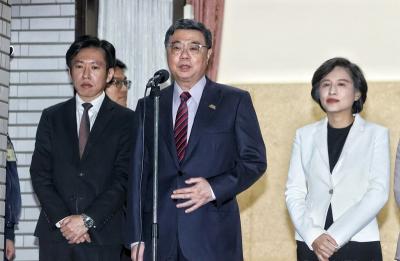
Taiwan is awaiting official notification from the US regarding the status of the Agreement on Reciprocal Trade (ART) after the US Supreme Court ruled US President Donald Trump's global tariffs unconstitutional. Speaking to reporters before a legislative hearing today, Premier Cho Jung-tai (卓榮泰) said that Taiwan's negotiation team remains focused on ensuring that the bilateral trade deal remains intact despite the legal challenge to Trump's tariff policy. "The US has pledged to notify its trade partners once the subsequent administrative and legal processes are finalized, and that certainly includes Taiwan," Cho said when asked about opposition parties’ doubts that the ART was
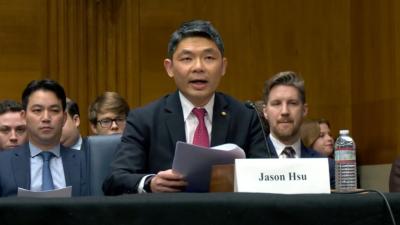
If China chose to invade Taiwan tomorrow, it would only have to sever three undersea fiber-optic cable clusters to cause a data blackout, Jason Hsu (許毓仁), a senior fellow at the Hudson Institute and former Chinese Nationalist Party (KMT) legislator, told a US security panel yesterday. In a Taiwan contingency, cable disruption would be one of the earliest preinvasion actions and the signal that escalation had begun, he said, adding that Taiwan’s current cable repair capabilities are insufficient. The US-China Economic and Security Review Commission (USCC) yesterday held a hearing on US-China Competition Under the Sea, with Hsu speaking on


 RSS
RSS