


The nation could see a double-digit percentage drop in Chinese visitors because Beijing has restricted the issuance of travel permits to Taiwan, Minister of Transportation and Communications Chen Jian-yu (陳建宇) said yesterday at a meeting of the legislature’s Transportation Committee in Taipei.
Chen said the reduction is not yet apparent based on National Immigration Agency’s data, but tour service operators and its sources of information in China had told the ministry that Beijing is reducing the number of Chinese visitors by limiting the issuance of travel passes to Taiwan.
“We estimate that the number of Chinese travelers would decrease by 30 percent, and the decline would begin to manifest itself in the latter half of this month,” he said.
Civil Aeronautics Administration Deputy Director-General Fang Chih-wen (方志文) said that the summer schedule for cross-strait flights shows the number of flights decreasing by 29 per week compared with the winter schedule, including 10 flights from Chinese carriers and 19 flights from Taiwanese carriers.
However, that represents an overall decrease of only 4 percent, which is not significant, he said.
Fang added that carriers have continued to apply for new flight services in line with their corporate strategies and do not seem to be suspending plans to launch new services.
Chen said Beijing had already indicated that the number of Chinese tourists would be determined based on developments in cross-strait relations and the tourism market.
He said that China should not enforce any measure that would hurt the feelings of people across the Taiwan Strait and affect the development of the tourism industry.
“We will reiterate these principles at the cross-strait meeting between tourism officials, which will take place later this month,” he said.
Tourism Bureau Director-General David Hsieh (謝謂君) said that his agency had tried to verify this information through its contacts in China, who have denied such a policy restricting travel to Taiwan.
About 40 percent of the nation’s foreign visitors come from China, lawmakers said.
Tourism Bureau statistics show that tourist arrivals last year totaled 10.44 million, of which 4.18 million were Chinese visitors.
Lawmakers said the government should not put all its eggs in one basket and should work to attract tourists throughout the region.
Democratic Progressive Party (DPP) legislators Lee Kun-tse (李昆澤) and Yeh Yi-jin (葉宜津) said that the government’s streamlining of visa application procedures for tourists from India, Indonesia, Thailand, Vietnam and the Philippines joining high-end tour groups have had only a limited effect.
Lee said that from November last year to last month, only 6,000 tourists used the program, accounting for a mere 2 percent of the total from these countries.
He said that travel from those countries to Taiwan takes only four to six hours, but Taiwan remains a relatively unknown tourist destination to most of them.
Yeh asked why Taiwanese are able to travel to 164 countries around the world visa-free, but Taiwan offers reciprocal services to only 73 countries.
She disagreed with the Ministry of Foreign Affairs’ rationale for not waiving visas for tourists from Southeast Asia.
The ministry has said that Southeast Asian tourists might overstay or work illegally in Taiwan.
Japan and South Korea have already waived visa requirements for tourists from these countries, she said.
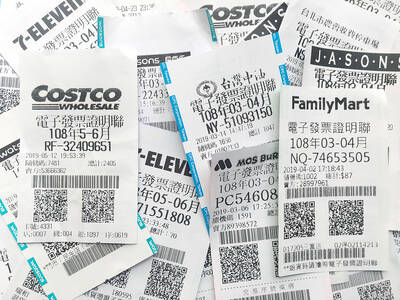
A NT$39 receipt for two bottles of tea at a FamilyMart was among the NT$10 million (US $312,969) special prize winners in the January-February uniform invoice lottery. FamilyMart said that two NT$10 million-winning receipts were issued at its stores, as well as two NT$2 million grand prizes and three NT$200,000 first prizes. The two NT$10 million receipts were issued at stores in Pingtung County and Yilan County’s Dongshan Township (冬山). One winner spent just NT$39 on two bottles of tea, while another spent NT$80 on water, tea and coffee, the company said. Meanwhile, 7-Eleven reported three NT$10 million winners — in New Taipei

Considering that most countries issue more than five denominations of banknotes, the central bank has decided to redesign all five denominations, the bank said as it prepares for the first major overhaul of the banknotes in more than 24 years. Central bank Governor Yang Chin-lung (楊金龍) is expected to report to the Legislative Yuan today on the bank’s operations and the redesign’s progress. The bank in a report sent to the legislature ahead of today’s meeting said it had commissioned a survey on the public’s preferences. Survey results showed that NT$100 and NT$1,000 banknotes are the most commonly used, while NT$200 and NT$2,000

The Centers for Disease Control (CDC) yesterday reported the first case of a new COVID-19 subvariant — BA.3.2 — in a 10-year-old Singaporean girl who had a fever upon arrival in Taiwan and tested positive for the disease. The girl left Taiwan on March 20 and the case did not have a direct impact on the local community, it said. The WHO added the BA.3.2 strain to its list of Variants Under Monitoring in December last year, but this was the first imported case of the COVID-19 variant in Taiwan, CDC Deputy Director-General Lin Ming-cheng (林明誠) said. The girl arrived in Taiwan on

ANNUAL EVENT: Two massive Pokemon balloons are to be set up in Daan Park, with an event zone operating from 10am to 6pm This year’s Taipei Floral Picnic is to be held at Daan Park today and tomorrow, featuring an exclusive Pokemon Go event, a themed food market, a coffee rave picnic area and stage performances, the Taipei Department of Information and Tourism said yesterday. Two massive Pokemon balloons are to be set up in the park as attractions, with an exclusive event zone operating from 10am to 6pm, it said. Participants who complete designated tasks on-site would have a chance to receive limited-edition souvenirs, it added. People could also try the newly launched game Pokemon Pokopia in the trial area, the department said. Three PokeStops are


 RSS
RSS