


Taipei Mayor Ko Wen-je’s (柯文哲) administration has shown narrow-minded focus on commercial profit and ignorance of cultural affairs by allowing department stores and eateries to rent units in the Mass Rapid Transit (MRT) underground bookstore lane, book vendors and cultural industry experts said.
The Zhongshan Metro Mall’s underground bookstore lane, a 815m corridor between Zhongshan MRT Station and Shuanglian MRT Station containing more than 100 bookstores, had since 2006 reserved 46 of its rent-controlled shopfronts for bookstores, publishers and cultural industries.
The policy, set by Taipei Rapid Transit Corp (TRTC), was made in response to the Taipei Department of Cultural Affairs’ promotion of cultural industries, a program Ko in a meeting with city officials reportedly criticized for being a commercial flop.
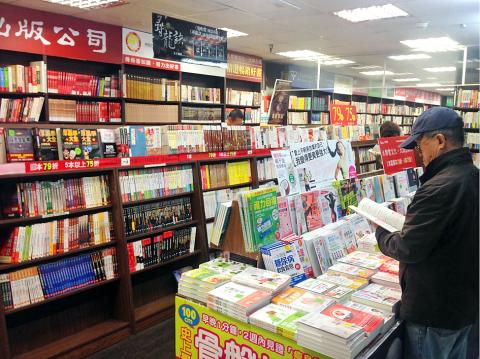
Photo: Ho Shih-chang, Taipei Times
TRTC business division director Chan Wen-tao (詹文滔) said the lane makes more than a NT$1 million (US$30,885) loss every year.
By contrast, the East District MRT underground mall also operated by TRTC makes about a NT$30 million profit each year, Chan said, adding that TRTC is therefore terminating its favorable policy toward book vendors and is open to bids from department stores and eateries for units in Zhongshan.
The tenants who submit the highest bids would be awarded a unit, Chan said.
Zhongshan bookstore lane head Lu Ching-cheng (盧欽政) defended the lane’s record, saying that vendors’ profits had improved at the steady rate of 10 percent per year and that prestigious publishing houses such as Cite, Yuan-Liou and Linking all have stores operating in the corridor.
The 11 vendors that went out of business in the corridor were cultural industry stores, not bookstores, he added.
Lu said the lane was established to promote small publishers and that he had made personal sacrifices, including borrowing tens of millions of New Taiwan dollars and his health suffering, to keep the lane in business.
“Allowing other businesses to move in could be the end of all the bookstores in the lane,” Lu said.
Chou Chun-liang (周均亮), head of Cosmos Culture Co, a vendor in the lane, said the value of bookstores should not be measured by profits alone and that he chose to be in the business to promote book culture.
“If I am in it for the money, I would do book expos. I can easily make NT$4 million in 10 days that way,” Chou said.
“When Ko ran for mayor, his book party was held right here [in the lane] and he now wants to pack this up all for profit?” he said, adding that Ko’s actions “sent chills through [my] heart.”
Ho Ching-hui (何清輝), a visiting professor of visual communication design at National Taiwan University of the Arts and a business director at BBDO Group, said that inviting commercial groups such as Uni-President Hankyu Department Store and Eslite Bookstore to bid for units in the lane is misguided.
“Corporations are not cultural and creative industry operators. This will only allow the big fish to stay big forever, and discourage the growth of cultural and creative industries,” Ho said, adding that developing the cultural industries takes “long-term vision, not adrenaline shots to the heart.”
“You cannot apply key performance indicators to cultural and creative industries... Small cultural and creative businesses selling handmade arts and crafts struggle at the beginning, and that is why government policy and subsidies are crucial in making cultural consumption affordable to the public,” he said.
In response, the Taipei Department of Cultural Affairs said the management of lane and decisions about which commercial operators can rent units are determined by TRTC and that it would be glad to provide assistance if businesses based in the lane need to adjust their business models.

SPACE VETERAN: Kjell N. Lindgren, who helps lead NASA’s human spaceflight missions, has been on two expeditions on the ISS and has spent 311 days in space Taiwan-born US astronaut Kjell N. Lindgren is to visit Taiwan to promote technological partnerships through one of the programs organized by the US for its 250th national anniversary. Lindgren would be in Taiwan from Tuesday to Saturday next week as part of the US Bureau of Educational and Cultural Affairs’ US Speaker Program, organized to celebrate the 250th anniversary of the signing of the Declaration of Independence, the American Institute in Taiwan (AIT) said in a statement yesterday. Lindgren plans to engage with key leaders across the nation “to advance cutting-edge technological partnerships and inspire the next generation of scientists and engineers,”

The Chinese Nationalist Party (KMT) caucus yesterday said it opposes the introduction of migrant workers from India until a mechanism is in place to prevent workers from absconding. Minister of Labor Hung Sun-han (洪申翰) on Thursday told the Legislative Yuan that the first group of migrant workers from India could be introduced as early as this year, as part of a government program. The caucus’ opposition to the policy is based on the assessment that “the risk is too high,” KMT caucus secretary-general Lin Pei-hsiang (林沛祥) said. Taiwan has a serious and long-standing problem of migrant workers absconding from their contracts, indicating that

UNREASONABLE SURVEILLANCE: A camera targeted on an road by a neighbor captured a man’s habitual unsignaled turn into home, netting him dozens of tickets The Taichung High Administrative Court has canceled all 45 tickets given to a man for failing to use a turn signal while driving, as it considered long-term surveillance of his privacy more problematic than the traffic violations. The man, surnamed Tseng (曾), lives in Changhua County and was reported 45 times within a month for failing to signal while driving when he turned into the alley where his residence is. The reports were filed by his neighbor, who set up security cameras that constantly monitored not only the alley but also the door and yard of Tseng’s house. The surveillance occurred from July

TRADE-OFF: Beijing seeks to trade a bowl of tempura for a Chinese delicacy, an official said, while another said its promises were attempts to interfere in the polls The government must carefully consider the national security implications of building a bridge connecting Kinmen County and Xiamen, China, the Public Construction Commission (PCC) said yesterday. PCC Commissioner Derek Chen (陳金德), who is also a minister without portfolio, made the remarks in a meeting of the legislature’s Transportation Committee, after Democratic Progressive Party Legislator Hsu Fu-kuei (徐富癸) asked about China’s proposal of new infrastructure projects to further connect Kinmen and Lienchiang (Matsu) counties with Xiamen. China unveiled the bridge plan, along with nine other policies for Taiwan, on Sunday, the last day of Chinese Nationalist Party (KMT) Chairwoman Cheng Li-wun’s (鄭麗文) visit


 RSS
RSS