

A survey conducted on Tuesday by Dailyview.tw — a Web site analyzing the latest trends among Internet users — showed that the approval rating of Taipei Mayor Ko Wen-je (柯文哲) has plunged to 35 percent, with the site saying that the Taipei City Government’s slow progress on its probe into the “five cases” and its transportation policies are the main factors behind Ko’s decrease in popularity.
The survey, conducted at the behest of the Chinese-language Liberty Times (the Taipei Times’ sister newspaper), used big data analysis to process 200,000 messages posted by Internet users on social networking Web sites such as the Professional Technology Temple (PTT).
Dailyview chief editor Liu Yan-li (劉彥澧) said the top five sources of negative feedback on Ko were the encumbered investigation into the “five cases,” which Liu said had “petered out,” Taipei’s traffic congestion, Ko’s proposal that people work a makeup day after typhoon days, his scooter parking fee proposal and a scheduled bus fare hike.
Liu said that Ko’s popularity peaked at about 70 percent close to the 100th day after he assumed office and remained mostly stable at about 50 percent in the following six months; but that the mayor’s support rating took a major dip last month.
Ko used to refer to the five cases as the “five cases of malpractice.”
However, he has changed his rhetoric and now calls them the “five cases” after failing to produce evidence of his predecessors’ wrongdoing.
The “five cases” are the Taipei Dome (台北大巨蛋) complex build-operate-transfer project, the MeHas City (美河市) housing project, the Songshan Cultural and Creative Park, the Syntrend Digital Park and the Taipei Twin Towers project (雙子星).
Ko in October last year said that the city’s Clean Government Committee had closed the Twin Towers case after failing to provide evidence that former Taipei mayor Hau Lung-bin (郝龍斌) and his officials committed any illegalities in the bidding process for the project.
Ko yesterday refused to comment on his plummeting popularity.
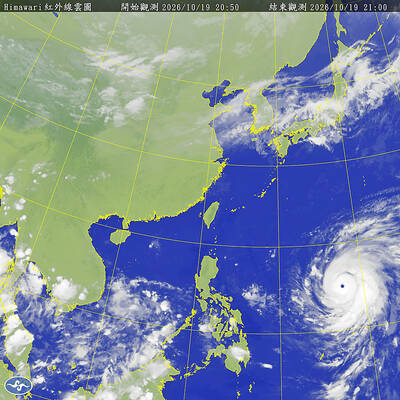
Typhoon Champi is forecast to turn northward earlier than previously expected, sparing Taiwan a direct hit but still bringing heavy rain to the north of the country on Friday and Saturday, the Central Weather Administration (CWA) said yesterday. Typhoon Champi had strengthened and increased in size over the past 12 hours, and as of yesterday afternoon, was packing sustained winds of 198kph near its center, CWA forecaster Cheng Chieh-jen (鄭傑仁) said. However, due to the weakening of a Pacific high-pressure system the storm is now expected to turn northward earlier than initially forecast, likely around Japan’s Ishigaki Island, Cheng said. As Champi brushes
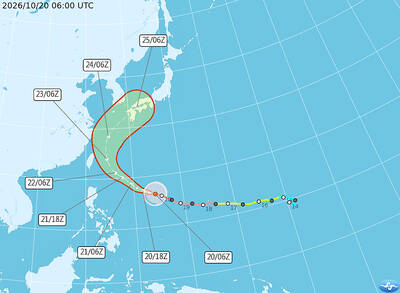
A sea warning for Typhoon Champi might be issued tonight, while the storm’s trajectory would determine whether a land warning is to be issued tomorrow night, the Central Weather Administration (CWA) said yesterday. As of 2pm yesterday, Champi was about 1,536km east-southeast of Taiwan proper’s southernmost point, Oluanpi (鵝鑾鼻), packing maximum sustained winds of 198kph, CWA forecaster Tseng Chao-cheng (曾昭誠) said. The storm was moving west-northwest at 23kph and was expected to strengthen over the next 24 hours before weakening slightly as it approaches cooler waters east of Taiwan, Tseng said. Champi is expected to turn north tomorrow, with the angle of the
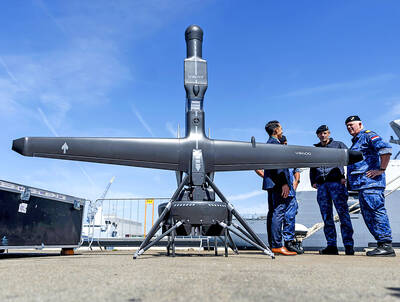
DEFENSE PROCUREMENT: Taiwan could become the largest operator of V-BAT drones outside the US if the contract is finalized, the Ministry of National Defense said The navy and the coast guard reportedly plan to acquire 292 units of MQ-35A V-BAT vertical takeoff and landing (VTOL) surveillance drones. If the contract is awarded and finalized, it would make Taiwan one of the largest buyers of the uncrewed aerial vehicle (UAV) developed by the US-based defense technology company Shield AI. The Coast Guard Administration budgeted NT$1.2 billion (US$37.1 million) to buy 12 drones, which have been delivered, Shield AI said in a report on Oct 13. The navy is planning to spend NT$36 billion under a four-year program code-named Project Yuan Hsiao (遠鴞) to acquire 280 V-BAT drones,
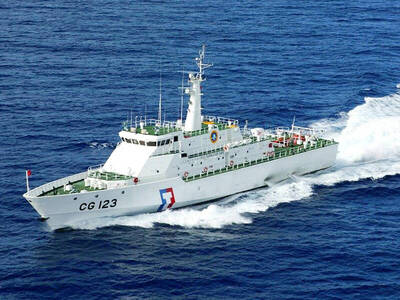
A patrol vessel donated by the Coast Guard Administration (CGA) to the Philippines would not be used in waters near Taiwan or areas where Taiwanese fishing vessels operate, Premier Cho Jung-tai (卓榮泰) said yesterday. The vessel, formerly the CGA's 500-tonne-class Kinmen (金門), was commissioned into the Philippine Coast Guard on Oct. 2. Speaking at the Legislative Yuan, Cho said the Philippines had pledged during the donation process that the vessel would be used only for designated missions and would not operate in waters related to Taiwan. The vessel could even provide assistance to Taiwan if needed, he added. Responding to questions from Chinese


 RSS
RSS